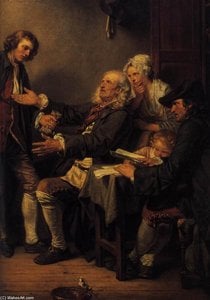
A Life Etched in Sentiment: The World of Jean-Baptiste Greuze
Jean-Baptiste Greuze, a name synonymous with the intimate and emotionally charged world of 18th-century French painting, was born in Tournus, a small Burgundian town steeped in history, on August 21st, 1725. His early life, far removed from the grand salons and aristocratic circles that dominated the art world, shaped his artistic vision profoundly. His father, a humble roofer, initially discouraged his son’s burgeoning artistic inclinations, believing it an unsuitable pursuit for a young man destined for a practical trade. However, a chance encounter with Grandon, a respected Lyonese artist known for his portraits, ignited a spark within Greuze – a passion that would ultimately redefine the landscape of French painting. Grandon recognized and nurtured this talent, providing young Jean-Baptiste with invaluable instruction and laying the foundation for his future success. This early mentorship proved pivotal, setting him on a path that defied societal expectations and led to an extraordinary artistic career.
The Rise of a Genre Painter
Greuze’s ascent to fame began in 1755 with *Le Père de famille expliquant la Bible à ses enfants* (The Father Explaining the Bible to His Children). This wasn't merely a depiction of domestic life; it was an embodiment of Enlightenment ideals, a carefully constructed tableau that championed familial piety and moral instruction. The painting resonated deeply with contemporary audiences, capturing a spirit of bourgeois virtue – a burgeoning sense of morality and social responsibility – that was rapidly gaining prominence in French society. The discerning collector Ange-Laurent de La Live de Jully recognized the work’s significance and acquired it, catapulting Greuze to immediate recognition and establishing him as a rising star within the Parisian art scene. Following this initial success, he embarked on a series of further genre scenes – intimate glimpses into everyday life imbued with emotional depth and moral undertones. A pivotal journey to Italy in 1755, undertaken alongside Abbé Gougenot, broadened his artistic horizons, exposing him to classical models and influencing his approach to composition and subject matter. However, despite this exposure, Greuze ultimately found greater inspiration in the realities of French society than in the idealized world of ancient Greece and Rome.
Mastering Emotion and Moral Narrative
Greuze’s true genius lay not simply in his technical skill but in his unparalleled ability to capture and convey human emotion. His paintings are characterized by a remarkable sensitivity to nuance, a profound understanding of psychological states, and an almost uncanny capacity to evoke empathy in the viewer. Works such as *La Jeune Fille qui pleure son oiseau mort* (The Young Girl Weeping for Her Dead Bird) and *Savoyard with a Dancing Doll* are prime examples of this talent. These aren’t merely portraits; they are explorations of grief, innocence, vulnerability, and the complexities of human experience. He possessed an extraordinary ability to capture subtle expressions – a fleeting glance, a tremor in the hand, a tear rolling down a cheek – conveying inner turmoil with remarkable precision. His compositions were often meticulously staged, utilizing dramatic lighting, carefully chosen props, and expressive gestures to heighten emotional impact. The use of chiaroscuro—the contrast between light and dark—was particularly effective in drawing attention to key moments and amplifying the drama of his scenes.
Denis Diderot, a leading intellectual of the Enlightenment, recognized Greuze’s unique talent, praising his ability to “paint morality” – to distill complex ethical dilemmas into accessible and emotionally resonant narratives.
The Academy and Shifting Styles
Despite his burgeoning fame and critical acclaim, Greuze faced significant obstacles in achieving recognition within the established art world. He initially sought admission to the Académie Royale de Peinture et de Sculpture in Paris, hoping to be accepted as a history painter – the most prestigious category within the institution. However, his attempts were repeatedly rebuffed, largely due to his refusal to submit a “salon piece” – a work designed to impress the Academy’s members. This rejection led him to focus on genre painting, a less demanding but equally rewarding path. In 1769, he presented *Septimius Severus Reproaching Caracalla* (The Emperor Septimius Severus Reproaching His Son Caracalla), an ambitious historical scene intended to demonstrate his mastery of classical composition and subject matter. Unfortunately, the painting was met with harsh criticism, and Greuze was ultimately accepted into the Academy only as a genre painter – a decision that deeply wounded his artistic pride. This rejection marked a turning point in his career, leading him to withdraw from exhibiting at the Salon for many years and to increasingly explore darker and more morally ambiguous themes in his work.
Later Years and Lasting Legacy
The final years of Greuze’s life were characterized by financial hardship and increasing isolation. He continued to paint prolifically, but his later works often explored themes of seduction, illicit love, and moral transgression – subjects that departed significantly from the sentimental morality of his earlier masterpieces. These paintings, while technically proficient, lacked the emotional depth and moral clarity that had defined his most celebrated work. Despite this decline in artistic form, Jean-Baptiste Greuze’s influence on French art remains profound. He pioneered a new genre of painting – a distinctly modern approach to depicting everyday life and exploring universal human emotions. His ability to capture subtle nuances of expression and to tell compelling moral stories paved the way for later artists who sought to portray the realities of contemporary society with honesty and sensitivity. Greuze’s legacy endures as one of the most important figures in 18th-century French art, a testament to his extraordinary talent and enduring ability to move audiences through the power of paint.
Key Works & Their Significance
- Le Père de famille expliquant la Bible à ses enfants (1755): A cornerstone of his early success, embodying Enlightenment ideals of familial piety.
- La Jeune Fille qui pleure son oiseau mort (c. 1765): Demonstrates Greuze’s mastery of emotional expression and poignant storytelling.
- Savoyard with a Dancing Doll (c. 1763): Captures the spirit and vulnerability of childhood, showcasing his skill in portraiture.
- Septimius Severus Reproaching Caracalla (1769): A failed attempt at historical painting that highlighted his strengths lay elsewhere.
- The Broken Pitcher (c. 1770s): Represents a shift towards more sensual and morally ambiguous themes in his later work.



 Megtekintés
 Kézzel festett másolat rendelése
 Küldés
 Megosztás
 Részletek

 Letöltés
 Hasonló darabok
 X-ray felvétel
 Diavetítés
 Statisztika


 Összes részlet megjelenítése






































 Az üvegkeretes opció csak 110 cm alatti méretben érhető el