Megtekintés AR előnézet Váltás nyomtatványra Kézzel festett másolat rendelése Küldés
Részletek Útmutató Kedvencekhez ad Letöltés Hasonló darabok X-ray felvétel Diavetítés Statisztika

Third Class Carriage

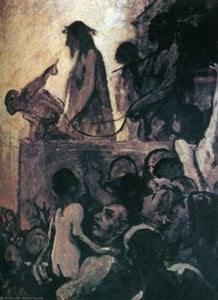
The Third-Class Carriage by Honoré Daumier is an unfinished oil painting portraying passengers in a cramped third class train car. It exemplifies Daumier's commitment to depicting everyday life with unflinching honesty and capturing the essence of human experience.

Fedezze fel az Honoré Daumier (1808-1879) francia művészt! Kiemelkedő karikatúrái, festményei és szobrai a 19. századi társadalmi igazságtalanságok kritikájára mutatnak példát, befolyásolva a modern művészetet.

Get a print-ready file that goes far beyond the web preview. Every digital image we sell comes from a high-resolution master in our stock database — usually 5,000 to 15,000 pixels wide — so you can print large, crop tightly, or reproduce fine detail with confidence.

No file leaves our studio untouched. A digital expert checks the colors against the original painting and corrects them if needed, then improves clarity and detail with professional retouching tools — always staying faithful to the artist's brushwork and style. The result is an image that looks like the painting, not like a filtered scan.

You approve before you're done: our expert sends the image by e-mail within 72 hours for your review. Not satisfied? Ask for improvements or corrections, or request a refund if the quality falls short.

This is the quality relied on by publishers, design studios, galleries and print shops.

Digitális kép

Töltsön le nagy felbontású fájlt személyes kiállításokhoz, nyomtatáshoz és kreatív projektekhez. ( Váltás nyomtatványra Kézzel festett másolat rendelése)

Összesített ár

Ft 8038,60

Minden digitális kép rendeléséhez tartozó extrák

Szakértői digitális kézbesítés, garantáltan

Amikor a WahooArt.com szolgáltatást választja, nem csupán egy képet kap – professzionálisan felmagasított digitális műalkotást kap, amely precizitással készült, és amelyet megelégsedési gwarancia tesz biztoslássá. Az alábbiakban automatikusan minden benne 】

Gyors e-mail teslimítés

A nagy felbontású digitális képmásolatát a megrendelést követő 72 órán belül e-mailben elküldjük Önnek – azonnal használható formátumban.

MI-alapú digitális fájljavítás

Műve professzionális módon kerül optimalizálásra fejlett mesterséges intelligencia eszközök és manuális szerkesztés segítségével, biztosítva a maximális részletességet, tisztaságot és színpontosságot.

Örök életű ingyenes újradelivery

Véletlenül törölted vagy elvesztetted a fájlodat? Ne aggódj – bármikor ingyen újra megküldjük neked.

Nincs importköltség – soha

Élvezze műalkotásait azonnal, vám, illeték vagy szállítási költség nélkül – a digitális letöltések mindig adamentesek.

Színpontosság garantálása

Professzionális eszközök és színkezelés segítségével garantáljuk, hogy digitális képe a lehető legpontosabban tükrözze az eredeti színeket.

100 napos elégedettségi garancia

Ha nemມີ elégedett a digitális képével, 100 napon belül felülvizsgáljuk vagy 100% visszatérítjük az amountot – kérdés बिना.

100% Pénzvisszatérítési garancia

Nem tetszett a vásárlás? 100 napon belül teljes visszatérítést garantálunk a digitális fájl megvételétől számítva – kérdés nélkül.

Tömegrendelési kedvezmények

Vásároljon 3 képet, spóroljon 10%-et - Vásároljon 5-öt, spóroljon 15%-et - Vásároljon 10+ képet, spóroljon 20%-at. Kiváló kreatív projektekhez, galériákhoz és ügynökségekhez.

Gyors információk

  • Movement: Realism
  • Title: Third Class Carriage
  • Notable elements: Train passengers
  • Artist: Honoré Daumier
  • Influences:
    • Daumier
    • Rubens

Honoré Daumier’s ‘Third Class Carriage’: A Window into 19th-Century France

Honoring the legacy of Honoré Daumier, this meticulously crafted hand-painted reproduction captures a quintessential moment in French history – a snapshot of everyday life aboard a third-class train carriage. Painted with an astute eye for detail and imbued with the social commentary that defined Daumier’s oeuvre, “Third Class Carriage” offers more than just a visual representation; it's a poignant glimpse into the lives and experiences of ordinary people navigating the burgeoning industrial landscape of 19th-century France. The scene unfolds within a tightly composed black and white image, dominated by the utilitarian space of the train car itself – benches stretching across the frame, occupied by thirteen individuals engaged in quiet contemplation or absorbed in their pursuits.

Realism and Social Critique: Daumier’s Artistic Vision

  • Style & Technique: Daumier's mastery lies in his ability to fuse realism with a distinctly expressive draftsmanship. The painting employs a meticulous technique, characteristic of the Realist movement, focusing on accurate depiction and avoiding romanticized embellishment. Notice the subtle variations in shading, creating depth and volume within the figures and their surroundings. The use of black and white amplifies the starkness of the scene, intensifying the emotional impact and emphasizing the social disparities inherent in the subject matter.
  • Historical Context: Created during a period of significant social and political upheaval in France – the rise of industrialization, urbanization, and growing class tensions – Daumier’s work served as a powerful form of social critique. The third-class carriage represented a microcosm of French society, highlighting the diverse experiences and struggles of its passengers.
  • Influences: Daumier's artistic development was shaped by several key influences. His early training under Alexandre Lenoir exposed him to classical traditions and the dramatic use of light and shadow reminiscent of Rubens. This foundation, combined with his own keen observation of Parisian life, allowed him to develop a unique style that blended technical skill with profound social awareness.

Symbolism and Narrative

The composition itself is rich in symbolic potential. The close proximity of the passengers suggests both intimacy and constraint – a reflection of the realities of shared space and circumstance. The men in ties, representing various professions and social strata, underscore the diverse nature of the traveling public. Daumier’s deliberate choice to depict this seemingly mundane scene elevates it to a powerful statement about human connection, social inequality, and the transformative power of travel. It invites viewers to consider the stories behind each face, prompting reflection on themes of class, identity, and the shared human experience.

A Timeless Masterpiece for Your Collection

This hand-painted reproduction of “Third Class Carriage” by Honoré Daumier is more than just a beautiful artwork; it’s an investment in art history. Printed on high-quality archival paper with meticulous attention to detail, this piece will bring a touch of Daumier's genius into your home or office. Its size (26 x 33 cm) makes it ideal for a variety of settings – from a small study to a larger living room. Perfect for interior designers seeking to evoke the spirit of 19th-century France, or art collectors drawn to Daumier’s powerful social commentary and masterful technique, this reproduction offers an unparalleled opportunity to own a piece of artistic history.

Kérdések és válaszok

Milyen elhelyezés és milyen térhelyiség ajánlott a(z) „Third Class Carriage”, Daumier Honore alkotása számára?

A "Third Class Carriage" művet Statement célokra javasoljuk, a legalkalmasabb helyszín pedig egy Living Room.

Megrendelhető-e a "Third Class Carriage" olajfestmény kézzel festett másolata?

A „Third Class Carriage”, Daumier Honore alkotása kézzel festett másolataival a ez a weboldal oldalon találkozhat, kézzel festett olajfesték reprodukció lino vászonon formában, melyet a(z) Kézzel festett másolat oldalon lehet megrendelni.

Milyen témák jelennek meg a(z) „Third Class Carriage”, Daumier Honore alkotása alkotásban?

A "Third Class Carriage" alkotás tárgyai: railroad, carriage, passengers, winter, poverty, observation, realism.


Művész életrajza

A Life Etched in Satire: The World of Honoré Daumier

Honoré-Victorin Daumier’s life unfolded against the backdrop of a rapidly changing France, a nation grappling with revolution and social upheaval. Born in Marseille in 1808, his early years were steeped in the traditions of his family—a lineage of glaziers and artisans—but his spirit yearned for something beyond the confines of his humble beginnings. His father, a poet who had experienced both success and disappointment in Paris, instilled in him a love for literature and a keen awareness of social injustices. This early exposure to the complexities of human experience would profoundly shape Daumier’s artistic vision. The family's move to Paris in 1814 provided young Honoré with access to the vibrant artistic scene of the capital, exposing him to the works of masters like Rubens and Titian through his mentor, Alexandre Lenoir—a painter who also nurtured a deep appreciation for classical sculpture. This foundation laid the groundwork for Daumier’s distinctive style, blending realism with expressive draftsmanship. However, it wasn't merely technical skill that defined him; it was an unwavering commitment to exposing hypocrisy and challenging authority through his art.

The Sharpened Pen: Caricature and Social Commentary

Daumier’s career truly ignited in the tumultuous aftermath of the 1830 Revolution. This pivotal event, which dramatically reshaped French society and politics, provided him with a fertile ground for his burgeoning satirical talent. He quickly established himself as a master lithographer, initially contributing anonymously to various publications—most notably *Le Charivari*, a fiercely independent comic journal founded by Charles Philipon. It was within the pages of *Le Charivari* that Daumier’s genius truly blossomed. His caricatures weren't simply humorous illustrations; they were biting critiques of the bourgeoisie, the legal system, and the political establishment—a deliberate provocation aimed at exposing corruption and challenging the status quo. His unflinching portrayal of King Louis-Philippe, for example, led to his imprisonment in 1832 after a particularly pointed caricature was published. This act of defiance, rather than silencing him, solidified his commitment to using art as a weapon against injustice. The sheer volume of his output during this period is staggering—thousands of lithographs that served as both popular entertainment and potent political statements, capturing the spirit of dissent and offering a critical commentary on the societal ills of his time. The meticulous detail in his work, combined with a sharp wit and keen observation, made him a powerful voice for the marginalized and oppressed.

Beyond Caricature: Painting and Sculptural Visions

While Daumier is overwhelmingly celebrated for his lithography, to reduce his artistic output solely to caricature would be a profound disservice. He was also a dedicated painter and sculptor, though recognition for these works came later in life. His paintings—often depicting scenes of everyday Parisian life—are imbued with a remarkable sense of realism and empathy. He didn’t shy away from portraying the hardships faced by ordinary people: the cramped conditions of third-class carriages, the backbreaking labor of laundresses, the self-importance of lawyers. These works are not idealized representations; they are unflinching depictions of poverty, struggle, and resilience. Daumier masterfully employed loose brushwork and dramatic lighting to convey emotion and atmosphere—techniques that foreshadowed some of the innovations later embraced by the Impressionists. Furthermore, his sculptural work, largely created in clay during his lifetime (many pieces remaining unbaked), reveals a similar commitment to capturing the human form with honesty and emotional depth. These sculptures, rediscovered after his death, demonstrate a remarkable talent for modeling and an ability to convey psychological complexity through physical gesture—a testament to his profound understanding of the human condition.

A Lasting Legacy: Influence and Historical Significance

Honoré Daumier’s impact on art history is undeniable. He bridged the gap between Romanticism and Realism, laying the foundation for future generations of artists who sought to depict the world as it truly was—warts and all. His unflinching social commentary profoundly influenced artists like Gustave Courbet and Édouard Manet, both of whom were deeply affected by his willingness to challenge authority and expose injustice through art. Moreover, Daumier’s innovative use of lithography revolutionized printmaking, transforming it from a primarily decorative medium into a powerful tool for political satire and social critique. His work continues to resonate today, reminding us of the enduring power of art to challenge established norms, expose corruption, and bear witness to the human condition. The Musée d'Orsay in Paris houses a significant collection of his paintings and sculptures, offering visitors a unique opportunity to immerse themselves in the world he so vividly portrayed. His lithographs are widely accessible through collections like those found on WahooArt, ensuring that his satirical genius continues to provoke thought and inspire dialogue—a legacy that extends far beyond the confines of the 19th century. Daumier wasn’t merely an artist; he was a chronicler of his time—a visual poet who used his talent to give voice to the voiceless and hold power accountable.

Current Meta Description:

Honoré Daumier (1808-1879), the French master of realism & satire. Explore his powerful lithographs, paintings & sculptures critiquing 19th-century society and influencing modern art.

Current Meta Keywords:

Honoré Daumier, Honore Daumier, French Realism, 19th Century Art, Political Satire, Lithography, Caricature, Parisian Life, Daumier Prints

Daumier Honore

Daumier Honore

1808 - 1879 , Franciaország

Érmeradatok

  • Artistic Movement Or Style: Realizmus, Szatirikus
  • Artists Or Movements Influenced By This Artist:
    • Impressionizmus
    • Modern művészet
  • Artists Who Influenced This Artist:
    • Alexandre Lenoir
    • Jacques-Louis David
  • Date Of Birth: 1808. Feb 26.
  • Date Of Death: 1879. Feb 10.
  • Full Name: Honoré-Victorin Daumier
  • Nationality: Francia
  • Notable Artworks:
    • Rue Transnonain
    • Les gens de justice
    • Ecce Homo
  • Place Of Birth: Marseille, Francia