A művész életrajza
A Life Etched in Satire: The World of Honoré Daumier
Honoré-Victorin Daumier’s life unfolded against the backdrop of a rapidly changing France, a nation grappling with revolution and social upheaval. Born in Marseille in 1808, his early years were steeped in the traditions of his family—a lineage of glaziers and artisans—but his spirit yearned for something beyond the confines of his humble beginnings. His father, a poet who had experienced both success and disappointment in Paris, instilled in him a love for literature and a keen awareness of social injustices. This early exposure to the complexities of human experience would profoundly shape Daumier’s artistic vision. The family's move to Paris in 1814 provided young Honoré with access to the vibrant artistic scene of the capital, exposing him to the works of masters like Rubens and Titian through his mentor, Alexandre Lenoir—a painter who also nurtured a deep appreciation for classical sculpture. This foundation laid the groundwork for Daumier’s distinctive style, blending realism with expressive draftsmanship. However, it wasn't merely technical skill that defined him; it was an unwavering commitment to exposing hypocrisy and challenging authority through his art.
The Sharpened Pen: Caricature and Social Commentary
Daumier’s career truly ignited in the tumultuous aftermath of the 1830 Revolution. This pivotal event, which dramatically reshaped French society and politics, provided him with a fertile ground for his burgeoning satirical talent. He quickly established himself as a master lithographer, initially contributing anonymously to various publications—most notably *Le Charivari*, a fiercely independent comic journal founded by Charles Philipon. It was within the pages of *Le Charivari* that Daumier’s genius truly blossomed. His caricatures weren't simply humorous illustrations; they were biting critiques of the bourgeoisie, the legal system, and the political establishment—a deliberate provocation aimed at exposing corruption and challenging the status quo. His unflinching portrayal of King Louis-Philippe, for example, led to his imprisonment in 1832 after a particularly pointed caricature was published. This act of defiance, rather than silencing him, solidified his commitment to using art as a weapon against injustice. The sheer volume of his output during this period is staggering—thousands of lithographs that served as both popular entertainment and potent political statements, capturing the spirit of dissent and offering a critical commentary on the societal ills of his time. The meticulous detail in his work, combined with a sharp wit and keen observation, made him a powerful voice for the marginalized and oppressed.
Beyond Caricature: Painting and Sculptural Visions
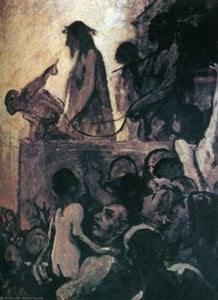
While Daumier is overwhelmingly celebrated for his lithography, to reduce his artistic output solely to caricature would be a profound disservice. He was also a dedicated painter and sculptor, though recognition for these works came later in life. His paintings—often depicting scenes of everyday Parisian life—are imbued with a remarkable sense of realism and empathy. He didn’t shy away from portraying the hardships faced by ordinary people: the cramped conditions of third-class carriages, the backbreaking labor of laundresses, the self-importance of lawyers. These works are not idealized representations; they are unflinching depictions of poverty, struggle, and resilience. Daumier masterfully employed loose brushwork and dramatic lighting to convey emotion and atmosphere—techniques that foreshadowed some of the innovations later embraced by the Impressionists. Furthermore, his sculptural work, largely created in clay during his lifetime (many pieces remaining unbaked), reveals a similar commitment to capturing the human form with honesty and emotional depth. These sculptures, rediscovered after his death, demonstrate a remarkable talent for modeling and an ability to convey psychological complexity through physical gesture—a testament to his profound understanding of the human condition.
A Lasting Legacy: Influence and Historical Significance
Honoré Daumier’s impact on art history is undeniable. He bridged the gap between Romanticism and Realism, laying the foundation for future generations of artists who sought to depict the world as it truly was—warts and all. His unflinching social commentary profoundly influenced artists like Gustave Courbet and Édouard Manet, both of whom were deeply affected by his willingness to challenge authority and expose injustice through art. Moreover, Daumier’s innovative use of lithography revolutionized printmaking, transforming it from a primarily decorative medium into a powerful tool for political satire and social critique. His work continues to resonate today, reminding us of the enduring power of art to challenge established norms, expose corruption, and bear witness to the human condition. The Musée d'Orsay in Paris houses a significant collection of his paintings and sculptures, offering visitors a unique opportunity to immerse themselves in the world he so vividly portrayed. His lithographs are widely accessible through collections like those found on WahooArt, ensuring that his satirical genius continues to provoke thought and inspire dialogue—a legacy that extends far beyond the confines of the 19th century. Daumier wasn’t merely an artist; he was a chronicler of his time—a visual poet who used his talent to give voice to the voiceless and hold power accountable.
Current Meta Description:
Honoré Daumier (1808-1879), the French master of realism & satire. Explore his powerful lithographs, paintings & sculptures critiquing 19th-century society and influencing modern art.
Current Meta Keywords:
Honoré Daumier, Honore Daumier, French Realism, 19th Century Art, Political Satire, Lithography, Caricature, Parisian Life, Daumier Prints



 Előnézet
 Váltás nyomtatványra
 Megosztás
 Megosztás
 Részletek
 Útmutató

 Letöltés
 Hasonló darabok
 X-ray felvétel
 Diavetítés
 Statisztika


 Tovább olvasom






































 Az üvegkeretes opció csak 110 cm alatti méretben érhető el