A Symphony of Virtue: Unveiling Raphael’s “The Virtues”
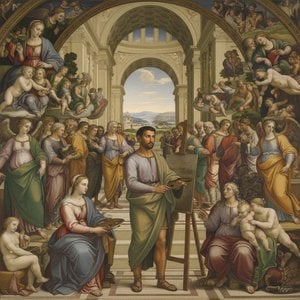
Raphael’s fresco, "The Virtues," painted in 1511 for the Stanza della Segnatura within the Vatican Palace, stands as a pinnacle of High Renaissance artistry. More than just a decorative panel, it's a profound meditation on human potential and moral philosophy, commissioned by Pope Julius II to embody the cardinal virtues – Prudence, Justice, Fortitude, and Temperance – alongside wisdom and knowledge. The scene unfolds within an idealized architectural setting, reminiscent of classical Roman design, creating a harmonious blend of earthly grandeur and divine inspiration. The fresco’s impact is immediate; it radiates serenity and intellectual depth, inviting contemplation on the qualities that define a virtuous life.
- Composition: The arrangement is meticulously balanced, with each virtue occupying a distinct space within the lunettes – arched windows above – of the room. This deliberate structure reinforces their individual significance while contributing to the overall sense of order and harmony.
- Color Palette: Raphael masterfully employs a restrained yet luminous color palette, dominated by cool blues, greens, and golds. These hues evoke a sense of tranquility and wisdom, complementing the allegorical nature of the subject matter.
- Symbolism: Each virtue is represented through carefully chosen symbols – Justice with scales, Temperance with grapes and vines, Fortitude with a lion, Prudence with a shield, and Wisdom with an owl. These visual cues deepen the fresco’s meaning, offering viewers a tangible understanding of each concept.
The Architects of Morality: Raphael's Philosophical Vision
Raphael wasn’t merely depicting virtues; he was engaging in a complex philosophical dialogue. The fresco reflects the humanist ideals prevalent during the Renaissance – a renewed interest in classical philosophy and a belief in human potential for moral excellence. The figures, though idealized, are grounded in earthly reality, representing the practical application of virtue within everyday life. The scene echoes Plato’s concept of the ideal city, where each citizen fulfills their designated role based on their inherent strengths and virtues. Notably, Raphael's work directly responds to the intellectual currents of his time, particularly the rediscovery of ancient Greek philosophy and its emphasis on reason and moral conduct.
The fresco’s setting itself—a grand architectural space reminiscent of Roman design—underscores this connection to classical thought. It suggests that virtue is not merely an individual trait but a fundamental element of a well-ordered society, mirroring the principles of civic harmony espoused by Plato and Cicero.
Technique and Artistic Innovation
Raphael’s mastery of fresco technique is evident in every detail. He employed *buon fresco*, a method that involves applying pigments to wet plaster, ensuring their permanence and vibrancy. The intricate details—the drapery, the facial expressions, the architectural elements—demonstrate his exceptional skill as a draftsman and painter. His use of *sfumato* – a subtle blurring technique – creates a sense of depth and atmosphere, lending the fresco an ethereal quality. Furthermore, Raphael’s ability to seamlessly integrate figures into the architectural setting showcases his remarkable compositional skills.
The fresco's scale is also significant; it covers a substantial area of wall space, demanding careful planning and execution. The sheer ambition of the project reflects Raphael’s position as one of the leading artists of his time.
A Legacy of Harmony: “The Virtues” Today
“The Virtues” continues to captivate viewers centuries after its creation. Its enduring appeal lies in its timeless message – a celebration of human potential and the importance of moral character. Reproductions of this masterpiece offer an opportunity to experience Raphael’s genius firsthand, bringing his vision of harmony, balance, and intellectual depth into our homes and spaces. Whether admired as a work of art or studied as a philosophical treatise, “The Virtues” remains a testament to the power of beauty and the enduring relevance of human values.
Questions et réponses
Les couleurs de «The Virtues» de Raphaël sont-elles saturées ou atténuées ?
La palette de « The Virtues » présente une saturation Couleurs subtiles.
Qui a créé « The Virtues » et dans quel style s'inscrit cette œuvre ?
« The Virtues » a été créé par Raphaël dans le style High Renaissance. L'artiste et le mouvement définissent la tradition de l'œuvre.
Où puis-je trouver un guide pour « The Virtues » ?
Le guide de « The Virtues » est la page Guide de l'œuvre — une fiche informative imprimable présentant l'œuvre accompagnée de sa légende, de sa mention de crédit et de son tableau d'identification (artiste, dates, technique, dimensions originales, collection).



 Aperçu en situation
 Acheter la peinture faite à la main
 Partager
 Partager
 Détails
 Guide imprimable

 Télécharger
 Articles similaires
 Radiographie
 Voir le diaporama
 Statistiques

 Afficher la suite






































 L'option verre n'est disponible que pour les dimensions inférieures à 110 cm.


![Stanze Vaticane - La Disputa (detail) [02] — Raphaël, Renaissance](/media/artworks/images-thumb/55/c5/55c5db1a88764a9697fe9eb0ea9d43c9.jpg)