Aperçu en situation Aperçu en RA Passer au format impression Passer au format image numérique Partager
Détails Guide imprimable Ajouter aux favoris Télécharger Articles similaires Radiographie Voir le diaporama Statistiques

The Virtues

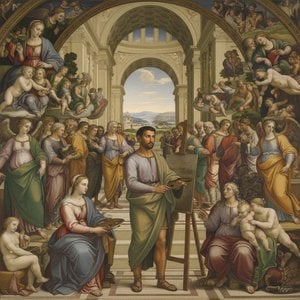
Experience Raphael's 'The Virtues,' a stunning fresco depicting the Cardinal and Theological Virtues. A masterpiece of High Renaissance art, showcasing wisdom, justice, courage & temperance.

Découvrez Raphaël (1483-1520), le maître de la Renaissance italienne réputé pour son élégance, sa clarté et ses compositions harmonieuses. Explorez les œuvres emblématiques telles que 'La Scuola di Atene', les Madones et les fresques qui définissent la beauté classique. #ArtRenaissance #Italie

Reproduction à l'huile faite à la main

Huile sur toile peinte à la main, avec cadre et dimensions personnalisés, réalisée sur commande par nos artistes. ( Passer au format impression Passer au format image numérique)

Corner sample of the P118B picture frame: polystyrène moulé, 5 cm wide and 3 cm thick
P118B 10
Corner sample of the P118H picture frame: polystyrène moulé, 5 cm wide and 3 cm thick
P118H 10
Corner sample of the P118W picture frame: polystyrène moulé, 5 cm wide and 3 cm thick
P118W 10
Corner sample of the P438Z picture frame: polystyrène moulé, 5.5 cm wide and 3.5 cm thick
P438Z 10
Corner sample of the P508JH picture frame: polystyrène moulé, 7 cm wide and 3.5 cm thick
P508JH 12
Corner sample of the P508YH picture frame: polystyrène moulé, 7 cm wide and 3.5 cm thick
P508YH 12
Corner sample of the P805H picture frame: polystyrène moulé, 5 cm wide and 3.5 cm thick
P805H 10
Corner sample of the P805Z picture frame: polystyrène moulé, 5 cm wide and 3.5 cm thick
P805Z 10
Corner sample of the P919BZ picture frame: polystyrène moulé, 7 cm wide and 3.5 cm thick
P919BZ 10
Corner sample of the P919G picture frame: polystyrène moulé, 7 cm wide and 3.5 cm thick
P919G 10
Corner sample of the P919XJ picture frame: polystyrène moulé, 7 cm wide and 3.5 cm thick
P919XJ 10
Corner sample of the P959ZH picture frame: polystyrène moulé, 5 cm wide and 3 cm thick
P959ZH 10
Corner sample of the P968JZ picture frame: polystyrène moulé, 6 cm wide and 4 cm thick
P968JZ 12
Corner sample of the W106C picture frame: bois massif, 5 cm wide and 3 cm thick
W106C 8
Corner sample of the W218G picture frame: bois massif, 5 cm wide and 3 cm thick
W218G 10
Corner sample of the W218JH picture frame: bois massif, 5 cm wide and 3 cm thick
W218JH 8
Corner sample of the W218Y picture frame: bois massif, 5 cm wide and 3 cm thick
W218Y 10
Corner sample of the W307PJ picture frame: bois massif, 6 cm wide and 3 cm thick
W307PJ 10
Corner sample of the W316G picture frame: bois massif, 6 cm wide and 3 cm thick
W316G 10
Corner sample of the W316PJ picture frame: bois massif, 6 cm wide and 3 cm thick
W316PJ 8
Corner sample of the W316Y picture frame: bois massif, 6 cm wide and 3 cm thick
W316Y 10
Corner sample of the W398PJ picture frame: bois massif, 5 cm wide and 3 cm thick
W398PJ 8
Corner sample of the W4111J picture frame: bois massif, 6.5 cm wide and 3.5 cm thick
W4111J 10
Corner sample of the W500HY picture frame: bois massif, 7 cm wide and 5 cm thick
W500HY 15
Corner sample of the W500JH picture frame: bois massif, 7 cm wide and 5 cm thick
W500JH 15
Corner sample of the W692G picture frame: bois massif, 8 cm wide and 4 cm thick
W692G 12
Corner sample of the W849H picture frame: bois massif, 5 cm wide and 3 cm thick
W849H 8
Corner sample of the W940BG picture frame: bois massif, 7.5 cm wide and 4.5 cm thick
W940BG 15
Corner sample of the W953PJ picture frame: bois massif, 6 cm wide and 3.5 cm thick
W953PJ 8

Format standard
personnalisé
CM
INCH

Choisissez parmi nos formats prédéfinis qui respectent les proportions originales de l’œuvre.

largeur
hauteur

Saisissez la largeur et la hauteur souhaitées, pour s'adapter à votre cadre ou à votre mur. Cette œuvre est peinte à la main ; ainsi, pour un format de forme différente, l'artiste peut peindre un peu plus autour du tableau ou réduire légèrement les bords — c'est vous qui choisissez. Nous vous envoyons une maquette numérique pour approbation avant que la peinture ne commence. L'image présentée sur cette page ne reflète pas le résultat réel — seule la maquette le fait.

Exemples de personnalisation possibles : remplacer un visage par la photo du client ; ajouter un animal de compagnie (par exemple, remplacer un chat par un chien) ; inclure un message caché en arrière-plan ; modifier le paysage ou les éléments de l'arrière-plan.
Après la commande, l’équipe WahooArt.com contactera le client par e-mail pour recueillir ses instructions et lui fournira une maquette d’aperçu

Livraison dans le monde entier () en 3 à 4 semaines au lieu des 5 semaines habituelles. (20 octobre). Aucun compromis sur la qualité.

Livraison express gratuite dans le monde entier
Toile de lin de haute qualité
Assurance transport complète
Garantie de remboursement des droits de douane
Garantie de fidélité des couleurs
Garantie de retour de 100 jours (uniquement en cas de défaut)
Garantie de remboursement à 100%
Tarifs dégressifs sur quantité

Prix total

€ 237

The Virtues

Technique de reproduction

Format de la reproduction

-

Prix total final

€ 237

A Symphony of Virtue: Unveiling Raphael’s “The Virtues”

Raphael’s fresco, "The Virtues," painted in 1511 for the Stanza della Segnatura within the Vatican Palace, stands as a pinnacle of High Renaissance artistry. More than just a decorative panel, it's a profound meditation on human potential and moral philosophy, commissioned by Pope Julius II to embody the cardinal virtues – Prudence, Justice, Fortitude, and Temperance – alongside wisdom and knowledge. The scene unfolds within an idealized architectural setting, reminiscent of classical Roman design, creating a harmonious blend of earthly grandeur and divine inspiration. The fresco’s impact is immediate; it radiates serenity and intellectual depth, inviting contemplation on the qualities that define a virtuous life.

  • Composition: The arrangement is meticulously balanced, with each virtue occupying a distinct space within the lunettes – arched windows above – of the room. This deliberate structure reinforces their individual significance while contributing to the overall sense of order and harmony.
  • Color Palette: Raphael masterfully employs a restrained yet luminous color palette, dominated by cool blues, greens, and golds. These hues evoke a sense of tranquility and wisdom, complementing the allegorical nature of the subject matter.
  • Symbolism: Each virtue is represented through carefully chosen symbols – Justice with scales, Temperance with grapes and vines, Fortitude with a lion, Prudence with a shield, and Wisdom with an owl. These visual cues deepen the fresco’s meaning, offering viewers a tangible understanding of each concept.

The Architects of Morality: Raphael's Philosophical Vision

Raphael wasn’t merely depicting virtues; he was engaging in a complex philosophical dialogue. The fresco reflects the humanist ideals prevalent during the Renaissance – a renewed interest in classical philosophy and a belief in human potential for moral excellence. The figures, though idealized, are grounded in earthly reality, representing the practical application of virtue within everyday life. The scene echoes Plato’s concept of the ideal city, where each citizen fulfills their designated role based on their inherent strengths and virtues. Notably, Raphael's work directly responds to the intellectual currents of his time, particularly the rediscovery of ancient Greek philosophy and its emphasis on reason and moral conduct.

The fresco’s setting itself—a grand architectural space reminiscent of Roman design—underscores this connection to classical thought. It suggests that virtue is not merely an individual trait but a fundamental element of a well-ordered society, mirroring the principles of civic harmony espoused by Plato and Cicero.

Technique and Artistic Innovation

Raphael’s mastery of fresco technique is evident in every detail. He employed *buon fresco*, a method that involves applying pigments to wet plaster, ensuring their permanence and vibrancy. The intricate details—the drapery, the facial expressions, the architectural elements—demonstrate his exceptional skill as a draftsman and painter. His use of *sfumato* – a subtle blurring technique – creates a sense of depth and atmosphere, lending the fresco an ethereal quality. Furthermore, Raphael’s ability to seamlessly integrate figures into the architectural setting showcases his remarkable compositional skills.

The fresco's scale is also significant; it covers a substantial area of wall space, demanding careful planning and execution. The sheer ambition of the project reflects Raphael’s position as one of the leading artists of his time.

A Legacy of Harmony: “The Virtues” Today

“The Virtues” continues to captivate viewers centuries after its creation. Its enduring appeal lies in its timeless message – a celebration of human potential and the importance of moral character. Reproductions of this masterpiece offer an opportunity to experience Raphael’s genius firsthand, bringing his vision of harmony, balance, and intellectual depth into our homes and spaces. Whether admired as a work of art or studied as a philosophical treatise, “The Virtues” remains a testament to the power of beauty and the enduring relevance of human values.

Questions et réponses

Les couleurs de «The Virtues» de Raphaël sont-elles saturées ou atténuées ?

La palette de « The Virtues » présente une saturation Couleurs subtiles.

Qui a créé « The Virtues » et dans quel style s'inscrit cette œuvre ?

« The Virtues » a été créé par Raphaël dans le style High Renaissance. L'artiste et le mouvement définissent la tradition de l'œuvre.

Où puis-je trouver un guide pour « The Virtues » ?

Le guide de « The Virtues » est la page Guide de l'œuvre — une fiche informative imprimable présentant l'œuvre accompagnée de sa légende, de sa mention de crédit et de son tableau d'identification (artiste, dates, technique, dimensions originales, collection).


Biographie de l'artiste

**Jeunesse et formation**

Raphaël (Raffaello Sanzio da Urbino), un peintre et architecte italien renommé, est né entre le 28 mars et le 6 avril 1483, dans la petite mais culturellement significative ville d'Urbino. Son père, Giovanni Santi, était peintre de cour du duc, lui offrant une exposition précoce au monde artistique. Après le décès de son père à l’âge de onze ans, Raphaël a vraisemblablement géré l’atelier familial, consolidant ainsi sa base artistique.

**Carrière artistique et influences**

Le parcours artistique de Raphaël peut être divisé en trois phases distinctes, chacune marquée par un style unique :
  • Premières années à Umbrie : caractérisée par l'influence de son père et l'ambiance culturelle d’Urbino.
  • Période florentine (1504-1508) : absorbant les traditions artistiques de Florence, qui a considérablement façonné son style.
  • Période romaine (1508-1520) : travaillant pour deux papes et leurs associés, produisant certaines de ses œuvres les plus célèbres, notamment l’école des Athènes dans la stanza della segnatura du Vatican.

**Œuvres notables et héritage**

Certaines des œuvres notables de Raphaël comprennent :

**Influence et héritage**

L'influence de Raphaël sur l'art est profonde, avec son œuvre constituant un pilier du grand Siècle. Son style serein et harmonieux a servi de modèle à la peinture néoclassique, comme le note l’historien d’art Johann Joachim Winckelmann. Malgré l'influence ultérieure du style de Michel-Ange, Raphaël reste l'un des artistes les plus vénérés de l'histoire. Voir le profil de Raphaël sur WahooArt
Raphaël

Raphaël

1483 - 1520 , Italie

En bref

  • Artistes Influents:
    • Giovanni Santi
    • Pietro Perugino
  • Date De Décès: 6 avril 1520
  • Date De Naissance: 28 mars 1483
  • Influences Artistiques: Peinture néoclassique
  • Lieu De Naissance: Urbino, Italie
  • Mouvement Artistique: Haute Renaissance
  • Nationalité: Italienne
  • Nom Complet: Raphaël (Raffaello Sanzio)
  • Œuvres Notables:
    • L'École d'Athènes
    • Madone Esterházy
    • La Transfiguration
    • Les Stanze Vaticanes
Explorez des œuvres d'art classées par thèmes, styles et caractéristiques.