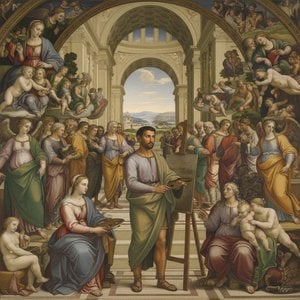
A Symphony of Virtue: Exploring Raphael’s “The Virtues” Fresco
The fresco "The Virtues," painted by Raphael Sanzio da Urbino between 1509 and 1511 as part of the Stanza della Segnatura in Vatican City, stands as an unparalleled achievement of High Renaissance art. More than just a decorative embellishment of papal chambers, it’s a profound meditation on moral philosophy—a visual embodiment of Christian virtues designed to inspire contemplation and guide spiritual understanding. Commissioned by Pope Julius II during a period of ambitious artistic patronage, Raphael undertook this monumental task with unwavering dedication, transforming an unremarkable hallway into a breathtaking panorama of humanist ideals.
The Compositional Harmony: Michelangelo’s Influence
Raphael's masterful handling of perspective and spatial arrangement owes considerable debt to the pioneering work of Michelangelo Buonarroti on the Sistine Chapel ceiling. Like Michelangelo’s depiction of biblical figures soaring across the vault, Raphael employs dramatic diagonals and expansive curves to draw the viewer’s eye into the scene. The careful positioning of the figures—particularly Fortitude's lion—echoes Michelangelo’s monumental sculptures, demonstrating a shared artistic lineage and reflecting the broader Renaissance fascination with grandeur and anatomical accuracy. This deliberate stylistic kinship elevates “The Virtues” beyond mere aesthetic beauty; it speaks to a deeper engagement with the intellectual currents shaping European culture at the time.
Symbolism Rooted in Classical Tradition
The fresco’s symbolism is intricately interwoven with classical humanist thought, reflecting Raphael's exposure to the philosophical ideas circulating amongst intellectuals of his era. Each virtue—Fortitude, Charity, Prudence, Hope and Temperance—is represented by a female figure, embodying abstract concepts rather than literal representations. The mirror held aloft by Prudence symbolizes wisdom and discernment, prompting viewers to examine their own moral compass. Fortitude’s lion represents courage and resilience, while Temperance's reins symbolize moderation and self-control. Crucially, the depiction of Faith points upwards towards heaven, emphasizing the importance of spiritual devotion and belief—a cornerstone of Christian theology. The central tondo depicting Justice reinforces this thematic core, symbolizing righteousness and moral accountability.
Technique: Fresco Painting – A Legacy of Brilliance
Raphael’s technique exemplifies the mastery of fresco painting achieved during the High Renaissance. This method involves applying pigment onto wet plaster—a process demanding meticulous planning and execution. The durability of fresco ensures that “The Virtues” continues to captivate audiences centuries later, preserving Raphael's vibrant colors and nuanced detailing with remarkable fidelity. Unlike oil paint, which allows for reworking and blending, fresco necessitates a decisive approach, resulting in an image that is both timeless and powerfully expressive. The subtle gradations of color achieved through layering pigments contribute to the fresco’s luminous quality—a testament to Raphael’s artistic skill and his unwavering commitment to capturing the essence of humanist ideals.
Emotional Resonance: Inspiration for Generations
“The Virtues” transcends its formal artistry, resonating with viewers on an emotional level. Its serene beauty and harmonious composition convey a sense of moral upliftment—inviting contemplation and fostering reflection upon ethical conduct. Raphael’s masterpiece serves as a poignant reminder of the enduring power of art to communicate profound philosophical concepts and inspire spiritual aspiration. It remains a cornerstone of High Renaissance art, continuing to inspire artists and collectors alike who seek to emulate its elegance and imbue their own creations with similar moral depth.
Questions et réponses
L'œuvre « The Virtues » présente-t-elle des contrastes ombre et lumière marqués ?
Le niveau de contraste de «The Virtues» de Raphaël est Énoncé.
«The Virtues» de Raphaël est-il une œuvre lumineuse ou sombre ?
« The Virtues » présente une luminosité globale de équilibré, avec une luminance de Luminosité douce.
Quelle couleur domine la composition de «The Virtues» de Raphaël ?
Céladon (#bebca0) est la couleur dominante de «The Virtues» de Raphaël.



 Aperçu en situation
 Passer au format impression
 Partager
 Partager
 Détails
 Guide imprimable

 Télécharger
 Articles similaires
 Radiographie
 Voir le diaporama
 Statistiques
 Afficher la suite






































 L'option verre n'est disponible que pour les dimensions inférieures à 110 cm.