Kim Ho Deuk: A Journey Through Korean Ink Landscape
Kim Ho Deuk, born in Daegu, South Korea in 1950, stands as a prominent figure in contemporary Korean ink painting—a tradition deeply rooted in Buddhist philosophy and artistic expression. His formative years were marked by rigorous academic pursuits at Seoul National University’s College of Fine Arts, culminating in degrees in both B.F.A. and M.F.A., specializing in painting. This grounding in classical techniques profoundly shaped his artistic vision, informing a lifelong dedication to exploring the profound symbolism inherent within landscape imagery.- Early Influences: Ho Deuk’s artistic sensibilities were nurtured by exposure to Zen Buddhism and its emphasis on mindfulness and contemplation—influences that permeate his oeuvre. The teachings of Zen masters resonated deeply with him, shaping his understanding of emptiness (sunyata) and interconnectedness – concepts central to Buddhist cosmology.
- Formal Training: His studies at Seoul National University provided him with a comprehensive understanding of Western art history alongside Korean painting traditions, fostering a balanced perspective on artistic innovation. He studied the works of Impressionists and Expressionists alongside masters of Korean calligraphy and landscape painting, recognizing the importance of both Eastern and Western influences in shaping artistic creativity.
The Essence of Korean Ink Landscape Painting
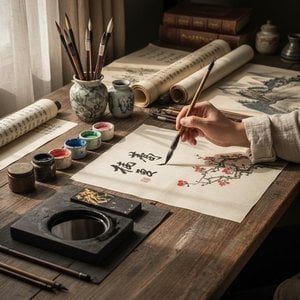
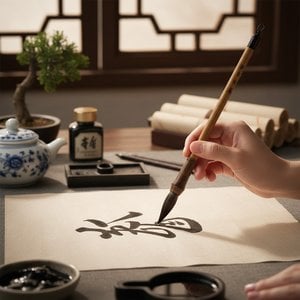
At the core of Kim Ho Deuk's artistic practice lies the meticulous execution of ink wash painting—a technique characterized by its deliberate simplicity and profound expressive power. Unlike Western landscape paintings that strive for realistic representation, Korean ink landscapes prioritize conveying emotion and spiritual insight rather than visual accuracy. The artist employs subtle gradations of tone achieved through layering washes of ink onto rice paper, creating textures that mimic the natural world while simultaneously embodying concepts of emptiness (sunyata) and interconnectedness—themes central to Buddhist cosmology.- Technique: Ho Deuk’s mastery lies in mastering the delicate balance between spontaneity and control—a hallmark of Korean ink painting tradition. He utilizes a technique known as *ma*, or negative space, which is crucial for conveying mood and creating visual harmony.
- Symbolism: Recurring motifs such as mountains, trees, and rocks are imbued with symbolic significance, representing permanence, resilience, and the cyclical nature of existence. Each brushstroke carries intention—a deliberate effort to capture not just what is seen but what is felt – mirroring Zen Buddhist ideals.
Exploring Conceptual Depth Through Landscape Imagery
Kim Ho Deuk distinguishes himself from many contemporary artists by embracing a conceptual approach to landscape painting—a departure from purely descriptive representations. Drawing inspiration from Zen Buddhist texts like the Linji Lu, he seeks to capture not merely what is seen but what is felt—the underlying essence of experience itself. As expressed in the Linji Lu, “One must distinguish black and white in a split second and determine life and death in a flash of lightning,” Ho Deuk’s paintings reflect this preoccupation with immediacy and transformative insight.- Zen Influence: The concept of "now"—a state of pure presence—serves as a guiding principle for his artistic process, mirroring the Zen ideal of achieving enlightenment through mindfulness. He strives to capture the fleeting beauty of nature – acknowledging that true understanding comes from accepting impermanence.
- Gestalt Psychology: He utilizes Gestalt principles to create visual compositions that emphasize relationships between elements—demonstrating an awareness of perceptual psychology and its impact on artistic interpretation. This approach seeks to evoke a feeling of unity and harmony, reflecting the Buddhist notion of interconnectedness.
- Philosophical Resonance: Like Kosuth’s “One and Three Chairs,” Ho Deuk's work engages in a dialogue with philosophical concepts, prompting viewers to consider questions of perception, reality, and the human condition.
Recognition and Legacy
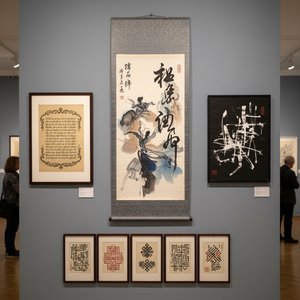
Kim Ho Deuk’s artistic achievements have been recognized internationally through prestigious art fairs such as Art Basel Hong Kong and Ink Studio—solidifying his position as a leading voice in Korean contemporary art. His representation by Hakgojae Gallery ensures continued visibility for his work and contributes to the preservation of Korean ink painting traditions for future generations. Ultimately, Kim Ho Deuk’s enduring contribution lies in his ability to transform landscape imagery into vehicles for profound spiritual contemplation—a testament to the transformative power of artistic expression. He continues to inspire younger artists with his unwavering dedication to tradition while simultaneously pushing boundaries and exploring new avenues of creative exploration.Kysymykset ja vastaukset
Mistä löytää Kim Ho Deuk's teokset ryhmiteltynä avainsanojen mukaan?
Kim Ho Deuk:n teoksia voi tutkia avainsanoittain artistin Avainsanoittain -sivulla. Jokainen avainsana kokoaa yhteen aiheeseen liittyvät teokset.
Mistä löytää Kim Ho Deuk -taiteilijan teokset aihepiireittäin ryhmiteltynä?
Kim Ho Deuk:n teoksia voi tutkia aiheen mukaan artistin Aiheatlas -sivulla.
Mitä tunnelmia Kim Ho Deuk's teokset välittävät?
Kim Ho Deuk:n teoksia voi selata tunnelman mukaan artistin Tunnelman mukaan -sivulta, jossa teokset on järjestetty niiden välittämän tunnelman mukaan.
Miten voin nähdä kaikki Kim Ho Deuk -taiteilijan teokset?
Jokaisen tämä verkkosivusto-sivustolla olevan Kim Ho Deuk teoksen voi selata artistin Kaikki teokset -sivulta.
Mistä löydän Kim Ho Deuk's teokset ryhmiteltynä taidesuuntauksen mukaan?
Kim Ho Deukn edustamat taidesuuntaukset löytyvät artistin Kaikki suuntaukset -sivulta, jossa teokset on ryhmitelty tyylisuuntien mukaan.
Kuinka monta Kim Ho Deuk teosta on katseltavissa?
Voit selata 1 teosta teosta taiteilijalta Kim Ho Deuk sivulla Kaikki teokset.
Onko Kim Ho Deuk esittelyssä aikajärjestyksessä?
Kim Ho Deuk:n tuotannon kronologinen esitys löytyy taiteilijan Kronikka -sivulta, jossa teokset etenevät luomisjärjestyksessä luku luvulta.
Voinko selata Kim Ho Deuk teoksia tekniikan mukaan?
Kaikki tekniikat-sivulla Kim Ho Deuk:n teokset on ryhmitelty tekniikan mukaan.