Oil On PaperWallArtAbstract Expressionism
 1949Modern
 46.0 x 51.0 cm
Tällä sivulla esitettyä taideteosta suojaa tekijänoikeuslaki, mikä tarkoittaa, ettemme voi laillisesti luoda tai myydä täsmälleen samanlaista jäljennöstä. Tämä suoja toteutetaan kansainvälisten sopimusten, kuten esimerkiksi Berne-konventio ja kansallisilla laeilla, mukaan lukien niillä määritellyt Yhdysvaltain tekijänoikeuslaki – Luku 17. Kaikki oikeudet pidätetään. Luvaton kopiointi tai jäljittely on kielletty.
Tämä menetelmä noudattaa täysin tekijänoikeussäännöksiä, sillä se ei sisällä suojatun taideteoksen kopioimista tai jäljentämistä. Sen sijaan kyseessä on luova uudelleentulkinta – uusi maalaus, joka ammentaa vaikutteita alkuperäisestä, mutta ei ole sen identtinen kopio.
Museolaatuisia giclée- tai kankaitaulun tulosteita nopealla tuotannolla ja joustavilla viimeistelyvaihtoehdoilla. ( Tilaa käsinmaalattu jäljennös Siirry digitaaliseen kuvaan)





























Valitse valmiista mitoistamme sellaiset, jotka vastaavat teoksen alkuperäisiä mittasuhteita.

Kirjoita tarvitsemasi leveys ja korkeus, jotta tuloste sopii kehyskokoon tai seinällesi. Tulostetta voidaan vain leikata, sitä ei voi koskaan tehdä suuremmaksi kuin alkuperäinen kuva, joten eri muotoinen koko aiheuttaa osan kuvasta katoamisen. Lähetämme sinulle digitaalisen mallikuvan hyväksyttäväksi ennen kuin aloitamme tulostuksen. Tällä sivulla näkyvä kuva ei näytä lopullista leikkausta — vain mallikuva näyttää sen.
Maailmanlaajuinen toimitus () 2 viikossa tavallisen 4–5 viikon sijaan. (26 lokakuu)
Zot
Replikaatin koko
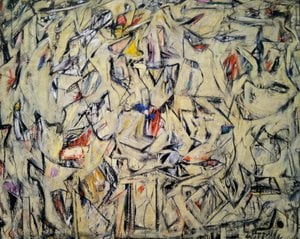
Willem de Kooning's "Zot," painted in 1949, isn’t merely a painting; it’s an embodiment of the fervor and uncertainty that characterized the height of Abstract Expressionism. This monumental canvas—measuring 46 x 51 cm—immediately confronts the viewer with a landscape dominated by stark white space punctuated by bursts of energetic pigment. It's a visual declaration of spontaneity, rejecting traditional representational conventions in favor of conveying raw emotion and psychological depth.
The painting’s compositional strategy defies easy categorization. Rather than adhering to linear perspective or establishing a discernible horizon line, De Kooning employs an all-over design where shapes overlap and intersect, creating a mesmerizing dance of visual complexity. Thick impasto—heavy application of paint—dominates much of the surface, punctuated by drips and splatters that seem to defy gravity. This technique isn’t about meticulous control; it's about allowing chance to guide the artist’s hand, resulting in textures that are palpably alive.
Despite its apparent lack of color, “Zot” possesses a subtle chromatic richness. Predominantly white serves as the foundational backdrop, subtly shifting hues through tonal variations achieved with black, grey, and fleeting touches of ochre yellow. These colors aren’t blended harmoniously; instead, they are layered and juxtaposed to generate tension and provoke contemplation. The muted palette contributes significantly to the painting's emotional impact—a feeling of unease mingled with exhilaration—reflecting the anxieties prevalent during the postwar period.
Lines in “Zot” are not descriptive; they’re expressive. Bold, sweeping strokes wrestle for dominance across the canvas, while thinner scribbles weave intricate patterns beneath them. Shapes— amorphous and fragmented—lack recognizable forms, resembling organic growths rather than geometric solids. This deliberate rejection of form underscores De Kooning's commitment to conveying emotion directly through gesture – capturing the artist’s subconscious impulses on a monumental scale.
Created during the Second World War and immediately following its conclusion, “Zot” speaks to the profound psychological upheaval experienced by artists grappling with trauma and disillusionment. The title itself—a nonsensical word—adds another layer of intrigue, suggesting a playful defiance of logic and inviting viewers to engage in an imaginative dialogue. As exemplified by The Metropolitan Museum of Art’s detailed analysis, De Kooning's work stands as a testament to the transformative power of abstraction – prioritizing feeling over representation and cementing his place among the titans of 20th-century art.
"Zot" vivahtaa Green Spectrum sävyyn.
Teoksen Willem de Kooning:n "Zot" värikylläisyys on Muted.
Willem de Kooning:n "Zot" välittää Energetic tunnelman.


1904 - 1997 , Alankomaat

Journey through the raw emotion of Abstract Expressionism. From Pollock's drips to Rothko's color fields, explore 10 iconic masterpieces and their stories. Find museum-quality art reproductions for your space at WahooArt.com. Discover all masterpieces on WahooArt.com.

Immerse yourself in the luminous world of Laurent Fabre. Explore 25 iconic Neo-Abstract masterpieces defined by geometric precision and chromatic harmony. Find inspiration for your space with museum-quality art reproductions. Discover all masterpieces on WahooArt.com.

 Katso seinällä
 Lähetä
 Jaa
Jaa
 Tarkemmat tiedot
 Opas
Opas

 Lataa kuva
 Samanlaisia kohteita
 Röntgenkuvaus
 Diaesitys
 Tilastot
 Lue lisää









 Lasivaihtoehto on saatavilla vain alle 110 cm kokoisille teoksille