

 Oil On CanvasWallArtConcrete Art
 1949Modern
 72.0 x 53.0 cm
 Banco do Brasil Cultural Center (Rio de Janeiro)
Tällä sivulla esitettyä taideteosta suojaa tekijänoikeuslaki, mikä tarkoittaa, ettemme voi laillisesti luoda tai myydä täsmälleen samanlaista jäljennöstä. Tämä suoja toteutetaan kansainvälisten sopimusten, kuten esimerkiksi Berne-konventio ja kansallisilla laeilla, mukaan lukien niillä määritellyt Yhdysvaltain tekijänoikeuslaki – Luku 17. Kaikki oikeudet pidätetään. Luvaton kopiointi tai jäljittely on kielletty.
Kunnioittavana ja laillisena vaihtoehtona tarjoamme alkuperäisestä inspiroituneita, yksilöllisiä ja käsinmaalattuja taideteoksia. Taitavat ja ammattimaiset taiteilijamme tutkivat huolellisesti alkuperäisen teoksen tyyliä, tunnelmaa ja taiteellista ydintä luodakseen uuden, ainutlaatuisen teoksen, joka herättää saman tunteen – säilyttäen samalla oman itsenäisen alkuperäisyytensä.
Tämä menetelmä noudattaa täysin tekijänoikeussäännöksiä, sillä se ei sisällä suojatun taideteoksen kopioimista tai jäljentämistä. Sen sijaan kyseessä on luova uudelleentulkinta – uusi maalaus, joka ammentaa vaikutteita alkuperäisestä, mutta ei ole sen identtinen kopio.
Käsinmaalattu öljyväri kankaalle haluamassasi koossa ja kehyksissä, taiteilijoidemme valmistamana tilauksesta. ( Vaihda tulosteeseen Siirry digitaaliseen kuvaan)





























Valitse valmiista mitoistamme sellaiset, jotka vastaavat teoksen alkuperäisiä mittasuhteita.

Kirjoita tarvitsemasi leveys ja korkeus, jotta teos sopii kehyskehyksiisi tai seinällesi. Koska kyseessä on käsinmaalattu teos, taiteilija voi maalata hieman enemmän kuvan ympärille tai rajata sitä hieman, jos haluat eri muotoisen koon — valinta on sinun. Lähetämme sinulle digitaalisen mallikuvan hyväksyttäväksi ennen kuin maalaus alkaa. Tällä sivulla näkyvä kuva ei vastaa lopullista tulosta — vain mallikuva näyttää sen.
Maailmanlaajuinen toimitus () 3–4 viikossa tavallisen 5 viikon sijaan. (24 lokakuu). Laadusta ei tingitä.
Sem título
Replikaatin koko
In the realm of mid-century abstraction, few works command attention with such silent, mathematical authority as Waldemar Cordeiro’s “Sem título”. Created in 1949, this masterpiece serves as a profound window into a pivotal moment in art history, where the chaotic emotions of expressionism began to yield to the disciplined clarity of the Concrete Art movement. At first glance, the viewer is met with a striking, nocturnal void—a deep, expansive black background that provides a stage for a singular, dramatic performance of color and form. A vibrant red triangle commands the upper portion of the canvas, its sharp edges cutting through the darkness with surgical precision. This geometric protagonist is not merely a shape but an architectural event, bisected by a delicate yellow line and anchored by a warm orange circle that pulses like a captured sun within the heart of the triangle.
The composition is further enriched by subtle, rhythmic accents, such as the two blue squares nestled in the lower corner, which provide a sense of weight and structural balance. This careful arrangement of primary and secondary colors—black, red, white, blue, yellow, and orange—creates a visual tension that is both intellectually stimulating and aesthetically harmonious. For the discerning collector or interior designer, this piece offers a sophisticated interplay of light and shadow, making it an ideal focal point for modern spaces that value minimalist elegance and structural depth.
To understand the soul of “Sem título,” one must look toward the transformative journey of its creator. Waldemar Cordeiro was a man of dual worlds, born in Rome to an Italian mother and a Brazilian father. His early training at the Accademia di Belle Arti in Rome provided him with a foundation in figurative mastery, yet it was his encounter with the radical abstractions of the international Art Club that ignited his true passion. As he transitioned from the expressive traditions of Europe to the burgeoning avant-garde scene in Brazil, Cordeiro became a central architect of the Grupo Ruptura. This movement sought to liberate art from the burden of representation, striving instead for a purely rational aesthetic inspired by the principles of the Bauhaus and Russian Constructivism.
This painting stands as an early testament to that transition. While Cordeiro would later become a pioneer in the digital frontier through his groundbreaking computer art, this 1949 work captures him at the height of his geometric exploration. It embodies the ethos of Concrete Art: the belief that a painting should not be a window into another world, but an object in its own right—a self-contained reality composed of pure form and color. The meticulous technique required to achieve such crisp, unblemished edges speaks to Cordeiro’s dedication to technical perfection and his desire to eliminate the "hand" of the artist in favor of a universal, objective beauty.
For those looking to curate an environment of intellectual rigor and timeless style, a high-quality reproduction of “Sem título” offers more than mere decoration; it offers a conversation. The painting’s ability to evoke both the cosmic scale of the universe and the intimate precision of a mathematical formula makes it uniquely versatile. In a contemporary living space, its bold geometry can anchor a room, providing a sense of order and calm amidst the complexities of modern life. In a professional gallery or design studio, it serves as a tribute to the historical importance of Latin American abstraction.
Owning a piece that reflects Cordeiro’s mastery is an opportunity to celebrate the intersection of art, science, and history. The vibrant contrast between the deep black field and the luminous primary shapes creates a dynamic energy that remains captivating long after the first encounter. Whether you are an art historian drawn to its role in the Concrete movement or a decorator seeking a striking geometric statement, this work remains a powerful symbol of the beauty found in absolute clarity.
Teoksessa "Sem título" Oil On Canvas-tekniikka kohtaa Concrete Art-suuntauksen.
Waldemar Cordeiro:n "Sem título" -teoksen Tilastot esittää julkiset käyntitilastot: teoksen kuukausittaiset vierailut, vertailun taiteilijan katsotuimpiin teoksiin sekä tiedot siitä, mistä vierailijat ovat kotoisin.
Teoksen Waldemar Cordeiro:n "Sem título" koettu kirkkaus on brilliant. Sen valoisuuden voi sovittaa tarkoitettuun tilaan.

Waldemar Cordeiro was a significant figure in the Brazilian art scene, recognized as both an influential artist and a compelling art critic. Born in Recife, Brazil, in 1924, he tragically passed away in 1973. His legacy is deeply intertwined with the Concrete Art movement in Latin America, where he played a pivotal role in shaping the artistic landscape of his country.
Cordeiro's career began with an innovative foray into computer art – a groundbreaking pursuit for its time. He was among the first artists to experiment with this emerging medium, establishing himself as a pioneer in the field. His involvement with Grupo Ruptura proved crucial in his artistic development. This group of artists aimed to advance modern art in Brazil and became instrumental in fostering the Concrete Art movement.
Cordeiro’s artistic style is characterized by a distinct use of strong geometric shapes and bold colors. His work reflects a commitment to creating objects that exist independently of representational imagery, aligning with the core principles of Concrete Art. He collaborated with other notable artists like Carlos Alberto Zilio, another prominent figure in Brazilian Concrete Art. Some of his most recognized works are displayed at the Museu de Valores do Banco Central do Brasil in Brasília. His paintings often feature alongside works by Amílcar Augusto Pereira de Castro, known for his contributions to the neo-constructivist movement.
Cordeiro’s dedication to Grupo Ruptura directly contributed to the development of the Concrete Art movement. This movement emphasized creating works that exist as objects rather than representations of reality, prioritizing pure form and geometric abstraction. His theoretical writings significantly shaped the philosophy behind this movement. He was influenced by Max Bill's Concrete Art concepts and Visual Gestalt principles. Cordeiro’s work also reflects a Marxist political perspective, believing art should be accessible to all and rejecting “art for art’s sake.”
Waldemar Cordeiro's legacy continues to resonate within the art world. His contributions to Concrete Art have inspired generations of artists, and his work stands as a testament to innovation and experimentation. Institutions like the Museu de Valores do Banco Central do Brasil and the São Paulo Museum of Modern Art recognize his significant impact. Beyond painting, he was also a landscape designer, creating sculptural gardens and public spaces that disseminated modern architecture and landscaping throughout Brazil. His pioneering use of computers in art, known as Arteonica, further solidified his place as a visionary artist who pushed the boundaries of artistic expression.

1924 - 1973 , Brazil
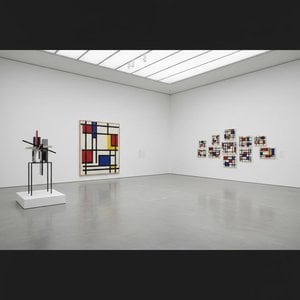
Explore the profound essence of Neoplasticism. Discover how Piet Mondrian and De Stijl masters used pure color and geometric form to redefine modern art. An essential guide for collectors seeking to understand the enduring power of abstract harmony and universal order.

Explore the profound spiritual depth of geometric abstraction. From Malevich's Suprematism to modern masters, our expert guide reveals how pure form and color command presence in fine art collections.

Explore the profound synergy of Cubo-Futurism, where geometric precision meets dynamic motion. Discover an expert analysis of this avant-garde movement, its historical impact on modern abstraction, and how to curate these powerful, kinetic masterpieces for your private collection.

Explore the profound impact of geometric form in art history. From Cubism to Op Art, discover how shape creates movement and emotion in masterpieces, and learn how to curate these powerful compositions for your private collection.

 Katso seinällä
 Lähetä
 Jaa
Jaa
 Tarkemmat tiedot
 Opas
Opas

 Lataa kuva
 Samanlaisia kohteita
 Röntgenkuvaus
 Diaesitys
 Tilastot
 Lue lisää









 Lasivaihtoehto on saatavilla vain alle 110 cm kokoisille teoksille


