Museolaatuisia giclée- tai kankaitaulun tulosteita nopealla tuotannolla ja joustavilla viimeistelyvaihtoehdoilla. ( Tilaa käsinmaalattu jäljennös Siirry digitaaliseen kuvaan)
Valitse valmiista mitoistamme sellaiset, jotka vastaavat teoksen alkuperäisiä mittasuhteita.

Voit syöttää omat mitat sopiaksesi tiettyyn kehykseen tai tilaan. Jos valittu koko ei vastaa alkuperäisen kuvan mittasuhteita, rajaamme teosta tai laajennamme kuvaa peilatulla tai yhtenäisellä reunalla. Digitaalinen mallikuva lähetetään hyväksyttäväksi ennen tuotannon aloittamista.
Huomaathan, että näytöllä näkyvä esikatselu ei vastaa lopullista rajausta tai laajennusta. Vain mallikuva näyttää lopullisen sommittelun tarkasti.
Vaikka räätälöityjä kokoja on saatavilla, suosittelemme valitsemaan mitat valmiista listasta alkuperäisten mittasuhteiden säilyttämiseksi.
Maailmanlaajuinen toimitus () 2 viikossa tavallisen 4–5 viikon sijaan. (22 syyskuu)


Chabot Valley
Replikaatin koko
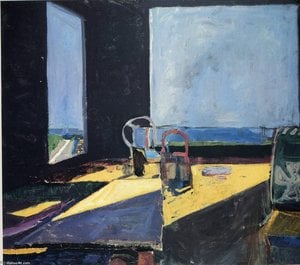
“Chabot Valley” is a captivating oil painting by Richard Diebenkorn, exemplifying his signature style within the Bay Area Figurative Movement. This artwork presents a semi-abstracted landscape scene, capturing the essence of California’s beauty with a dynamic and expressive approach. It's more than just a depiction of a valley; it's an exploration of color, form, and feeling.
Diebenkorn abandons traditional perspective in "Chabot Valley," creating a composition that feels both familiar and disorienting. Shapes are flattened and layered, overlapping to generate visual complexity rather than spatial realism. The eye is drawn across the canvas by bold brushstrokes and unexpected juxtapositions of color. A striking dark vertical element—likely representing a telephone pole—dominates the right side, acting as an anchor amidst the fragmented landscape. Houses cluster in the mid-ground, fields stretch towards a horizon suggested rather than defined, and a broad band of red commands attention in the foreground. This deliberate lack of conventional perspective contributes to the painting’s energetic and somewhat chaotic feel.
The color palette is arguably the most striking aspect of "Chabot Valley." Diebenkorn employs a rich range of blues, greens, reds, yellows, and purples, applied in distinct strokes rather than blended smoothly. This technique creates a palpable texture and emphasizes the painting’s expressive quality. The contrast between cool tones (in the sky and houses) and warmer hues (in the fields and foreground) generates visual tension and adds depth to the composition. The colors aren't merely descriptive; they convey emotion, contributing to the overall sense of dynamism and energy that permeates the work. It’s a landscape not just seen but *felt*.
“Chabot Valley” was created during a pivotal period in Richard Diebenkorn’s career, following World War II and influenced by the shift of artistic focus from Paris to America. While initially inspired by Edward Hopper, Diebenkorn moved towards Abstract Expressionism before developing his unique style that blended figuration with abstraction. This painting reflects this evolution, demonstrating a move away from strict representation toward capturing the essence of a place through color and form. The influence of aerial views, which fascinated him after a cross-country flight in 1951, is evident in the flattened perspective and patchwork quality of the landscape. Diebenkorn’s work during this period helped define the Bay Area Figurative Movement, a group of artists who rejected both Abstract Expressionism's complete abstraction and traditional representational art.
“Chabot Valley” doesn’t tell a specific story; instead, it aims to evoke a feeling or impression. The fragmented composition and expressive color palette suggest dynamism, energy, and perhaps even emotional intensity. It's an invitation for the viewer to engage with the landscape on a visceral level, interpreting its meaning through their own experiences and emotions. The painting’s enduring appeal lies in its ability to transcend mere representation, offering a glimpse into Diebenkorn’s unique vision of California’s beauty.


1922 - 1993 , Yhdysvallat

Tutustu Wassily Kandinskin 25 vaikuttavinta teosta! Uppoudu abstraktin taiteen maailmaan, värien symboliikkaan ja modernin ekspressionismin historiaan. Löydä inspiraatiota kodin sisustukseen WahooArt.com:ista – laadukkaat taideprintit ja reproduktiot.

Tutustu abstraktin ekspressionismin 10 mestariteokseen! Jackson Pollock, Mark Rothko ja muut taiteilijat inspiroivat tunteellisuudellaan. Löydä upeita taidemaalauksia kotiisi WahooArt.comista – museolaatuista laatua ja sisustusehdotuksia.

Embark on a cultural journey through Lyrical Abstraction. Explore how masters like Kandinsky used color and motion to translate emotion into visual poetry. Discover the profound beauty of abstract expressionism and learn to curate emotional resonance in your own art collection.

Explore the evolution of Richard Diebenkorn's iconic art – from abstract expressionism to his celebrated Ocean Park series. Discover insights for collectors & enthusiasts.

Explore the profound emotional world of Abstract Expressionism with WahooArt. Discover key artists like Pollock & Rothko, learn about collecting, and find museum-quality reproductions to inspire your space.

 Katso seinällä
 Lähetä
 Jaa
Jaa
 Tarkemmat tiedot
 Opas
Opas

 Lataa kuva
 Samanlaisia kohteita
 Röntgenkuvaus
 Diaesitys
 Tilastot
 Lue lisää




































 Lasivaihtoehto on saatavilla vain alle 110 cm kokoisille teoksille