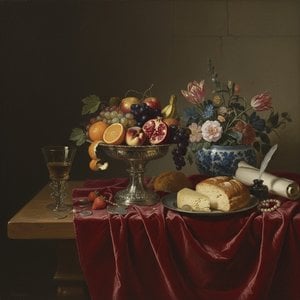
Alms teoksen Montien Boonma käsinmaalattu öljyvärimaalausreprosentti mestaritaiteilijalta
Esikatselu Esikatsele AR-tilassa Vaihda tulosteeseen Siirry digitaaliseen kuvaan Jaa teos
Tiedot Opas Lisää suosikkeihin Lataa kuva Samanlaisia kohteita Röntgenkuvaus Diaesitys Kysymykset ja vastaukset Lataa esitys Tilastot

Alms Käsinmaalattu öljyvärimaalausreproduktio

Mitat
300.0 x 66.0 cm

Discover Montien Boonma's modern take on Thai religious mendicancy with this delicate study of cups, inviting you to own a piece of contemporary Southeast Asian art.

A pioneer of meditative installations like House of Hope. Discover the spiritual depth of his unique sculptural works today.

Tällä sivulla esitettyä taideteosta suojaa tekijänoikeuslaki, mikä tarkoittaa, ettemme voi laillisesti luoda tai myydä täsmälleen samanlaista jäljennöstä. Tämä suoja toteutetaan kansainvälisten sopimusten, kuten esimerkiksi Berne-konventio ja kansallisilla laeilla, mukaan lukien niillä määritellyt Yhdysvaltain tekijänoikeuslaki – Luku 17. Kaikki oikeudet pidätetään. Luvaton kopiointi tai jäljittely on kielletty.

Kunnioittavana ja laillisena vaihtoehtona tarjoamme alkuperäisestä inspiroituneita, yksilöllisiä ja käsinmaalattuja taideteoksia. Taitavat ja ammattimaiset taiteilijamme tutkivat huolellisesti alkuperäisen teoksen tyyliä, tunnelmaa ja taiteellista ydintä luodakseen uuden, ainutlaatuisen teoksen, joka herättää saman tunteen – säilyttäen samalla oman itsenäisen alkuperäisyytensä.

Tämä menetelmä noudattaa täysin tekijänoikeussäännöksiä, sillä se ei sisällä suojatun taideteoksen kopioimista tai jäljentämistä. Sen sijaan kyseessä on luova uudelleentulkinta – uusi maalaus, joka ammentaa vaikutteita alkuperäisestä, mutta ei ole sen identtinen kopio.

Käsinmaalattu öljyvärinen jäljennös

Käsinmaalattu öljyväri kankaalle haluamassasi koossa ja kehyksissä, taiteilijoidemme valmistamana tilauksesta. ( Vaihda tulosteeseen Siirry digitaaliseen kuvaan)

Corner sample of the P118B picture frame: valettu polystyreeni, 5 cm wide and 3 cm thick
P118B €10
Corner sample of the P118H picture frame: valettu polystyreeni, 5 cm wide and 3 cm thick
P118H €10
Corner sample of the P118W picture frame: valettu polystyreeni, 5 cm wide and 3 cm thick
P118W €10
Corner sample of the P438Z picture frame: valettu polystyreeni, 5.5 cm wide and 3.5 cm thick
P438Z €10
Corner sample of the P508JH picture frame: valettu polystyreeni, 7 cm wide and 3.5 cm thick
P508JH €12
Corner sample of the P508YH picture frame: valettu polystyreeni, 7 cm wide and 3.5 cm thick
P508YH €12
Corner sample of the P805H picture frame: valettu polystyreeni, 5 cm wide and 3.5 cm thick
P805H €10
Corner sample of the P805Z picture frame: valettu polystyreeni, 5 cm wide and 3.5 cm thick
P805Z €10
Corner sample of the P919BZ picture frame: valettu polystyreeni, 7 cm wide and 3.5 cm thick
P919BZ €10
Corner sample of the P919G picture frame: valettu polystyreeni, 7 cm wide and 3.5 cm thick
P919G €10
Corner sample of the P919XJ picture frame: valettu polystyreeni, 7 cm wide and 3.5 cm thick
P919XJ €10
Corner sample of the P959ZH picture frame: valettu polystyreeni, 5 cm wide and 3 cm thick
P959ZH €10
Corner sample of the P968JZ picture frame: valettu polystyreeni, 6 cm wide and 4 cm thick
P968JZ €12
Corner sample of the W106C picture frame: massiivipuu, 5 cm wide and 3 cm thick
W106C €8
Corner sample of the W218G picture frame: massiivipuu, 5 cm wide and 3 cm thick
W218G €10
Corner sample of the W218JH picture frame: massiivipuu, 5 cm wide and 3 cm thick
W218JH €8
Corner sample of the W218Y picture frame: massiivipuu, 5 cm wide and 3 cm thick
W218Y €10
Corner sample of the W307PJ picture frame: massiivipuu, 6 cm wide and 3 cm thick
W307PJ €10
Corner sample of the W316G picture frame: massiivipuu, 6 cm wide and 3 cm thick
W316G €10
Corner sample of the W316PJ picture frame: massiivipuu, 6 cm wide and 3 cm thick
W316PJ €8
Corner sample of the W316Y picture frame: massiivipuu, 6 cm wide and 3 cm thick
W316Y €10
Corner sample of the W398PJ picture frame: massiivipuu, 5 cm wide and 3 cm thick
W398PJ €8
Corner sample of the W4111J picture frame: massiivipuu, 6.5 cm wide and 3.5 cm thick
W4111J €10
Corner sample of the W500HY picture frame: massiivipuu, 7 cm wide and 5 cm thick
W500HY €15
Corner sample of the W500JH picture frame: massiivipuu, 7 cm wide and 5 cm thick
W500JH €15
Corner sample of the W692G picture frame: massiivipuu, 8 cm wide and 4 cm thick
W692G €12
Corner sample of the W849H picture frame: massiivipuu, 5 cm wide and 3 cm thick
W849H €8
Corner sample of the W940BG picture frame: massiivipuu, 7.5 cm wide and 4.5 cm thick
W940BG €15
Corner sample of the W953PJ picture frame: massiivipuu, 6 cm wide and 3.5 cm thick
W953PJ €8

Vakiokoko
räätälöity
CM
INCH

Valitse valmiista mitoistamme sellaiset, jotka vastaavat teoksen alkuperäisiä mittasuhteita.

leveys
korkeus

Kirjoita tarvitsemasi leveys ja korkeus, jotta teos sopii kehyksiisi tai seinällesi. Koska kyseessä on käsinmaalattu teos, taiteilija voi maalata hieman enemmän kuvan ympärille tai rajata sitä hieman, jos haluat eri muotoisen koon — valinta on sinun. Lähetämme sinulle digitaalisen mallikuvan hyväksyttäväksi ennen kuin maalaus alkaa. Tällä sivulla näkyvä kuva ei vastaa lopullista tulosta — vain mallikuva näyttää sen.

Esimerkkejä muokattavista asioista: Vaihda kasvot asiakkaan omaan valokuvaan; Lisää lemmikki (esim. korvaa kissa koiralla); Lisää taustalle piilotettu viesti; Muuta taustan maisemaa tai elementtejä.
Tilauksen jälkeen WahooArt.com -tiimi lähettää asiakkaalle sähköpostitse ohjeet ja esikatselukuvan

Maailmanlaajuinen toimitus () 3–4 viikossa tavallisen 5 viikon sijaan. (8 marraskuu). Laadusta ei tingitä.

Ilmainen pikatoimitus ympäri maailman
Korkealaatuinen pellavakangas
Kattava kuljetusvakuutus
Tulliveron palautustakuu
Takuu täydellisestä värien vastaavuudesta
100 päivän palautusoikeus (vain valmistusvirheet)
100% rahat takaisin -takuu
Määräalennus tarjolla

Kokonaishinta

€ 243

Alms

Reproduktiotekniikka

Replikaatin koko

-

Kokonaishinta

€ 243

Pikaista tietoa

  • Title: Alms
  • Dimensions: 300 x 66 cm

The Quiet Resonance of Form: An Encounter with Alms

To stand before Alms by Montien Boonma is to enter a space suspended between the tangible and the ephemeral. This painting transcends a mere depiction of objects; it offers a meditation on absence, suggestion, and the enduring spirit embedded within everyday ritual. The composition, dominated by a substantial table surface upon which an array of cups rests, immediately draws the eye into a study of geometry and quiet accumulation. It is a scene steeped in the profound tradition of Buddhist mendicancy, yet rendered through a lens so modern that it feels both deeply rooted in history and startlingly contemporary.

Technique and The Art of Suggestion

Boonma’s mastery here lies not just in his ability to render form—the varying sizes and graceful curves of the cups are executed with meticulous care, suggesting a high degree of technical proficiency—but in what he chooses to omit. The description notes that instead of directly painting hands holding the bowls, Boonma suggests their existence by leaving marks upon the clay itself. This is the core genius of the piece: transforming the visible act into an invisible residue. It forces the viewer’s mind to complete the circuit, to participate in the narrative. Furthermore, the structural tension, hinted at by the delicate moulding supporting solid volumes, speaks to a sophisticated understanding of balance, making the entire arrangement feel poised on the edge of gravity.

Symbolism and Spiritual Echoes

The theme of religious mendicancy anchors the work in the cultural heartland of Thailand. The cups are not simply vessels; they are conduits for devotion, symbols of giving, receiving, and the cyclical nature of sustenance. By elevating this ordinary motif—the collection of alms bowls—into such a refined and modern visual language, Boonma invites us to reconsider what holds spiritual weight in our own lives. It prompts an inquiry into the invisible things: the unseen acts of generosity, the quiet moments of contemplation that define a life lived with intention.

A Modern Dialogue for Contemporary Spaces

For the collector or designer seeking art that speaks volumes without shouting, Alms offers unparalleled depth. Its sophisticated palette and intricate arrangement allow it to anchor a room with intellectual gravity. It functions beautifully in spaces that appreciate both cultural reverence and minimalist modernism. The painting doesn't demand attention; rather, it earns it through its quiet complexity. Owning this piece is acquiring not just a beautiful object for the wall, but a thoughtful conversation starter—a visual prompt to pause, observe, and contemplate the beauty found in suggestion.

Kysymykset ja vastaukset

Mikä väri erottuu eniten teoksessa "Alms"?

Teoksen Montien Boonma:n "Alms" hallitseva väri on Espresso (#39201e).

Missä teosta Montien Boonma:n "Alms" voidaan tällä hetkellä nähdä?

Teos Montien Boonma:n "Alms" on esillä Fukuoka Asian Art Museum, Fukuoka, Japani-museossa. Museoluettelo viittaa alkuperäisteokseen, ei jäljennöksiin.

Mitkä ovat alkuperäisen "Alms" mitat?

Alkuperäisen teoksen Montien Boonma:n "Alms" mitat ovat 300 x 66 cm.


Taiteilijan elämäkerta

The Soul of Materiality: The Life and Legacy of Montien Boonma

To encounter the work of Montien Boonma is to step into a space where the boundaries between the physical world and the spiritual realm begin to dissolve. Born in Bangkok, Thailand, Boonma emerged as one of the most gifted contemporary sculptors working in Southeast Asia, a pioneer who bridged the gap between local traditions and international conceptual frameworks. His practice was never merely about the creation of objects; rather, it was an invitation to meditation, a way to navigate the profound tensions of a rapidly modernizing Thai society. Through his mastery of both high-tech media and ephemeral, organic materials, he crafted an aesthetic language that spoke of the transient nature of existence.

Boonma’s artistic journey was shaped by a rigorous academic foundation, having earned a Master of Fine Arts from Silpakorn University in Bangkok before furthering his studies in France at the École Nationale Supérieure des Beaux-Arts, Paris, and the Université de Paris VIII. This dual exposure to Thai cultural roots and European intellectualism allowed him to develop a unique sculptural voice. He was deeply influenced by the arte povera movement and the works of sculptors such as Tony Cragg and Bill Woodrow, yet his work remained anchored in the spiritual heartland of Thailand. His sculptures often functioned as sensory experiences, utilizing scent, sound, and sight to draw the viewer into a state of contemplation.

Ritual, Religion, and the Sensory Experience

The essence of Boonma’s practice lay in his ability to transform everyday materials into conduits for devotion. A devout Buddhist, he utilized familiar religious symbols—the bowl, the bell, and the lotus—to ground his work within a specific ritualistic system. However, he avoided mere nostalgia, instead using these icons to address contemporary anxieties regarding environmental pollution, urban expansion, and the shifting landscape of spiritual life. His installations were often immersive, employing aromatic herbs, medicinal pigments, and earthy elements like rice flour, terracotta, wood, ash, and soil to create a palpable atmosphere of sanctity.

In his most celebrated works, such as House of Hope, Boonma transformed gallery spaces into temple-like environments. He might paint walls with herbal pigments that released subtle fragrances, or suspend thousands of beads to mimic the sensation of "black rain" bringing hope. These pieces were not just visual displays but psychological landscapes designed to focus the spiritual body through physical sensation. His use of materials was intentionally elemental and often perishable, reflecting his view of life as a perpetual cycle of change and movement—a concept he frequently illustrated through the use of spiral shapes and question marks, symbolizing the journey from the exterior self to the inner being.

A Poignant Legacy

The trajectory of Boonma’s career was marked by both immense international recognition and profound personal tragedy. He was a rising star on the global biennial circuit, participating in prestigious exhibitions such as the 8th Biennale of Sydney, the Liverpool Biennale, and the Asia-Pacific Triennial of Contemporary Art in Brisbane. Despite his growing fame, his later years were shadowed by illness; diagnosed with cancer in mid-1999, he continued to create vital works until his death. This period of personal struggle added a layer of poignant depth to his explorations of mortality and the ephemeral.

Today, Montien Boonma is remembered as a pathfinder who provided an alternative conceptual framework for contemporary sculpture in Asia. His ability to synthesize the primitive with the modern, and the rural with the urban, ensures that his work remains strikingly relevant. His legacy is preserved in prestigious institutions worldwide, including:

  • Fukuoka Asian Art Museum, Japan
  • National Gallery of Australia
  • Art Gallery of New South Wales
  • Museum of Contemporary Art in Tokyo
  • Deste Foundation for Contemporary Art, Athens
Montien Boonma

Montien Boonma

1953 - 2003 , Thailand

Pähkinänkuoressa

  • Artistic Movement Or Style: Contemporary Realism
  • Artists Who Influenced This Artist:
    • Tony Cragg
    • Bill Woodrow
    • Arte Povera
  • Full Name: Montien Boonma
  • Notable Artworks:
    • Alms
    • Black Question
    • Lotus sound
    • House of Hope
  • Place Of Birth: Bangkok, Thailand
  • Date Of Birth: 1953
  • Date Of Death: 2003