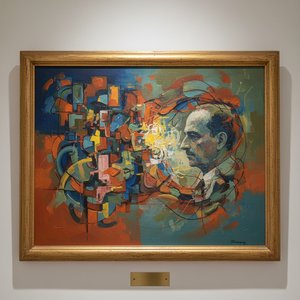
Jorge Oteiza: Life and Legacy
Early Life and Education
- Born: Jorge de Oteiza Embil on October 21, 1908, in Orio, Gipuzkoa, Spain.
- Oteiza’s early life was marked by a strong connection to his Basque heritage and the surrounding landscape. This would profoundly influence his artistic vision.
- He initially pursued studies in architecture but soon gravitated towards sculpture and painting.
Years in South America (1935-1948)
- Exile and Artistic Development: In 1935, anticipating the Spanish Civil War, Oteiza moved to Buenos Aires, Argentina. This period was crucial for his artistic development.
- He experimented with various materials and techniques, moving away from traditional representational sculpture towards more abstract forms.
- His time in South America allowed him to develop a unique artistic voice, free from the constraints of European academic traditions.
Return to Spain and Artistic Maturity (1948-1975)
- Post-War Spain: Oteiza returned to Spain in 1948, a country still recovering from the Civil War and under Franco’s dictatorship.
- He became a leading figure in the Spanish avant-garde movement, challenging artistic norms and exploring new forms of expression.
- ‘Quosque tandem!’ (1963): This seminal essay articulated Oteiza’s aesthetic philosophy, rooted in Basque prehistoric art and anthropology. It explored the “soul” of the Basque people through their artistic heritage.
- He co-founded the artistic group Gaur in 1966, dedicated to promoting modern Basque art and culture.
Artistic Style and Influences
- Abstract Sculpture: Oteiza is best known for his abstract sculptures, often constructed from wood, stone, or steel. These works are characterized by their minimalist forms, geometric shapes, and empty spaces.
- Influences: His work draws inspiration from Basque mythology, prehistoric art, Constructivism, and the work of artists like Constantin Brâncuși and Henry Moore.
- He often employed a technique of “emptying” forms, creating sculptures that suggest both presence and absence. This reflects his philosophical interest in the relationship between being and nothingness.
Major Achievements and Recognition
- International Acclaim: Oteiza’s work gained international recognition through exhibitions in São Paulo, Paris, and London.
- He received numerous awards throughout his career, including the Prince of Asturias Prize for the Arts (1988) and the Gold Medal for Fine Arts (Spain).
- The Oteiza Museum: Following his death in 2003, a museum dedicated to his work was opened in Alzuza, Navarre, fulfilling his wish to create a space for preserving and studying his artistic legacy.
Historical Significance
- Pioneer of Basque Modern Art: Oteiza is considered one of the most important figures in 20th-century Spanish art, particularly for his role in defining a modern Basque artistic identity.
- His work challenged traditional notions of sculpture and explored profound philosophical themes.
- He left behind a vast body of work that continues to inspire artists and scholars today.