

 Acrylic On CanvasWallArtNeo-Conceptualism
 2010Contemporary
 274.0 x 89.0 cm
 Guggenheim-museo Bilbao
Tällä sivulla esitettyä taideteosta suojaa tekijänoikeuslaki, mikä tarkoittaa, ettemme voi laillisesti luoda tai myydä täsmälleen samanlaista jäljennöstä. Tämä suoja toteutetaan kansainvälisten sopimusten, kuten esimerkiksi Berne-konventio ja kansallisilla laeilla, mukaan lukien niillä määritellyt Yhdysvaltain tekijänoikeuslaki – Luku 17. Kaikki oikeudet pidätetään. Luvaton kopiointi tai jäljittely on kielletty.
Tämä menetelmä noudattaa täysin tekijänoikeussäännöksiä, sillä se ei sisällä suojatun taideteoksen kopioimista tai jäljentämistä. Sen sijaan kyseessä on luova uudelleentulkinta – uusi maalaus, joka ammentaa vaikutteita alkuperäisestä, mutta ei ole sen identtinen kopio.
Museolaatuisia giclée- tai kankaitaulun tulosteita nopealla tuotannolla ja joustavilla viimeistelyvaihtoehdoilla. ( Tilaa käsinmaalattu jäljennös Siirry digitaaliseen kuvaan)





























Valitse valmiista mitoistamme sellaiset, jotka vastaavat teoksen alkuperäisiä mittasuhteita.

Kirjoita tarvitsemasi leveys ja korkeus, jotta tuloste sopii kehyskokoon tai seinällesi. Tulostetta voidaan vain leikata, sitä ei voi koskaan tehdä suuremmaksi kuin alkuperäinen kuva, joten eri muotoinen koko aiheuttaa osan kuvasta katoamisen. Lähetämme sinulle digitaalisen mallikuvan hyväksyttäväksi ennen kuin aloitamme tulostuksen. Tällä sivulla näkyvä kuva ei näytä lopullista leikkausta — vain mallikuva näyttää sen.
Maailmanlaajuinen toimitus () 2 viikossa tavallisen 4–5 viikon sijaan. (23 lokakuu)
Arno Pair
Replikaatin koko
Jenny Holzer’s “Arno Pair,” created in 2010, is more than just a visually striking artwork; it’s an invitation to contemplate the enduring power of language and its poignant resonance within public space. Donated to the Collection, this piece serves as a powerful complement to her earlier installation, "Installation for Bilbao," demonstrating Holzer's consistent exploration of themes surrounding communication, loss, and the shifting boundaries between private experience and collective consciousness. The work’s stark simplicity – two precisely crafted marble benches facing each other – belies its profound intellectual depth.
Jenny Holzer’s artistic practice is firmly rooted within the neo-conceptual movement, a critical response to the perceived limitations of traditional art forms. Born in 1950 in Gallipolis, Ohio, Holzer has consistently employed language – often delivered through electronic means or etched into stone – as her primary medium. Her work isn’t about creating beautiful objects; it's about provoking thought and challenging viewers to confront uncomfortable truths about society, power structures, and the human condition. “Arno Pair” exemplifies this approach, transforming a simple architectural element into a site for profound reflection.
Holzer’s background in architecture informs her work, emphasizing spatial relationships and the impact of environment on perception. She meticulously considers how her words will be received within a specific context, recognizing that art's power resides not just in its aesthetic qualities but also in its ability to engage with the viewer on an emotional and intellectual level.
The phrases themselves are laden with symbolism. “I SAY YOUR NAME” speaks to the fundamental human need for recognition and connection, while "I KEEP YOUR CLOTHES" evokes images of remembrance, mourning, and the preservation of memory. These seemingly simple statements carry immense emotional weight, tapping into universal experiences of loss, intimacy, and the desire to hold onto what is precious. The deliberate choice of Basque as the sole language adds another layer of complexity, inviting viewers to engage with a culture beyond their immediate understanding.
The setting of “Arno Pair” – a museum space – further amplifies its impact. By removing the artwork from the bustling streets and placing it within a contemplative environment, Holzer creates a deliberate distance between the viewer and the subject matter, encouraging deeper reflection. The inclusion of figures in the background adds to this sense of intimacy, suggesting that the benches are intended for private contemplation rather than public display.
"Arno Pair" is a significant artwork, measuring 274 x 89 cm. It showcases Holzer’s meticulous attention to detail and her mastery of stone carving techniques. The smooth, polished marble surfaces reflect light beautifully, enhancing the work's visual impact. This reproduction captures the essence of the original, offering an exceptional opportunity to experience Holzer’s thought-provoking vision in a high-quality format.
Alkuperäinen Jenny Holzer:n "Arno Pair" on Acrylic On Canvas-teos, jonka mitat ovat 274 x 89 cm. Tekniikka ja koko kuvaavat alkuperäistä teosta.
Teoksen Jenny Holzer:n "Arno Pair" hallitseva sävy on Green to Violet Spectrum. Tämä sävy on paletin perussävy.
Teoksen Jenny Holzer:n "Arno Pair" voi ladata sen Lataa -sivulta muodossa korkearesoluutioinen digitaalinen kuvalataus.

Jenny Holzer, a name synonymous with provocative public art and the potent deployment of language, stands as a pivotal figure in neo-conceptualism. Born in Gallipolis, Ohio, in 1950, her journey from aspiring painter to globally recognized artist is marked by a relentless interrogation of power, society, and the very nature of communication. Holzer’s work isn't merely visual; it’s an immersive experience designed to challenge viewers, sparking reflection and demanding engagement with complex ideas. Her career, spanning decades and encompassing diverse media – from billboards and LED projections to stone benches and painted signs – has cemented her legacy as a vital voice in contemporary art.
Holzer’s artistic roots were initially planted in the traditional world of painting. She began formal training at Duke University, Durham, North Carolina, followed by studies at the University of Chicago and Ohio University, where she honed her skills in drawing, printmaking, and painting. However, a pivotal shift occurred during her time at the Rhode Island School of Design (RISD) in 1974-75. It was here that she began to experiment with language as a primary artistic medium, moving beyond representational imagery and embracing the directness of text. This nascent interest coincided with her relocation to New York City in 1976, where she joined the Whitney Museum’s Independent Study Program – a crucible for experimental art practices. Crucially, Holzer found work as a typesetter for Laundry News, a laundromat-industry trade newspaper, providing a grounding in typography and printmaking that would later inform her distinctive visual style.
Holzer’s breakthrough arrived with the creation of *Truisms* (1977-79), a series of nearly 300 aphoristic statements printed on white paper in black italic script and wheat-pasted onto buildings, walls, and fences throughout Manhattan. These deceptively simple pronouncements – often drawn from her extensive reading list at the Whitney Independent Study Program – served as a radical intervention into the urban landscape. *Truisms* weren’t intended to be aesthetically pleasing; their power lay in their bluntness, challenging viewers to question assumptions about truth, knowledge, and societal norms. The anonymity of the project further amplified its impact, fostering a sense of collective engagement and critical dialogue. This early work established Holzer's core methodology: deploying concise, often unsettling statements within public spaces to provoke thought and challenge conventional perspectives.
Following *Truisms*, Holzer continued to explore the possibilities of language in public space. The *Living* series (1980-82), presented on aluminum and bronze plaques, addressed the mundane necessities of daily life – eating, breathing, sleeping, and human relationships – with a stark, matter-of-fact tone. This period also saw Holzer’s first foray into electronic signage, culminating in her iconic display at Times Square in 1982. From this point forward, LED projections became a central element of her practice, allowing for dynamic, site-specific installations that responded to the architecture and context of their surroundings. Holzer's work has since diversified dramatically, incorporating traditional media such as painting, stone benches, and even a race car for BMW, demonstrating an ongoing commitment to experimentation and pushing the boundaries of artistic expression.
Jenny Holzer’s impact on contemporary art is undeniable. She belongs to a generation of artists who sought new ways to integrate narrative and commentary into visual objects, challenging traditional notions of representation. Her work has been exhibited worldwide, including at major institutions such as the Guggenheim Museum in New York and the Neue Nationalgalerie in Berlin. Holzer’s exploration of themes like power, gender, war, and surveillance continues to resonate deeply with audiences today, prompting critical reflection on the social and political forces shaping our world. Her legacy extends beyond individual artworks; she has fundamentally altered the way public space is perceived and utilized as a site for artistic intervention, solidifying her position as a pioneering voice in neo-conceptualism and a vital commentator on the complexities of modern society.

1950 - , United States of America

Explore the profound evolution of Neo-Abstract art. Discover how bold geometric forms, vibrant chromatic depth, and tactile textures redefine modern expression for the discerning collector seeking sophisticated, high-impact masterpieces for contemporary interiors.

Discover the mesmerizing world of Pointillism. Explore the revolutionary techniques of Georges Seurat, the science of optical color mixing, and the enduring legacy of Neo-Impressionism in this expert guide for classical art enthusiasts.

Explore the raw energy of Jean-Michel Basquiat and Neo-Expressionism. Discover how urban rebellion redefined modern art through a lens of luxury, identity, and profound emotional intensity for the discerning collector.
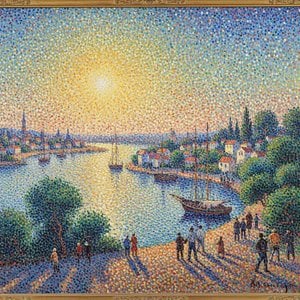
Embark on a sophisticated journey into the luminous world of Neo-Impressionism. Uncover the scientific brilliance of Pointillism, from Georges Seurat’s revolutionary color theory to the mesmerizing magic of the dot. An expert exploration for true art history enthusiasts.

 Katso seinällä
 Lähetä
 Jaa
Jaa
 Tarkemmat tiedot
 Opas
Opas

 Lataa kuva
 Samanlaisia kohteita
 Röntgenkuvaus
 Diaesitys
 Tilastot
 Lue lisää









 Lasivaihtoehto on saatavilla vain alle 110 cm kokoisille teoksille


