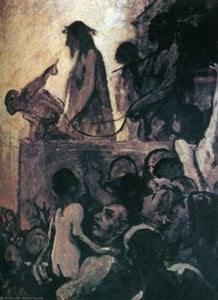
Honoré Daumier’s “The Defender”: A Study in Dramatic Realism
Honoré Daumier's "The Defender," created around 1865, stands as a cornerstone of Realist art—a genre dedicated to portraying life truthfully without romantic embellishment. More than just a depiction of a courtroom scene, this watercolor captures the palpable tension and psychological complexity inherent in legal proceedings, cementing Daumier’s reputation as a keen observer of human behavior and a fearless critic of societal injustices.
Composition and Technique: Mastering Line and Tone
The artwork's horizontal orientation emphasizes stability while simultaneously drawing the viewer’s eye into the central figures—a lawyer passionately gesturing with his arm and a woman radiating apprehension. Daumier skillfully employs expressive lines to sculpt form, particularly in the lawyer’s hand and forearm, conveying urgency and conviction. Hatching and cross-hatching techniques are meticulously applied throughout the composition, generating texture and shading that imbue the scene with depth and atmosphere. The muted color palette—primarily browns, grays, beige, and black—serves to heighten the drama, mirroring the solemnity of the courtroom setting.
Historical Context: Satirical Commentary on Justice
Daumier’s work emerged during a period of significant social upheaval in France – the Second Empire. He was deeply invested in documenting the realities of everyday life and exposing hypocrisy within the political elite. “The Defender” isn't merely a visual record; it’s a deliberate commentary on the legal system, questioning its impartiality and highlighting the vulnerability of those facing judgment. Daumier’s artistic choices reflect his commitment to portraying human emotion with unflinching honesty.
Symbolism: Anxiety, Advocacy, and Representation
The woman's posture—hunched shoulders, averted gaze—symbolizes anxiety and fear – emotions powerfully conveyed by Daumier through subtle shading and expressive lines. Conversely, the lawyer’s forceful gesture embodies advocacy and determination. The blurred background crowd represents the impersonal nature of justice, emphasizing the individual’s confrontation with a larger societal force. These symbolic elements elevate “The Defender” beyond a simple courtroom sketch, transforming it into an exploration of human psychology and social critique.
Emotional Impact: Capturing Human Vulnerability
"The Defender" resonates profoundly with viewers due to Daumier's masterful ability to capture the emotional core of his subject matter. The subdued color palette and meticulous linework contribute to a sense of melancholy and contemplation, prompting reflection on themes of vulnerability, courage, and the pursuit of truth. It’s a testament to Daumier’s enduring legacy as an artist who dared to confront uncomfortable realities with unwavering artistic integrity.



 Esikatselu
 Osta printti
 Jaa
Jaa Jaa
Jaa
 Tarkemmat tiedot

 Lataa
Lataa
 Samanlaisia
 Röntgenkuva
 Diaesitys


 Näytä lisää






































 Lasivaihtoehto on saatavilla vain alle 110 cm kokoisina teoksina