Katso seinällä Esikatsele AR-tilassa Tilaa käsinmaalattu jäljennös Siirry digitaaliseen kuvaan Lähetä
Tarkemmat tiedot Opas Lisää suosikkeihin Lataa kuva Samanlaisia kohteita Röntgenkuvaus Diaesitys Tilastot

Kefar Kama

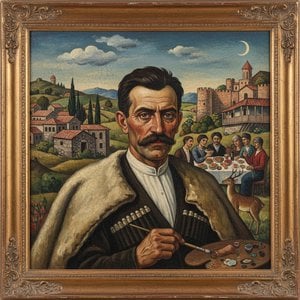
Grigory Gagarinin Kфар Кама maalauksessa näkyy Circassian sotilas maan päällä. Tämä vaikuttava yksityiskohtainen työ tuo esiin Caucasuksen historiaa ja kulttuuria.

Grigori Gagarin (1810-1893) oli venäläinen taiteilija, diplomaatti ja virkamies, tunnettu Kaukasian ihmisten muotokuvistaan ja Pushkinin teosten kuvituksista. Tutustu ainutlaatuiseen ikkunaansa 1800-luvun Venäjän taiteeseen ja kulttuuriin.

Giclée- ja taideprintit

Museolaatuisia giclée- tai kankaitaulun tulosteita nopealla tuotannolla ja joustavilla viimeistelyvaihtoehdoilla. ( Tilaa käsinmaalattu jäljennös Siirry digitaaliseen kuvaan)

Corner sample of the P118B picture frame: valettu polystyreeni, 5 cm wide and 3 cm thick
P118B €10
Corner sample of the P118H picture frame: valettu polystyreeni, 5 cm wide and 3 cm thick
P118H €10
Corner sample of the P118W picture frame: valettu polystyreeni, 5 cm wide and 3 cm thick
P118W €10
Corner sample of the P438Z picture frame: valettu polystyreeni, 5.5 cm wide and 3.5 cm thick
P438Z €10
Corner sample of the P508JH picture frame: valettu polystyreeni, 7 cm wide and 3.5 cm thick
P508JH €12
Corner sample of the P508YH picture frame: valettu polystyreeni, 7 cm wide and 3.5 cm thick
P508YH €12
Corner sample of the P805H picture frame: valettu polystyreeni, 5 cm wide and 3.5 cm thick
P805H €10
Corner sample of the P805Z picture frame: valettu polystyreeni, 5 cm wide and 3.5 cm thick
P805Z €10
Corner sample of the P919BZ picture frame: valettu polystyreeni, 7 cm wide and 3.5 cm thick
P919BZ €10
Corner sample of the P919G picture frame: valettu polystyreeni, 7 cm wide and 3.5 cm thick
P919G €10
Corner sample of the P919XJ picture frame: valettu polystyreeni, 7 cm wide and 3.5 cm thick
P919XJ €10
Corner sample of the P959ZH picture frame: valettu polystyreeni, 5 cm wide and 3 cm thick
P959ZH €10
Corner sample of the P968JZ picture frame: valettu polystyreeni, 6 cm wide and 4 cm thick
P968JZ €12
Corner sample of the W106C picture frame: massiivipuu, 5 cm wide and 3 cm thick
W106C €8
Corner sample of the W218G picture frame: massiivipuu, 5 cm wide and 3 cm thick
W218G €10
Corner sample of the W218JH picture frame: massiivipuu, 5 cm wide and 3 cm thick
W218JH €8
Corner sample of the W218Y picture frame: massiivipuu, 5 cm wide and 3 cm thick
W218Y €10
Corner sample of the W307PJ picture frame: massiivipuu, 6 cm wide and 3 cm thick
W307PJ €10
Corner sample of the W316G picture frame: massiivipuu, 6 cm wide and 3 cm thick
W316G €10
Corner sample of the W316PJ picture frame: massiivipuu, 6 cm wide and 3 cm thick
W316PJ €8
Corner sample of the W316Y picture frame: massiivipuu, 6 cm wide and 3 cm thick
W316Y €10
Corner sample of the W398PJ picture frame: massiivipuu, 5 cm wide and 3 cm thick
W398PJ €8
Corner sample of the W4111J picture frame: massiivipuu, 6.5 cm wide and 3.5 cm thick
W4111J €10
Corner sample of the W500HY picture frame: massiivipuu, 7 cm wide and 5 cm thick
W500HY €15
Corner sample of the W500JH picture frame: massiivipuu, 7 cm wide and 5 cm thick
W500JH €15
Corner sample of the W692G picture frame: massiivipuu, 8 cm wide and 4 cm thick
W692G €12
Corner sample of the W849H picture frame: massiivipuu, 5 cm wide and 3 cm thick
W849H €8
Corner sample of the W940BG picture frame: massiivipuu, 7.5 cm wide and 4.5 cm thick
W940BG €15
Corner sample of the W953PJ picture frame: massiivipuu, 6 cm wide and 3.5 cm thick
W953PJ €8

Vakiokoko
mittatilaustyö
CM
INCH

Valitse valmiista mitoistamme sellaiset, jotka vastaavat teoksen alkuperäisiä mittasuhteita.

leveys
korkeus

Kirjoita tarvitsemasi leveys ja korkeus, jotta tuloste sopii kehyskokoon tai seinällesi. Tulostetta voidaan vain leikata, sitä ei voi koskaan tehdä suuremmaksi kuin alkuperäinen kuva, joten eri muotoinen koko aiheuttaa osan kuvasta katoamisen. Lähetämme sinulle digitaalisen mallikuvan hyväksyttäväksi ennen kuin aloitamme tulostuksen. Tällä sivulla näkyvä kuva ei näytä lopullista leikkausta — vain mallikuva näyttää sen.

Maailmanlaajuinen toimitus () 2 viikossa tavallisen 4–5 viikon sijaan. (25 lokakuu)

Ilmainen pikatoimitus ympäri maailman
Korkealaatuinen pellavakangas
Kattava kuljetusvakuutus
Tulliveron palautustakuu
Takuu täydellisestä värien vastaavuudesta
100 päivän palautusoikeus valmistusvirhetapauksissa
100% rahat takaisin -takuu
Määräalennus saatavilla

Kokonaishinta

€ 60

Kefar Kama

Giclée- ja taideprintit

Replikaatin koko

-

Kokonaishinta

€ 60

Pikaista tietoa

  • Location: Art Palace of Georgia
  • Dimensions: 59 x 42 cm
  • Year: 1855
  • Title: Circassian Soldier
  • Artistic style: Academic painting
  • Medium: paper

Grigory Gagarinin Circassian Soldier - Taaganrog Art Museum

Grigory Gagarinin Circassian Soldier on display at the Taaganrog Art Museum is more than just a painting; it’s a window into a pivotal moment in Russian art history and a testament to Gagarin's fascination with capturing the spirit of the Caucasus region. Born in Saint Petersburg in 1810, Gagarin wasn’t formally trained as an artist but possessed an innate talent honed through private lessons with Karl Briullov, arguably Russia’s most celebrated painter of his era. This encounter profoundly shaped his artistic vision and instilled a dedication to meticulous observation and expressive detail—qualities evident throughout his oeuvre.
  • Subject Matter: The artwork depicts a Circassian soldier standing on a dirt ground, embodying the grandeur and solemnity of military portraiture. His posture exudes confidence and dignity, reflecting the idealized representation of heroism prevalent in Romantic art.
  • Style: Gagarin’s style aligns closely with Romanticism—characterized by dramatic lighting, emotive brushstrokes, and an emphasis on capturing psychological depth. The painting eschews academic conventions favoring instead a visceral response to its subject.
  • Technique: Executed in guache on paper, the artwork demonstrates Gagarin’s mastery of color blending and textural rendering. Careful layering of pigments creates a rich surface finish that captures the nuances of light and shadow—essential elements for conveying mood and atmosphere.
The Circassian Soldier exists within a broader context of artistic exploration during Gagarin's time. Artists like Pushkin and Lermontov were grappling with themes of nationalism, identity, and the sublime—influences that can be discerned in Gagarin’s meticulous depiction of Caucasian culture. The painting serves as an emblem of Russia’s engagement with its peripheral territories and reflects a desire to elevate the status of ordinary individuals through artistic representation.
  • Symbolism: The soldier's sword symbolizes strength, honor, and duty—values central to Romantic ideals. Furthermore, the dirt ground beneath him underscores the soldier’s connection to the earth and his grounding in reality amidst lofty aspirations.
  • Emotional Impact: Gagarin skillfully conveys a sense of solemn contemplation and quiet grandeur. The painting invites viewers to contemplate themes of courage, resilience, and the enduring legacy of history—themes that resonate powerfully with audiences today.
The Taaganrog Art Museum’s acquisition of this artwork underscores its significance as a cornerstone of Russian Romanticism. Its detailed portrayal of Circassian culture offers invaluable insight into the artistic sensibilities of the era and stands as an inspiring example of how art can illuminate both historical context and human emotion. Viewing it is akin to stepping back in time—a journey into the heart of a masterpiece that continues to captivate audiences with its beauty and depth.

Kysymykset ja vastaukset

Miten kontrasti ja harmonia yhdistyvät teoksessa "Kefar Kama"?

Teoksen Grigori Grigorevitš Gagarin:n "Kefar Kama" värianalyysi osoittaa Tasapainoinen kontrastin ja Vahva väriharmonia harmonian.

Miten voin esikatsella teoksen Grigori Grigorevitš Gagarin:n "Kefar Kama" reproduktiota?

"Kefar Kama"-teoksen Esikatselu -sivulla voit esikatsella teosta ennen tilaamista.

Millainen tunnelma teoksella "Kefar Kama" on?

Teoksen Grigori Grigorevitš Gagarin:n "Kefar Kama" tunnelmaa kuvataan olevan Seesteinen. Tämä luokittelu voi auttaa löytämään teokselle sopivan ympäristön.


Taiteilijan elämäkerta

Grigory Gagarin (1810 – 1893): A Painter's Journey Through Caucasus and Literature

Grigory Grigorievich Gagarin (1810 – 1893) stands as a singular figure in Russian art history—a diplomat, administrator, and above all, an artist whose canvases captured the spirit of his era. Born into the noble Rurikid Gagarin family in Saint Petersburg, Gagarin’s artistic path wasn't paved by formal instruction but rather nurtured by the mentorship of Karl Briullov, a titan of Romantic painting who instilled in him a profound appreciation for observation and expressive technique. This formative influence would shape his distinctive style—characterized by meticulous detail and imbued with an emotional resonance that distinguishes it from many contemporaries.
  • Early Life & Education: Gagarin’s childhood was spent largely in Italy, where he benefited from Briullov's guidance and immersed himself in the artistic milieu of Rome. His studies at Siena’s Collegium Ptolemy solidified his foundational knowledge of art history and broadened his intellectual horizons.
  • Literary Connections & Artistic Inspiration: Gagarin’s artistic sensibilities flourished alongside his engagement with Russia’s literary luminaries—Alexander Pushkin and Mikhail Lermontov. He became a devoted illustrator of Pushkin's masterpieces, “The Queen of Spades” and “The Tale of Tsar Saltan,” capturing the dramatic tension and poetic beauty of these narratives with remarkable fidelity.
  • Diplomatic Service & Artistic Travels: Gagarin’s career as a diplomat spanned Paris, Rome, Constantinople, and Munich, providing him with invaluable experience in navigating international relations while simultaneously exposing him to diverse cultures and landscapes. Notably, his voyage aboard the brig “Themistocles” from Athens to Constantinople fueled his fascination with the Caucasus region—a subject that would occupy much of his artistic output.
  • Caucasus Landscapes & Portraiture: Gagarin’s oeuvre is particularly celebrated for its depictions of Caucasian scenery—lush valleys, towering mountains, and vibrant ethnographic details rendered with breathtaking precision. His portraits, notably “Circassian Woman” and “A Priest from Armenia,” exemplify his skill in capturing the psychological depth and subtle nuances of human expression.
  • Legacy & Artistic Style: Gagarin’s artistic style aligns closely with Romanticism—characterized by an emphasis on emotion, imagination, and subjective experience. He skillfully blended meticulous observation with expressive brushwork, creating images that convey both visual splendor and profound emotional impact. His works reside in prominent museums across Russia and beyond, ensuring his enduring contribution to the canon of Russian art.
Notable Works:
  • Caucasian Prince: (59 x 42 cm) Art Palace of Georgia – Museum of Cultural History, Tbilisi, Georgia
  • Circassian Woman: (59 x 42 cm) Art Palace of Georgia – Museum of Cultural History, Tbilisi, Georgia
  • A Priest from Armenia: (59 x 42 cm) Art Palace of Georgia – Museum of Cultural History, Tbilisi, Georgia
  • Kurds from Ararat: (59 x 42 cm) Art Palace of Georgia – Museum of Cultural History, Tbilisi, Georgia
  • Georgian Man: (59 x 42 cm) Art Palace of Georgia – Museum of Cultural History, Tbilisi, Georgia
His artistic output stands as a testament to his intellectual curiosity and unwavering dedication—a captivating glimpse into the artistic spirit of Russia’s Romantic era.
Grigori Grigorevitš Gagarin

Grigori Grigorevitš Gagarin

1810 - 1893 , Venäjä

Tietoa taiteilijasta

  • Artistic Movement Or Style: Romanticism
  • Artists Who Influenced This Artist: ['Karl Briullov']
  • Date Of Birth: May 29 April 1810
  • Date Of Death: January 30 January 1893
  • Full Name: Grigory Grigorievich Gagarin
  • Nationality: Russian
  • Notable Artworks:
    • Caucasian Prince
    • Circassian Woman
    • A Priest from Armenia
    • Kurds from Ararat
    • Georgian Man
  • Place Of Birth: Saint Petersburg, Russia
Tutustu teoksiin, jotka on järjestetty aiheiden, tyylien ja ominaisuuksien mukaan.