

Tällä sivulla esitettyä taideteosta suojaa tekijänoikeuslaki, mikä tarkoittaa, ettemme voi laillisesti luoda tai myydä täsmälleen samanlaista jäljennöstä. Tämä suoja toteutetaan kansainvälisten sopimusten, kuten esimerkiksi Berne-konventio ja kansallisilla laeilla, mukaan lukien niillä määritellyt Yhdysvaltain tekijänoikeuslaki – Luku 17. Kaikki oikeudet pidätetään. Luvaton kopiointi tai jäljittely on kielletty.
Tämä menetelmä noudattaa täysin tekijänoikeussäännöksiä, sillä se ei sisällä suojatun taideteoksen kopioimista tai jäljentämistä. Sen sijaan kyseessä on luova uudelleentulkinta – uusi maalaus, joka ammentaa vaikutteita alkuperäisestä, mutta ei ole sen identtinen kopio.
Museolaatuisia giclée- tai kankaitaulun tulosteita nopealla tuotannolla ja joustavilla viimeistelyvaihtoehdoilla. ( Tilaa käsinmaalattu jäljennös Siirry digitaaliseen kuvaan)





























Valitse valmiista mitoistamme sellaiset, jotka vastaavat teoksen alkuperäisiä mittasuhteita.

Kirjoita tarvitsemasi leveys ja korkeus, jotta tuloste sopii kehyskokoon tai seinällesi. Tulostetta voidaan vain leikata, sitä ei voi koskaan tehdä suuremmaksi kuin alkuperäinen kuva, joten eri muotoinen koko aiheuttaa osan kuvasta katoamisen. Lähetämme sinulle digitaalisen mallikuvan hyväksyttäväksi ennen kuin aloitamme tulostuksen. Tällä sivulla näkyvä kuva ei näytä lopullista leikkausta — vain mallikuva näyttää sen.
Maailmanlaajuinen toimitus () 2 viikossa tavallisen 4–5 viikon sijaan. (22 lokakuu)
Dark
Replikaatin koko
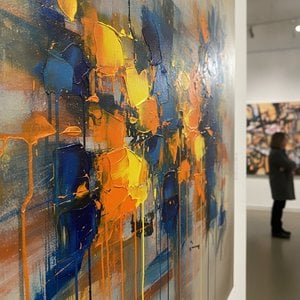
Gerhard Richter's "Dark," painted in 1968, is not merely an abstract composition; it’s a carefully constructed meditation on memory, displacement, and the very nature of perception. This close-up view reveals a canvas saturated with vibrant hues – bold reds and oranges battling against cooler blues – all rendered through Richter's signature technique of layered brushstrokes and subtly blurred surfaces. The painting immediately evokes a sense of unease, a feeling amplified by the deliberate ambiguity at its core. It’s a work born from a specific historical moment: Germany in the turbulent years following World War II, a nation grappling with the aftermath of unimaginable destruction and profound moral questions.
Richter’s personal history profoundly informs “Dark.” Born in Dresden in 1932, he experienced firsthand the instability and trauma of a nation divided. His childhood was shaped by displacement – his family repeatedly relocated during the war – an experience that instilled within him a deep-seated sense of disorientation. This biographical context is crucial to understanding the painting’s emotional resonance. The intense colors, particularly the reds and oranges, can be interpreted as echoes of the fires and destruction that ravaged Germany during the conflict, while the blues represent a yearning for peace and stability – a desire perhaps never fully realized.
The blurred areas within the composition are not accidental; they actively disrupt our ability to grasp a definitive image. This technique subtly suggests the fallibility of memory, the way in which experiences can be distorted or obscured over time. Richter masterfully utilizes this ambiguity to invite viewers into a dialogue with the work, prompting them to confront their own interpretations and emotional responses.
"Dark" resists easy categorization or definitive interpretation. The title itself suggests a preoccupation with shadow – not just literal darkness, but also the hidden aspects of human experience. The painting’s power lies in its ability to evoke a profound sense of melancholy and introspection. It's a work that demands attention, inviting viewers to contemplate themes of loss, uncertainty, and the enduring impact of historical trauma.
Gerhard Richter’s “Dark” is a testament to his extraordinary skill as an artist and his profound understanding of human psychology. This painting, created in 1968, remains a powerful example of abstract expressionism's ability to convey complex emotions and ideas through the manipulation of color, texture, and form. A hand-painted reproduction offers a unique opportunity to experience this captivating artwork firsthand, bringing Richter’s vision into your space and inviting contemplation for years to come.
Teoksen Gerhard Richter:n "Dark" tyylisuunta on Abstract Expressionism. Tämä luokittelu sijoittaa teoksen muiden samankaltaisten taiteilijoiden ja teosten joukkoon.
Vuosiluku 1968 sijoittaa teoksen "Dark" Gerhard Richter:n kehityksen Mature Period-vaiheeseen.
Teoksen Gerhard Richter:n "Dark" digitaalisen kuvan voi ostaa sen Digitaalinen kuva -sivulta: korkearesoluutioinen digitaalinen kuvalataus.


1932 - , Saksa

Tutustu Wassily Kandinskin 25 vaikuttavinta teosta! Uppoudu abstraktin taiteen maailmaan, värien symboliikkaan ja modernin ekspressionismin historiaan. Löydä inspiraatiota kodin sisustukseen WahooArt.com:ista – laadukkaat taideprintit ja reproduktiot.

Tutustu Mark Rothkon 25 mestariteokseen ja syvälliseen maailmaan abstraktin ekspressionismin parissa. Löydä tunteelliset väritaulut, taidehistorian helmet ja inspiraatiota kotiisi WahooArtilta. Tutki kokoelma verkossa!

Tutustu geometrisen abstraktion 10 mestariteokseen! Piet Mondrian, Kandinsky ja muut taiteilijat muovasivat modernin taiteen historiaa. Löydä inspiraatiota kotiisi WahooArtilta – laadukkaat taideprintit ja sisustusehdotukset odottavat. Tutki kokoelma verkossa!

Tutustu abstraktin ekspressionismin 10 mestariteokseen! Jackson Pollock, Mark Rothko ja muut taiteilijat inspiroivat tunteellisuudellaan. Löydä upeita taidemaalauksia kotiisi WahooArt.comista – museolaatuista laatua ja sisustusehdotuksia.
Master the high-impact world of contemporary abstraction. Discover how bold colors, textures, and modern movements like Abstract Expressionism can transform your space with premium, high-energy art curated for the design-conscious professional.

 Katso seinällä
 Lähetä
 Jaa
Jaa
 Tarkemmat tiedot
 Opas
Opas

 Lataa kuva
 Samanlaisia kohteita
 Röntgenkuvaus
 Diaesitys
 Tilastot

 Lue lisää









 Lasivaihtoehto on saatavilla vain alle 110 cm kokoisille teoksille


