EsikatseluEsikatselu Esikatsele AR-tilassaEsikatsele AR-tilassa Osta käsintehty maalaus Osta käsintehty maalausSwitch to Digital Image Switch to Digital Image JaaJaa
Tarkemmat tiedotTarkemmat tiedot Lisää suosikkeihin Lisää suosikkeihin LataaLataa SamanlaisiaSamanlaisia RöntgenkuvaRöntgenkuva DiaesitysDiaesitys StatsStats

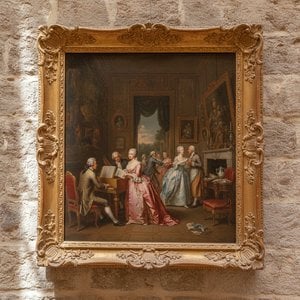
Gallant Conversation, known as

Tutustu Gerard ter Borchin elämään ja taiteeseen (1617–1681), hollantilaisen kultakauden mestariin, joka tunnetaan intiimeistä genremaalauksistaan realistisen valon vangitsemisesta. Löydä 'Kirje' ja lisää!

Giclée-printit ja taideprintit

Museolaatuisia giclée- tai kankaitaulun tulosteita nopealla tuotannolla ja joustavilla viimeistelyvaihtoehdoilla. (Osta käsintehty maalaus Osta käsintehty maalausSwitch to Digital Image Switch to Digital Image)

P118B $10
P118H $10
P118W $10
P438Z $10
P508JH $12
P508YH $12
P805H $10
P805Z $10
P919BZ $10
P919G $10
P919XJ $10
P959ZH $10
P968JZ $12
W106C $8
W218G $10
W218JH $8
W218Y $10
W307PJ $10
W316G $10
W316PJ $8
W316Y $10
W398PJ $8
W4111J $10
W500HY $15
W500JH $15
W692G $12
W849H $8
W940BG $15
W953PJ $8

Vakiokoko
räätälöity
CM
INCH

Valitse valmiista mitoistamme sellaiset, jotka vastaavat teoksen alkuperäisiä mittasuhteita.

leveys
korkeus

Voit syöttää omat mitat sopiaksesi tiettyyn kehykseen tai tilaan. Jos valittu koko ei vastaa alkuperäisen kuvan mittasuhteita, rajaamme teosta tai laajennamme kuvaa peilatulla tai yhtenäisellä reunalla. Digitaalinen mallikuva lähetetään hyväksyttäväksi ennen tuotannon aloittamista.
Huomaathan, että näytöllä näkyvä esikatselu ei vastaa lopullista rajausta tai laajennusta. Vain mallikuva näyttää lopullisen sommittelun tarkasti.
Vaikka räätälöityjä kokoja on saatavilla, suosittelemme valitsemaan mitat valmiista listasta alkuperäisten mittasuhteiden säilyttämiseksi.

Toimitus maailmanlaajuisesti () kahdessa viikossa tavallisen 4–5 viikon sijaan. (8 syyskuu)

why_choose_icon
Ilmainen pikatoimitus ympäri maailman
why_choose_icon
Korkealaatuinen pellavakangas
why_choose_icon
Kattava kuljetusvakuutus
why_choose_icon
Tulliveron palautustakuu
why_choose_icon
Täydellinen värien vastaavuustakuu
why_choose_icon
100 päivän palautusoikeus (vain valmistusvirheet)
why_choose_icon
100% rahat takaisin -takuu
why_choose_icon
Määräalennus tarjous

Kokonaishinta

$ 68

reproduction

Gallant Conversation, known as

Giclée-printit ja taideprintit

Replikaatin koko

-

Kokonaishinta

$ 68

Pikaista tietoa

  • Artistic style: Genre painting, realism
  • Influences: European travel
  • Notable elements: Subtle scene, brothel
  • Medium: Oil on panel
  • Dimensions: 73 x 71 cm
  • Artist: Gerard ter Borch
  • Location: Private Collection

Taidevisa

Jokaisessa kysymyksessä on vain yksi oikea vastaus.

Kysymys 1:
What is the most significant and initially misleading aspect of Gerard ter Borch’s ‘Gallant Conversation’?
Kysymys 2:
Based on the image description, what specific elements within the room strongly suggest the illicit setting?
Kysymys 3:
Gerard ter Borch is best known for his work in which genre of painting?
Kysymys 4:
What historical period does Gerard ter Borch primarily represent in his art?
Kysymys 5:
Which of the following best describes a key characteristic of Gerard ter Borch’s artistic style?

A Shadowed Intimacy: Unraveling Gerard ter Borch’s *Gallant Conversation*

Gerard ter Borch's *Gallant Conversation*, painted in 1655, is not merely a portrait; it’s an exquisitely rendered tableau of veiled secrets and subtle anxieties. Initially known as “The paternal admonition,” the painting quickly revealed a far more complex narrative – one that challenged viewers at the time and continues to intrigue today. It's a masterful example of Dutch Golden Age genre painting, showcasing ter Borch’s unparalleled ability to capture not just appearances but the very essence of human interaction, particularly within the confines of a private, almost clandestine setting.

The scene unfolds within a modestly furnished room, bathed in a muted red light that casts long shadows and adds an air of mystery. A young soldier, strikingly handsome yet undeniably youthful, occupies a central position, engaged in conversation with a woman of considerable elegance – likely a courtesan or prostitute. A third figure, a woman holding a glass, observes the interaction from a distance, her expression hinting at both amusement and perhaps a degree of control. The inclusion of a dog, casually observing the scene, further contributes to the feeling that this is a carefully constructed tableau, a staged moment rather than an impromptu gathering. The deliberate ambiguity surrounding the relationships – who is admonishing whom? – is precisely what makes this painting so compelling.

The Delicate Dance of Light and Shadow: Ter Borch’s Technique

Ter Borch's genius lies in his painstaking attention to detail and his revolutionary approach to light. Unlike many of his contemporaries, he eschewed the dramatic chiaroscuro favored by Rembrandt, opting instead for a subtle, almost photographic realism. He meticulously built up layers of translucent glazes, creating an astonishingly delicate surface texture that captures the sheen of silk, the gleam of metal, and the softness of skin with remarkable precision. Notice how the light catches the folds of the woman’s dress, revealing the intricate weave, or how it subtly illuminates the soldier's face, highlighting his youthful features and a hint of vulnerability. This technique wasn’t simply about realism; it was about capturing the *atmosphere* of the scene – a sense of quiet contemplation punctuated by unspoken tensions.

  • Glazing Technique: Ter Borch employed countless thin layers of translucent paint, building up color and depth gradually.
  • Subtle Modeling: He masterfully used light and shadow to sculpt the figures, creating a sense of volume and form without resorting to harsh contrasts.
  • Attention to Texture: The meticulous rendering of fabrics, metal, and skin demonstrates his dedication to capturing the tactile qualities of the scene.

A Brothel in Disguise: Historical Context and Symbolism

The painting’s true subject matter – a clandestine meeting within a brothel – was initially met with considerable debate. The original title, “The paternal admonition,” suggested a familial setting, leading to confusion about the nature of the scene. However, clues abound that point towards a more illicit reality: the bed in the background, the table with a mirror (a common feature in such establishments), and the overall atmosphere of intimacy and veiled intent. This ambiguity reflects the social realities of 17th-century Amsterdam – a city rife with wealth, commerce, and a thriving underworld. Ter Borch’s willingness to depict this darker side of society was remarkably bold for his time.

The soldier's youth is particularly significant. He isn’t a father dispensing wisdom; he’s a young man indulging in the pleasures of the flesh, suggesting themes of youthful folly and the corrupting influence of wealth. The woman observing from afar embodies a certain power – perhaps ownership or control – while the courtesan herself represents allure and danger.

Capturing Emotion: A Portrait of Quiet Tension

*Gallant Conversation* is not a painting that shouts; it whispers. It’s a study in restraint, conveying a complex web of emotions through subtle gestures and averted glances. The figures are caught in a moment of quiet contemplation, their faces betraying a mixture of curiosity, amusement, and perhaps even apprehension. The overall effect is profoundly unsettling – a reminder that appearances can be deceiving and that beneath the surface of polite conversation often lie hidden desires and unspoken truths. This painting’s enduring power lies in its ability to evoke a sense of unease and intrigue, prompting viewers to question what they are seeing and, more importantly, what they *aren't* being told.


Taiteilijan elämäkerta

Gerard ter Borch

Gerard ter Borch (Dutch: Gerard Terburg) was an influential and pioneering Dutch genre painter who lived in the Dutch Golden Age. He influenced fellow Dutch painters Gabriel Metsu, Gerrit Dou, Eglon van der Neer and Johannes Vermeer.

According to Arthur K. Wheelock Jr., Ter Borch “established a new framework for subject matter, taking people into the sanctum of the home”, showing the figures’ uncertainties and expertly hinting at their inner lives. His influence as a painter, however, was later surpassed by Vermeer.

Early Life and Influences

Gerard ter Borch was born in December 1617 in Zwolle in the province of Overijssel in the Dutch Republic. He received an excellent education from his father Gerard ter Borch the Elder, also an artist, and developed his talent very early.

The inscription on a study of a head proves that Ter Borch was at Amsterdam in 1632, where he studied possibly under Willem Cornelisz Duyster or Pieter Codde. Duyster's influence can be traced in a picture bearing the date 1638, in the lonides Bequest (Victoria and Albert Museum). In 1634 he studied under Pieter de Molijn in Haarlem.

Notable Works and Achievements

- **The Letter**: A masterpiece showcasing ter Borch’s skill in capturing texture and light.

- **The Gallant Conversation**: Engraved by Johann Georg Wille, this piece exemplifies the artist's ability to convey nuanced emotions.

- **Man on horseback (1634)**: An early work demonstrating ter Borch’s emerging talent.

- **Adrian Pauw’s arrival in Münster (1646)**: A significant piece that highlights the artist's narrative capabilities.

Museums and Collections Featuring Ter Borch’s Work

- The Hermitage: With six of his works, it boasts one of the largest collections.

- Berlin Museum: Features six pieces, showcasing ter Borch’s international appeal.

- Getty Center: Three of his paintings are part of this esteemed collection.

Legacy and Impact

Ter Borch's influence on Dutch painters like Gabriel Metsu, Gerrit Dou, Eglon van der Neer, and Johannes Vermeer is well-documented. His innovative approach to genre painting has made him a pivotal figure in the history of art.

Gerard ter Borch

Gerard ter Borch

1617 - 1681 , Alankomaat

Pikatiedot

  • Artistic Movement Or Style: Dutch Kultakauden taide
  • Artists Or Movements Influenced By This Artist: ['Vermeer']
  • Artists Who Influenced This Artist:
    • Gabriel Metsu
    • Gerrit Dou
    • Johannes Vermeer
  • Date Of Birth: 1617
  • Full Name: Gerard ter Borch
  • Nationality: Alankomaalainen
  • Notable Artworks:
    • Kirje ja Uljas Keskustelu
    • Man on horseback
  • Place Of Birth: Zwolle, Alankomaat
Tutustu teoksiin, jotka on järjestetty aiheiden, tyylien ja ominaisuuksien mukaan.