

Käsinmaalattu öljyväri kankaalle haluamassasi koossa ja kehyksissä, taiteilijoidemme valmistamana tilauksesta. ( Vaihda tulosteeseen Siirry digitaaliseen kuvaan)
Valitse valmiista mitoistamme sellaiset, jotka vastaavat teoksen alkuperäisiä mittasuhteita.

Kirjoita tarvitsemasi leveys ja korkeus, jotta teos sopii kehyskehyksiisi tai seinällesi. Koska kyseessä on käsinmaalattu teos, taiteilija voi maalata hieman enemmän kuvan ympärille tai rajata sitä hieman, jos haluat eri muotoisen koon — valinta on sinun. Lähetämme sinulle digitaalisen mallikuvan hyväksyttäväksi ennen kuin maalaus alkaa. Tällä sivulla näkyvä kuva ei vastaa lopullista tulosta — vain mallikuva näyttää sen.
Maailmanlaajuinen toimitus () 3–4 viikossa tavallisen 5 viikon sijaan. (22 lokakuu). Laadusta ei tingitä.
Work table
Replikaatin koko
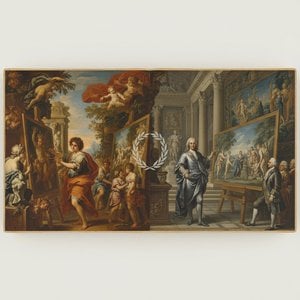
To stand before Adam Weisweiler’s Work table is not merely to observe furniture; it is to encounter a meticulously preserved moment from the zenith of eighteenth-century artistry. Created in 1786, this piece transcends its function as a mere surface for work or display. It stands instead as a profound testament to the Enlightenment's embrace of refined taste and unparalleled craftsmanship. The overall impression is one of breathtaking symmetry and controlled opulence. One senses the quiet dignity of an era that valued intellect alongside exquisite aesthetics, where every curve and inlay told a story of patronage and precision.
The technical brilliance embedded within this table is nothing short of astonishing. Weisweiler masterfully combined several high arts into one cohesive object. The primary structure, rendered in rich, dark mahogany, provides a deep, grounding warmth that allows the inlaid veneers to sing. Observe the marquetry—a complex tapestry woven from various exotic woods and accented with gleaming gold leaf. This is not simple decoration; it is an architectural narrative executed on wood. Further elevating the piece are the small, delicate blue porcelain medallions placed thoughtfully upon each tier. These elements introduce a cool, chromatic counterpoint to the warm browns of the wood, suggesting classical motifs and perhaps even subtle heraldic whispers from the period’s elite circles.
This table belongs firmly within the Neoclassical vocabulary, embodying the restrained grandeur characteristic of the late Louis XVI style. While the era celebrated luxury, it did so with a newfound appreciation for classical order and geometric purity, moving away from the excesses of earlier Baroque periods. Weisweiler, having trained under masters like David Roentgen, channeled this spirit into every joint and carving. The slender, turned legs, detailed with brass accents, speak to an adherence to proportion—a hallmark of Enlightenment thought applied to domestic objects. Owning a reproduction of this piece allows one to anchor a modern space in the sophisticated patina of history.
What truly captivates the viewer is the emotional resonance of quiet perfection. The table suggests a life lived with cultivated taste—a place where scholarly pursuits met social grace. It evokes the hushed atmosphere of a grand salon, filled with candlelight reflecting off polished veneers. For the collector or designer, this piece offers more than just storage; it provides an immediate elevation of ambiance. It whispers tales of learned conversation and refined ritual, transforming any room into a space imbued with enduring elegance.
"Work table" esittää aiheita 18th century furniture, french craftsmanship, marquetry detail, gold inlay decor, heraldic symbols, side table design, luxury interior, ja sen tunnelmaksi on tallennettu Luxurious.
"Work table" välittää Reflective tunnelman, ja sen suositeltu lahja Anniversary on.
Teoksen "Work table" värit muodostavat Neutrals-väripaletin. Tämä luokitus kuvaa hallitsevia väriperheitä.


1750 - 1810 , Germany

Uppoudu 1700-luvun taiteen maailmaan! Tutustu 10 mestariteokseen – barokin loistosta valistuksen ajan ajatuksiin. Löydä tunnettujen taidemaalareiden tarinat ja inspiroi kotisi sisustusta WahooArt.com:ssa. Explore the full collection online!

Explore the elegant world of Charles-André van Loo, a master of Rococo portraiture at the French court. Discover his life, techniques, and enduring influence on 18th-century art. Hand-painted reproductions available.
Explore the life & art of Simon Vouet, a pivotal French Baroque painter who introduced Italian styles to France. Discover his masterpieces and lasting influence on 17th-century art.

Explore the life & art of Charles Le Brun, master of French Baroque Classicism. Discover his royal commissions, influence on Versailles, and enduring legacy through detailed analysis & stunning artworks.

Explore the captivating world of Anne-Louis Girodet, a pivotal figure bridging Neoclassicism & Romanticism. Discover his masterpieces and unique artistic vision with WahooArt.

 Lähetä
 Jaa
Jaa
 Tarkemmat tiedot
 Opas
Opas

 Lataa kuva
 Samanlaisia kohteita
 Diaesitys
 Tilastot


 Lue lisää






































 Lasivaihtoehto on saatavilla vain alle 110 cm kokoisille teoksille


