
Get a print-ready file that goes far beyond the web preview. Every digital image we sell comes from a high-resolution master in our stock database — usually 5,000 to 15,000 pixels wide — so you can print large, crop tightly, or reproduce fine detail with confidence.
No file leaves our studio untouched. A digital expert checks the colors against the original painting and corrects them if needed, then improves clarity and detail with professional retouching tools — always staying faithful to the artist's brushwork and style. The result is an image that looks like the painting, not like a filtered scan.
You approve before you're done: our expert sends the image by e-mail within 72 hours for your review. Not satisfied? Ask for improvements or corrections, or request a refund if the quality falls short.
This is the quality relied on by publishers, design studios, galleries and print shops.
Lataa korkearesoluutioinen tiedosto henkilökohtaiseen näyttelyyn, tulostamiseen ja luoviin projekteihin. ( Vaihda tulosteeseen Tilaa käsinmaalattu jäljennös)
Kun valitset WahooArt.com-palvelun, et saa vain kuvaa – saat ammattimaisesti viimeistellyn digitaalisen taideteoksen, joka on luotu tarkkuudella ja jonka takaa tulee tyytyväisyystakuu. Tässä on kaikki, mitä tilauksesi sisältää, automaattisesti:
Saat korkearesoluutioisen digitaalisen kuvatiedostosi sähköpostiisi 72 tunnin kuluessa tilauksesta – valmiina käytettäväksi välittömästi.
Teoksesi on optimoitu ammattimaisesti edistyneiden tekoälytyökalujen ja manuaalisen jälkikäsittelyn avulla, mikä takaa maksimaalisen yksityiskohtaisuuden, selkeyden ja väritarkkuuden.
Oletko vahingossa poistanut tai kadottanut tiedostosi? Ei hätää – lähetämme sen sinulle uudelleen milloin tahansa täysin maksutta.
Nauti taiteestasi välittömästi ilman tullimaksuja, veroja tai toimituskuluja – digitaaliset lataukset ovat aina verovapaita.
Varmistamme, että digitaalinen kuvasi vastaa alkuperäisiä värejä mahdollisimman tarkasti käyttämällä ammattilaistason työkaluja ja värinhallintaa.
Jos et ole tyytyväinen digitaaliseen kuvaasi, muokkaamme sitä tai palautamme 100% hinnan 100 päivän kuluessa – kysymystä ei esitetä.
Et ole tyytyväinen? Saat täyden hyvityksen 100 päivän kuluessa digitaalisen tiedostosi vastaanottamisesta – kysymystä ei esitetä.
Osta 3 kuvaa, säästä 10% - Osta 5, säästä 15% - Osta 10+, säästä 20%. Erinomainen valinta luoviin projekteihin, gallerioille ja toimistoille.
Georges Seurat’s “La Grenouillère” – literally “The Pond” – stands as an emblem of Impressionism's audacious embrace of scientific inquiry. Painted in 1876, this monumental canvas depicts a Parisian café scene brimming with life, yet it’s far from merely capturing a snapshot of everyday existence. Instead, Seurat meticulously constructed his artwork using a revolutionary technique known as Pointillisme, pioneered alongside Paul Signac.
The scene itself is deceptively simple—a café terrace populated by men and women enjoying drinks and conversation. However, beneath the surface lies a profound exploration of color and perception. Seurat’s palette utilizes bold hues – reds, blues, yellows – arranged in discrete patches that shimmer with reflected light. This deliberate fragmentation contributes to an unsettling yet captivating effect; it invites viewers to actively participate in constructing the image.
Symbolism:The pond itself—a recurring motif in Seurat’s oeuvre—represents both physical space and psychological depth. It symbolizes tranquility amidst urban bustle, mirroring the artist's own quest for intellectual clarity and artistic innovation. The figures within the café are rendered with meticulous detail, yet their faces remain largely obscured, emphasizing the importance of emotion and intuition over precise representation.
“La Grenouillère” remains a cornerstone of Impressionist art history and continues to inspire artists and collectors alike. Its enduring appeal lies not only in its aesthetic beauty but also in its audacious intellectual ambition—a testament to Seurat’s unwavering belief that art could illuminate the mysteries of human consciousness.
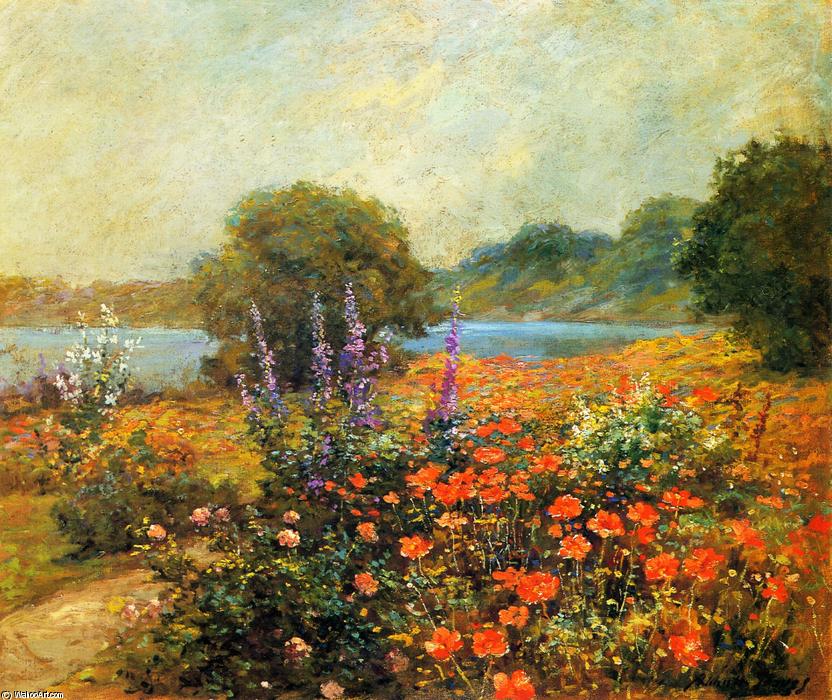
Elegant-tunnelmansa ansiosta "Poppies" sopii erinomaisesti tilaan Living Room.
Teoksen Abbott Fuller Graves:n "Poppies" tekniikka on Acrylic On Canvas. Vedosten tavoitteena on jäljitellä tämän tekniikan ulkoasua.
Abbott Fuller Graves:n "Poppies" esittää: landscape, flowers, birds, field, poppy, color theory, impressionist painting.

Abbott Fuller Graves was an American painter and illustrator whose brush captured the delicate intersection of nature and light. Born in Weymouth, Massachusetts, his early aspirations leaned toward the structured world of architecture, leading him to attend the Massachusetts Institute of Technology. However, a profound calling toward the ephemeral beauty of the natural world eventually redirected his path. This journey took him far beyond the borders of New England, as he traveled to Paris and Italy to refine his skills. In the vibrant art centers of Europe, Graves immersed himself in the study of floral painting and figure work, absorbing the revolutionary techniques that would later define his signature style.
During his formative years in Paris, Graves studied at the Académie Julian, learning under masters such as Fernand Cormon, Jean- Paul Laurens, and Paul Gervais. This rigorous academic training provided him with a foundation in realism, yet it was the burgeoning influence of European Impressionism that truly ignited his creative spirit. His time in Europe also allowed him to room with Edmund C. Tarbell, fostering connections within a circle of artists who were reshaping American art. Upon returning to Boston, Graves became a teacher at the Cowles Art School, working alongside notable figures like Childe Hassam, a relationship that undoubtedly enriched their mutual artistic development.
As his career matured, Graves found a permanent sanctuary in the coastal town of Kennebunkport, Maine. It was here that his work truly blossomed, as he began to specialize in decorative open-air garden paintings and floral still-lifes. His mastery lay in the ability to blend Impressionistic light with Realistic observation. He did not merely seek to replicate the appearance of a garden; he sought to capture how sunlight filtered through foliage, casting dappled shadows and illuminating blossoms with an ethereal glow. His use of thick brushstrokes and vibrant colors allowed him to translate the textures of roses, lilies, and lush landscapes onto the canvas, creating scenes that felt both alive and deeply serene.
His subject matter often celebrated the rhythms of local life and the splendor of the natural world. While many of his works focused on the intricate beauty of exotic gardens—sometimes reaching as far as Spain and South America—he remained deeply rooted in the American landscape. His paintings frequently featured genre scenes of Kennebunkport, portraying fishermen, farmers, and sea captains, often rendered with a charming, nostalgic quality that led to his work being widely reproduced on postcards and calendars. This ability to elevate everyday coastal life into a symphony of color and light remains his most enduring legacy.
Beyond the canvas, Graves possessed a unique vision for the integration of art and living space. In 1905, he applied his architectural sensibilities to design the Abbott Graves House in Kennebunkport. This structure, notable as one of the rare examples of the Prairie School of architecture in Maine, stands as a testament to his multifaceted talent. The house reflects the same harmony between form and nature that characterized his paintings, showcasing a sophisticated understanding of design and space.
In his later years, Graves moved between the creative energy of New York City and the tranquility of the coast. His membership in prestigious organizations such as the National Academy of Design, the Salmagundi Club, and the Allied Artists of America solidified his standing within the American art community. Through his dedication to capturing the fleeting beauty of a petal or the shifting light on a coastal shoreline, Abbott Fuller Graves left behind a body of work that continues to resonate with those who find poetry in the natural world.

1859 - 1936 , Yhdysvallat

 Katso seinällä
 Lähetä
 Jaa
Jaa
 Tarkemmat tiedot
 Opas
Opas

 Lataa kuva
 Samanlaisia kohteita
 Röntgenkuvaus
 Diaesitys
 Tilastot

 Lue lisää


