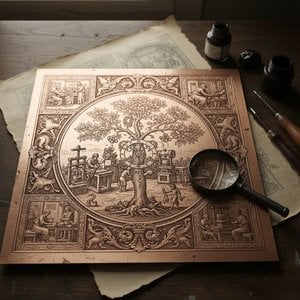
A Chronicle of Order and Disquiet: Unpacking James Ensor’s “The Gendarmes”
James Ensor's "The Gendarmes," a powerfully evocative monochromatic etching, isn’t merely a depiction of a scene; it’s a carefully constructed tableau brimming with social commentary and unsettling psychological depth. Completed in 1888, this work immediately draws the viewer into a densely packed urban landscape – a chaotic confluence of soldiers, civilians, and an atmosphere thick with unspoken tension. The image, born from Ensor's unique perspective as a Belgian artist living in Ostend, reflects his fascination with masks, carnivals, and the darker aspects of human nature, all rendered through the meticulous precision of etching technique.
The composition itself is deliberately claustrophobic. Figures are layered upon one another, creating an almost suffocating sense of proximity. Linear perspective is subtly flattened, suggesting a stage-like presentation rather than a realistic portrayal of space – a deliberate choice that amplifies the feeling of observation and detachment. The soldiers, rendered with exaggerated features and a certain severity in their expressions, dominate the scene, embodying authority and order. Yet, even within this framework of control, there’s an undeniable undercurrent of unease, hinting at the potential for rebellion or dissent simmering beneath the surface.
The Language of Line: Technique and Artistic Process
Ensor's mastery lies in his command of etching. The work is executed with thick, expressive lines that define forms with remarkable clarity while simultaneously generating a rich textural quality. These aren’t delicate, refined lines; they possess a palpable energy, conveying the urgency and intensity of the scene. The monochromatic palette – primarily shades of grey – further enhances this effect, stripping away any distractions and focusing attention on the intricate details of the composition and the expressive power of the linework. The process itself—incising into a metal plate and then applying ink before pressing onto paper—is evident in the grainy texture that surfaces, lending the image a tactile quality that invites close examination.
Notably, Ensor employed gouache additions to the etching plate, subtly enhancing certain areas with color. This layering of techniques adds another layer of complexity and visual interest, particularly noticeable in the faces of some figures, where the use of color contributes to their psychological intensity. The careful control demonstrated in this process speaks volumes about Ensor’s artistic discipline and his ability to manipulate the etching medium to achieve a specific effect.
Symbolism and Social Critique
“The Gendarmes” is far more than just a snapshot of a street scene; it's a potent symbol of societal control and the anxieties of the late 19th century. The uniforms and weaponry of the soldiers immediately evoke notions of authority, law enforcement, and potentially, repression. However, Ensor doesn’t simply celebrate these symbols of order. Instead, he presents them within a context that suggests their potential for misuse or abuse. The watchful gaze of the gendarmes, coupled with the apprehensive expressions of the onlookers, hints at a power dynamic fraught with tension.
The presence of masks – a recurring motif in Ensor’s work – is particularly significant. They represent hidden identities, deception, and the performance of social roles. The scene itself can be interpreted as a commentary on the superficiality of appearances and the underlying anxieties of a rapidly changing society. Considering Ensor's upbringing amidst the spectacle of Ostend's carnival, it’s reasonable to suggest that this image reflects his lifelong engagement with themes of disguise and the unsettling nature of human behavior.
A Legacy of Expression: Ensor’s Enduring Influence
James Ensor stands as a pivotal figure in the development of both Expressionism and Surrealism. “The Gendarmes” exemplifies his unique artistic vision – a blend of realism, symbolism, and psychological intensity that continues to resonate with viewers today. His willingness to challenge conventional artistic norms and explore unsettling subject matter paved the way for future generations of artists who sought to express their inner worlds through unconventional means. Reproductions of this powerful etching offer a remarkable opportunity to experience firsthand the genius of James Ensor and to contemplate the enduring relevance of his profound social commentary.
Küsimused ja vastused
Millist suurust ja orientatsiooni soovitatakse teosele „The Gendarmes“, autor James Ensor trükkimisel?
Teose "The Gendarmes" puhul on soovitatav trükiรูปแบบ on Medium suurusega ja Landscape suunaga.
Milline meeleolu ja emotsioon koosnevad teoses "The Gendarmes"?
Teose „The Gendarmes“, autor James Ensor edastatud meeleolu on Dramatic ning selle emotsionaalne toon on Melancholic.
Kes lõi "The Gendarmes"?
Teose "The Gendarmes" looja on James Ensor. Teos on kataloogitud nime James Ensor all.
Kes müüb teose "„The Gendarmes“, autor James Ensor" käsitsi maaldatud koopiaid?
Teos "The Gendarmes" on saadaval kujundis käsitsi maalatud õlireproduktsioon linaelapale. Tellimust saab esitada lehel see leht, kus on võimalik valida erinevad suurused.
Kuidas ma saan alla laadida teose „The Gendarmes“, autor James Ensor pildi?
Teose „The Gendarmes“, autor James Ensor tehes digitaalset pilti saab alla laadida selle Laadi alla lehelt vormatsis kõrge resolutsiooniga digitaalse pildi allalaadimine.
Kust saan osta teose „The Gendarmes“, autor James Ensor trükki?
Teos "The Gendarmes" on saadaval vormis kunstiprint puuvillalõikel}}^{\text{canvas}}$ või arhiveeritaval kangaspaberil. Tellimusi võetakse vastu lehel see leht soovitud suuruses.
Kui palju valgust tundub värvid teosele "The Gendarmes" peegeldatav olevat?
Teose „The Gendarmes“, autor James Ensor kirjeldatud luminants on Gentle Luminance.



 Vaata sisu
 Telli käsitsi maalitud reproduktsioon
 Jaga teost
 Jaga
Jaga
 Detailid
 Õppekate juhend

 Laadi alla
 Sarnased teosed
 Röntgenuuring
 Slaidietendus
 Statistika

 Loe lähemalt






































 Klaasivalik on saadaval ainult kuni 110 cm suuruses teostes