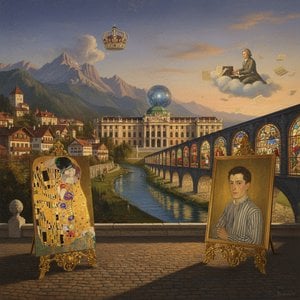
A Golden Legacy Amidst Baroque Splendor
To step into the Österreichische Galerie Belvedere is to wander through the very soul of Austrian identity. Nestled within the historic heart of Vienna, this architectural marvel serves as a breathtaking bridge between the imperial grandeur of the past and the avant-garde spirit of the modern era. The museum’s setting, comprised of the Upper and Lower Belvedere palaces, is itself a masterpiece of Baroque design. Conceived by the legendary Johann Lucas von Hildelybrandt in the early 18th century for Prince Eugene of Savoy, the palaces feature meticulously crafted facades and expansive, manicured gardens that evoke an era of unparalleled opulence. As visitors traverse these halls, they are not merely walking through a gallery but entering a living testament to the Habsburgs' imperial ambitions and the refined aesthetic of the European aristocracy.
The true heartbeat of the Belvedere, however, lies in its incomparable collection, most notably the world’s most significant assembly of works by Gustav Klimt . The museum serves as the definitive sanctuary for the Vienna Secession movement, where the shimmering, ethereal beauty of "The Kiss" meets the raw, psychological depth of the era's greatest innovators. To stand before Klimt’s masterpieces is to witness a revolution of gold leaf and intricate ornamentation, a style that redefined the boundaries of Art Nouveau. For the discerning collector or interior designer, these works offer profound inspiration, demonstrating how light, texture, and symbolic depth can transform a space into something transcendent.
Beyond the golden glow of Klimt, the collection delves into the darker, more visceral currents of Austrian Expressionism through the works of Egon Schiele and Oskar Kokoschka . These artists utilized the canvas to probe the depths of human emotion and vulnerability, challenging the social conventions of the Belle Époque with an uncompromising honesty that continues to captivate contemporary audiences. The museum’s narrative is one of continuous evolution, seamlessly blending medieval frescoes with the vibrant energy of Impressionism. This chronological journey allows enthusiasts to trace the metamorphosis of Austrian culture through centuries of political and social change.
Recent exhibitions have further cemented the Belvedere's reputation as a dynamic center for intellectual discourse, famously exploring the fascinating psychological intersections between Salvador Dalí and Sigmund Freud . Whether one is drawn to the erotic power found in Klimt’s "Judith II" or the opulent patterns of his portraits like "Bildnis Fritza Riedler," the museum offers an immersive experience. The Belvedere is far more than a repository of historical artifacts; it is a sanctuary where history and modernity collide, inviting every visitor to participate in the enduring beauty and intellectual vibrancy of Vienna’s golden age.