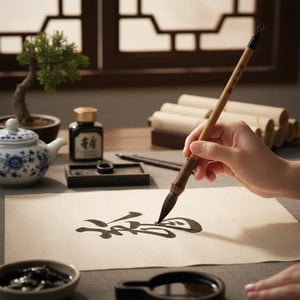
The Quiet Brush of the Qing Dynasty
The ink meets the paper in a controlled dance of shadow and light. Born in 1658, Xiao Chen lived through a transformative era of Chinese history, navigating the complexities of the Qing dynasty. His hand moved with a precision that sought to capture the essence of the natural world, not through mere imitation, but through a deep understanding of form and space. By 1675, the early traces of his talent were already manifesting in works that balanced the weight of ink with the lightness of color.
His existence was defined by the subtle nuances of the landscape. He did not seek to overwhelm the viewer with grandiosity. Instead, he focused on the quietude of mountains and the delicate flow of water, using ink and colors on paper to build a world that felt both immediate and distant. This technical restraint allowed his compositions to breathe, creating a sense of atmosphere that remains palpable in the surviving fragments of his output.
Technical Precision and Composition
The physical reality of his work reveals a meticulous approach to the medium. His compositions often utilize specific dimensions to frame a particular perspective of the natural world. In his known works, the relationship between the subject and the void is carefully managed.
- Medium: Ink and colors on paper
- Primary Subject Matter: Landscapes
- Historical Period: Qing dynasty
The application of ink is never accidental. Each stroke carries a specific intent, contributing to the structural integrity of the landscape. He worked within a tradition that demanded mastery over the brush, yet his specific touch remains identifiable through the way he handled the transition from deep blacks to the lightest washes of color.
Legacy and Preservation
Xiao Chen passed away in 1710, leaving behind a body of work that has survived the passage of centuries. His presence in the historical record is felt through the collections that hold his vision. These works have moved from private hands into the stewardship of major institutions, ensuring that his specific interpretation of the landscape continues to be studied. His contribution to the Qing dynasty's artistic landscape is preserved in the archives of the Palace Museum, Beijing, and other significant repositories.
Questions & Answers
Can I study Xiao Chen's use of color across all works?
The Palette Genome of Xiao Chen is a page that presents the color profile of the artist's body of work.
Can I browse Xiao Chen's works by color palette?
The By Palettes page groups Xiao Chen's artworks by their color palettes.
Is there an overview of all the subjects Xiao Chen painted?
The Subject Atlas page maps Xiao Chen's artworks by subject.