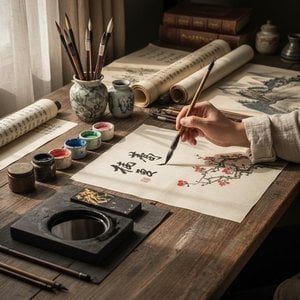
The Spirit of Ink and Zen
Wuxue Zuyuan, known in Japan as Mugaku Sogen, was far more than a mere practitioner of the brush; he was a profound 13th-century Zen Buddhist monk whose life and legacy bridged the worlds of China and Japan. Born in Ningbo, Zhejiang, during the Song dynasty, his existence was defined by the spiritual rigors of the Linji school of Chan Buddhism. As a student of the celebrated Master Wuzhun Shifo, he inherited a lineage that valued the profound simplicity of Zen training alongside an appreciation for the aesthetic elegance found in calligraphy and ink art. His journey took him from the temples of China to the heart of the Kamakura period in Japan, where his presence would fundamentally reshape the landscape of Japanese Zen practice.
His life was marked by a movement between cultures and eras, driven by both spiritual seeking and the turbulent shifts of history. After navigating the complexities of the Mongol invasions in China, Wuxue Zuyuan was invited to Japan in 1279 by the powerful regent Hojo Tokimune. This transition allowed him to serve as a pivotal figure in the establishment of Japanese Zen institutions. He held significant roles as the abbot of Kencho-ji Temple and later became the founding abbot of the great Engaku-ji monastery in Kamakura. Through these positions, he acted as a spiritual conduit, transmitting the essence of the Southern school of Chinese Chan to a new generation of Japanese monks, including influential figures such as Muso Soseki.
A Legacy of Calligraphy and Devotion
While his primary identity was that of a Zen master, the traces of his artistic sensibility remain visible in the surviving remnants of his calligraphic work. In the tradition of the masters he studied under, his approach to the written word and ink application reflected the core tenets of Zen: the beauty of emptiness, the economy of line, and the meditative focus of the moment. His works, such as the Calligraphy of a Seven-character Line About the Seven Deities of Good Fortune, demonstrate an exquisite command of East Asian calligraphy, where every stroke carries the weight of spiritual intention and Taoist influence.
The significance of Wuxue Zuyuan lies in his role as a founding patriarch. He did not merely practice a religion; he established a lineage—the Bukko lineage—that would endure for centuries. His posthumous title, Bukko Kokushi, or the "National Preceptor of the Buddha's Radiance," serves as a testament to the immense respect and spiritual authority he commanded. Through his teachings and his presence in Japan, he helped lay the foundation for a unique cultural synthesis where the discipline of Zen and the evocative power of ink became inextricably linked, leaving an indelible mark on the history of East Asian spirituality and art.
Questions & Answers
Can I visit a virtual museum of Wuxue Zuyuan's works?
A virtual visit is possible: the 3D Museum page of Wuxue Zuyuan presents the artist's works in a three-dimensional gallery.
What aliases or alternate names does Wuxue Zuyuan have?
Wuxue Zuyuan is also known as Mugaku-Guzen.
What are the birthplace and birth year of Wuxue Zuyuan?
Wuxue Zuyuan was born in Hangzhou in 1226.