Early Life and Training
- Born: March 21, 1785, in Haarlem, Netherlands
- Died: August 30, 1857, in Haarlem, Netherlands
- Woutherus Mol received his initial artistic training under the tutelage of Hermanus van Brussel, a painter from Haarlem. This early guidance laid the foundation for his future career.
- In 1802, he became a member of the "Tekengenootschap Kunstmin en Vlijt," the Haarlem drawing society, demonstrating an early commitment to artistic development and community engagement.
Parisian Period and Academic Influences
- Around 1806, Mol traveled to Paris with his parents' permission, seeking further artistic refinement.
- He studied floral painting under Gerard van Spaendonck at an institute in Paris.
- Recognizing a greater interest in historical paintings, he then studied under Jacques-Louis David, the renowned historical painter.
- In 1807, Mol was awarded the Dutch Prix de Rome and received a scholarship as "Hollandsch Kweekeling" (Hollandic pupil) to study and work in Paris, though he never formally visited Rome.
- His artistic style during this period reflected the influence of classical masters like Raphael, evident in his submission to the Amsterdam art exhibition in 1810 – a painting of the Holy Family after Raphael.
Return to Haarlem and Recognition
- After the restoration of the Netherlands in 1813, Mol returned to Haarlem.
- He focused on studying Dutch masters and gained recognition with his submission "The Death of Prince William I" to the Amsterdam art exhibition in 1818. This work, based on a portrait by Christiaen Jansz van Bieselingen, was highly acclaimed and purchased for a significant sum.
- This success led to him becoming an honorary member of the Royal Academy of Brussels.
Later Career and Decline
- While initially celebrated, Mol's later works were considered less impressive, leading to a decline in public opinion.
- He experienced a nervous breakdown and entered the "Rooms-Katholieke Wees- en armenhuis" (Catholic almshouse) in Haarlem in 1846, where he spent his final years without painting.
- Despite this later period, Woutherus Mol remains significant as an artist who bridged early classical influences with Dutch artistic traditions.
Artistic Style and Legacy
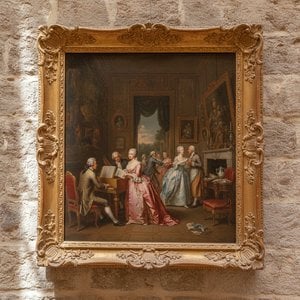
- Mol's work is characterized by a blend of academic training and genre scenes, often depicting interiors and portraits.
- His earlier works demonstrate a strong influence from historical painting masters, while his later pieces reflect a more intimate focus on Dutch life.
- He is remembered for his technical skill and ability to capture the nuances of human expression in his paintings.
- The Teylers Museum in Haarlem holds one of his notable works, "Sleeping Boy," which exemplifies his talent for portraying quiet domestic scenes.