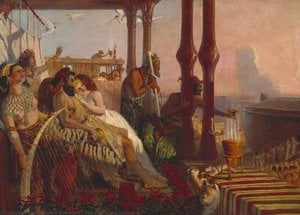
A Scottish Visionary: The Life and Art of William Bell Scott
William Bell Scott, born in Edinburgh in 1811, was a figure deeply embedded within the artistic currents of 19th-century Britain. More than simply a painter, he was a poet, an educator, and a keen observer of his time—a multifaceted artist whose work reflected both the romantic spirit of his upbringing and the burgeoning realities of the Industrial Revolution. Coming from an artistic family – his father, Robert Scott, was an engraver, and his brother David also pursued painting – young William’s path seemed predetermined, yet he forged a unique trajectory that blended historical narrative with contemporary life. His early training in Edinburgh provided a solid foundation, but it was his move to London in 1837 that truly ignited his artistic ambitions, coinciding with his marriage to Letitia Margery Norquoy. This relocation marked the beginning of a period of increasing recognition and engagement within the vibrant art scene of the capital.Newcastle, Industry, and the Pre-Raphaelite Circle
A pivotal moment in Scott’s career arrived in 1843 with his appointment as principal of the Government School of Art in Newcastle upon Tyne. This wasn't merely an administrative role; it was a twenty-year immersion into the heart of industrial England. Unlike many artists who shied away from depicting the changing landscape, Scott embraced it. He became one of the first British artists to systematically portray the processes and impact of the Industrial Revolution, recognizing its significance as a defining feature of his era. This fascination with industry wasn’t detached observation; it was interwoven with his personal life. His relationship with Alice Boyd, a student at the Newcastle School and sister to the Laird of Penkill Castle, began in 1860 with a visit to Penkill, blossoming into a long-lasting connection that profoundly influenced both his artistic output and his emotional landscape. Newcastle also brought him closer to the Pre-Raphaelite Brotherhood, particularly Dante Gabriel Rossetti, who famously painted Maria Leathart’s portrait at Scott's home, cementing their friendship and mutual influence.Murals, Ballads, and Historical Visions
Scott’s most celebrated works are undoubtedly the magnificent murals he created for Wallington Hall in Northumberland, now under the care of the National Trust. These expansive paintings aren’t simply historical illustrations; they are immersive narratives brought to life with dramatic intensity. Eight large compositions depict scenes from border history, populated by figures rendered at life-size, creating a powerful sense of presence and immediacy. Complementing these grand historical visions are eighteen smaller panels illustrating the ballad of Chevy Chase within the hall's arches—a testament to Scott’s skill in blending epic storytelling with intricate detail. A similar historical cycle was undertaken for Penkill Castle in Scotland, where he illustrated James I’s allegorical poem *The Kingis Quair*. These projects demonstrate his ability to translate literary themes into visual form, imbuing them with a romantic sensibility and a meticulous attention to historical accuracy. While not primarily known as a portraitist, Scott's striking portrayal of Algernon Charles Swinburne remains an iconic image, capturing the poet’s complex character with remarkable insight.Legacy and Literary Pursuits
After 1870, Scott divided his time between London and Penkill, deepening his friendship with Rossetti and gaining recognition as both an artist and a man of letters. He wasn't without artistic disagreements; he famously clashed with John Ruskin over aesthetic principles. However, this intellectual friction only served to sharpen his own artistic vision. Beyond painting, Scott was a prolific writer, publishing volumes of poetry – notably *Poems* in 1875, beautifully illustrated with his own etchings – and engaging in art and literary criticism. His poetic voice drew inspiration from the Romantic poets William Blake and Percy Bysshe Shelley, while also bearing the unmistakable influence of Rossetti’s lyrical style. In his later years, Scott dedicated himself to writing his *Autobiographical Notes*, published posthumously in 1892 with a memoir by Professor Minto. These reminiscences offer an invaluable glimpse into the world of Pre-Raphaelite artists and provide a candid account of his own artistic journey. William Bell Scott’s historical significance lies not only in his pioneering depictions of the Industrial Revolution but also in his role as a bridge between Romanticism, Pre-Raphaelitism, and the evolving artistic landscape of Victorian Britain. He remains a compelling figure—a Scottish visionary who captured the spirit of his age with both poetic grace and unflinching realism.Questions & Answers
Can I visit a virtual museum of William Bell Scott's works?
The 3D Museum of William Bell Scott is a page that displays the artist's artworks in a virtual three-dimensional gallery.
Where are William Bell Scott's artworks grouped by keywords?
To find works by William Bell Scott on a specific theme, use the artist's By Keywords page, which groups the artworks by keyword.
How did William Bell Scott's art evolve over time?
The Chronicle of William Bell Scott is a scroll-driven timeline that presents the artist's works in chronological order, grouped into career-period chapters.