Yoshitoshi, 1839 – 1892

The 100 Most Famous Paintings by Yoshitoshi

The painting that made Yoshitoshi famous is Kingio Hideaki From Kaidai Hyaku Senso. Asakusa and Tokugawa Iemitsu Receiving Lords in Audience (1875) follow it in the hearts of collectors and museum visitors. Of the 1,344 works by Yoshitoshi in our catalogue, these 100 are the most admired, each presented with its date, its museum and what sets it apart.

Ranked by our popularity score, which combines the searches, visits and orders for each work. Updated October 2026. Every masterpiece on this page can be ordered as a museum-quality, hand-painted oil reproduction or a fine art print, at the size you choose.

Portrait of Yoshitoshi
Yoshitoshi · 1839 – 1892
Born · died
1839 – 1892, Edo
Movement
Ukiyo-e
Works in our catalogue
1,344
Most famous
Kingio Hideaki From Kaidai Hyaku Senso
Most works at
Minneapolis Institute of Art

Yoshitoshi: the ten masterpieces

Kingio Hideaki From Kaidai Hyaku Senso by Yoshitoshi
1

Kingio Hideaki From Kaidai Hyaku Senso

Woodblock Print

The print’s enduring fascination stems from its ability to capture not just a moment in time but also the very essence of human experience during a pivotal era. Its haunting imagery continues to resonate with viewers today, cementing Yoshitoshi's legacy as one of Japan’s most profound artistic voices.

Asakusa by Yoshitoshi
2

Asakusa

Woodblock Print

Tsukioka Yoshitoshi's 1882 depiction of *Asakusa* is more than a simple street scene; it’s a poignant and powerfully rendered snapshot of a Japan on the cusp of profound transformation. Executed in the style quintessential Ukiyo-e, this woodblock print captures not just the physical appearance of the bustling district but also the anxieties, hopes, and ultimately, the melancholic beauty of a society grappling with rapid modernization. Yoshitoshi, considered the last great…

Tokugawa Iemitsu Receiving Lords in Audience (1875) by Yoshitoshi
3

Tokugawa Iemitsu Receiving Lords in Audience

1875 · Woodblock Print · Los Angeles County Museum of Art, Los Angeles

Tsukioka Yoshitoshi's "Tokugawa Iemitsu Receiving Lords in Audience," created in 1875, transcends mere visual representation; it embodies the anxieties and aspirations of Japan at a pivotal moment—the twilight of feudal rule and the dawn of modernization. Executed as a color woodblock print, this artwork exemplifies the zenith of *ukiyo-e*, demonstrating unparalleled detail and capturing an atmosphere steeped in formality and solemn contemplation. It’s more than just a depiction of a…

Okuko Hikozaemon Protects The Tokugawa Shogun From The Spear Of Goro Matabei Mototsugu by Yoshitoshi
4

Okuko Hikozaemon Protects The Tokugawa Shogun From The Spear Of Goro Matabei Mototsugu

Acrylic On Canvas

Dynamic Depiction of Heroism and Mythology This captivating artwork vividly captures a dramatic moment of heroism and mythic confrontation, set against a dark, nocturnal backdrop illuminated by a crescent moon. The scene is filled with intense action, depicting legendary warriors engaged in a fierce battle that embodies themes of bravery, conflict, and divine justice. The central figures, clad in detailed armor and traditional garments, evoke a sense of movement and…

Moon Over The Waters At Daimotsu Bay by Yoshitoshi
5

Moon Over The Waters At Daimotsu Bay

Woodblock Print

Moon Over The Waters At Daimotsu Bay is a significant woodblock print by the Japanese artist Yoshitoshi. This work belongs to his celebrated series, One Hundred Aspects of the Moon, also known as Tsuki hyakkei. Published between 1885 and 1892, the series represents a profound period in the artist's career, capturing a unique intersection of traditional aesthetics and the shifting social landscape of the Meiji era.

Uesugi Kenshin Nyudo Terutora Riding into Battle (1883) by Yoshitoshi
6

Uesugi Kenshin Nyudo Terutora Riding into Battle

1883 · Acrylic · Los Angeles County Museum of Art, Los Angeles

Tsukioka Yoshitoshi’s “Uesugi Kenshin Nyudo Terutora Riding into Battle,” created in 1883, transcends mere depiction; it embodies the anxieties and aspirations of Japan during its pivotal transition from feudal rule to modernization. This monumental woodblock print isn't simply a record of military prowess; it’s a carefully crafted tableau brimming with symbolism that speaks volumes about the era’s psychological landscape.

Komori No Godan by Yoshitoshi
7

Komori No Godan

Woodblock Print

Tsukioka Yoshitoshi’s “Komori No Godan” – literally “Six Bats Under the Umbrella” – is more than just a captivating image; it's a poignant meditation on mortality, protection, and the enduring spirit of Japanese folklore. Executed in stark monochrome with the meticulous precision characteristic of Ukiyo-e woodblock prints, this artwork transports the viewer to a world steeped in layered meaning and evocative atmosphere. Created during a period of immense social change…

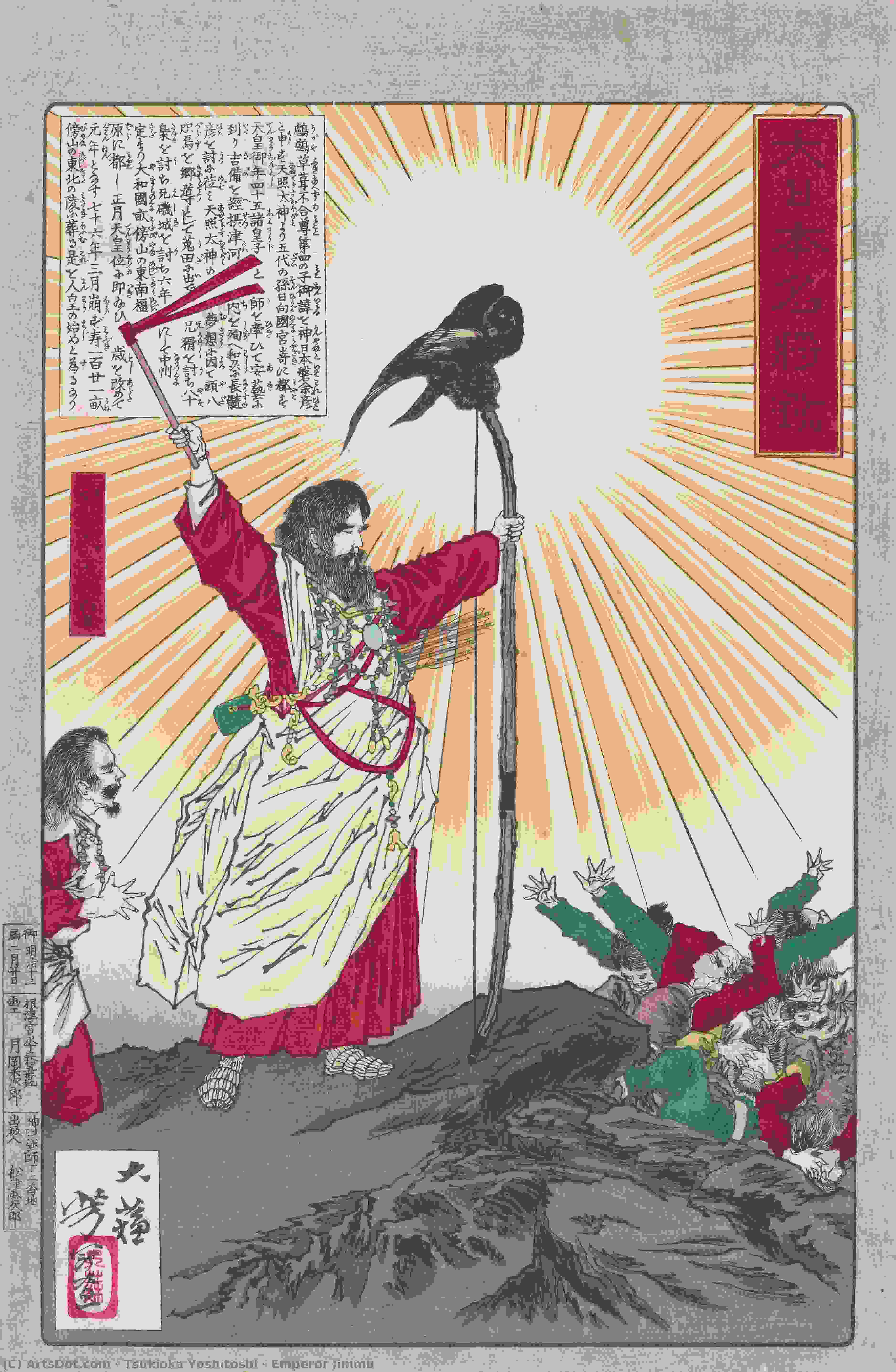
Emperor Jimmu by Yoshitoshi
8

Emperor Jimmu

Acrylic On Canvas

Tsukioka Yoshitoshi, a luminary of Japan’s Edo period (1603-1868), transcends mere artistic representation; he crafts narratives that breathe life into history. “Emperor Jimmu,” showcased as a meticulously crafted oil reproduction on AllPaintingsStore.com, isn’t simply a depiction of legend—it's an embodiment of Japan’s enduring spirit and Yoshitoshi’s unparalleled artistic vision.

Sadanobu Threatening A Demon In The Palace At Night by Yoshitoshi
9

Sadanobu Threatening A Demon In The Palace At Night

Acrylic On Canvas

A Dramatic Confrontation: Unveiling "Sadanobu Threatening A Demon In The Palace At Night" This striking black and white woodblock print, “Sadanobu Threatening a Demon in the Palace at Night,” is a powerful example of late 19th-century *ukiyo-e* art by Tsukioka Yoshitoshi. It depicts a tense and dramatic scene within a richly decorated palace setting, showcasing a warrior – likely Sadanobu – confronting a fearsome demon. The composition immediately draws the…

Restaurant by Yoshitoshi
10

Restaurant

Acrylic On Canvas

A Moment of Urban Life: Tsukioka Yoshitoshi’s “Restaurant” Tsukioka Yoshitoshi's "Restaurant" offers a captivating glimpse into 19th-century Japan, showcasing the artist’s mastery of ukiyo-e, or “pictures of the floating world.” This woodblock print depicts two elegantly dressed women pausing before a bustling restaurant. The scene isn’t grand or heroic; instead, it captures an everyday moment – a stroll through town, perhaps a planned meal, or simply observing the vibrant energy…

More Yoshitoshi masterpieces, 11 to 100

Woman With Iris by Yoshitoshi
#11

Woman With Iris

A woman stands at the center of a tranquil gathering, her long black hair cascading down her shoulders like ink spilled upon silk. She holds a branch of…

Order a reproduction →
January: Celebrating the New Year (1860) by Yoshitoshi
#16

January: Celebrating the New Year

1860 · Los Angeles County Museum of Art

January: Celebrating the New Year is a woodblock print created by Yoshitoshi in 1860. The artist, born in Edo, Japan, in 1839, lived through the transition from the…

Bring it home →
Sumidagawa- Koji Of Umewaka by Yoshitoshi
#21

Sumidagawa- Koji Of Umewaka

The artwork Sumidagawa-Koji Of Umewaka is a handmade oil reproduction that presents three distinct scenes within a single composition. The visual narrative unfolds through several figures engaged in…

Order a reproduction →
Comic Picture by Yoshitoshi
#22

Comic Picture

Tsukioka Yoshitoshi's "Comic Picture" is not simply a collection of images; it’s a poignant and unsettling window into the final decades of Edo-period Japan, a nation grappling with…

Order a reproduction →
Ariwara no Yukihira by Yoshitoshi
#51

Ariwara no Yukihira

Tsukioka Yoshitoshi's Ariwara no Yukihira, completed in the late 19th century, is more than just a depiction of three women on a moonlit beach; it’s a poignant meditation…

Order a reproduction →
Benkei And The Wave by Yoshitoshi
#58

Benkei And The Wave

Tsukioka Yoshitoshi’s “Benkei and the Wave” is more than just a depiction of a legendary warrior; it's a visceral embodiment of human resilience against overwhelming natural forces. This…

Bring it home →

Yoshitoshi's paintings by period

The subjects Yoshitoshi painted most

The four subjects that return most often among these masterpieces, with the finest example of each.

Where to see Yoshitoshi's paintings

The 4 museums that hold the most of the paintings on this page.

Museum City Works by Yoshitoshi Paintings from this list
Minneapolis Institute of Art, MinneapolisMinneapolis Institute of Art Minneapolis 4 Great Generals of the East and West, Great Generals of the East and West, Ghost
Los Angeles County Museum of Art, Los AngelesLos Angeles County Museum of Art Los Angeles 3 Tokugawa Iemitsu Receiving Lords in Audience, Uesugi Kenshin Nyudo Terutora Riding into Battle, January: Celebrating the New Year
Metropolitan Museum of Art, New YorkMetropolitan Museum of Art New York 2 The Spirit of the Deceased Yūgao Entwined in Moonflower Vines, based on the print “The Lady of the Evening Faces,” from the series One Hundred Aspects of the Moon (Tsuki hyakushi: Genji Yūgao no maki), Murasaki Shikibu at Ishiyamadera Temple, based on the print “The Moon at Ishiyama,” from the series One Hundred Aspects of the Moon (Tsuki hyakushi: Ishiyama no tsuki)
The Smithsonian’s National Museum of Asian Art, Washington, D.C.The Smithsonian’s National Museum of Asian Art Washington, D.C. 1 Kiyohime changing into a serpent at Hidaka River, from the series New Forms of Thirty-six Ghosts

Yoshitoshi, decade by decade: the defining painting of each

  1. 1860s
    January: Celebrating the New Year (1860) by Yoshitoshi
    Rank 16 / 100

    January: Celebrating the New Year

    Age 21 – 30 · Los Angeles County Museum of Art

    January: Celebrating the New Year is a woodblock print created by Yoshitoshi in 1860. The artist, born in Edo, Japan, in 1839, lived through the transition from the…

  2. 1870s
    Tokugawa Iemitsu Receiving Lords in Audience (1875) by Yoshitoshi
    #3 of 100

    Tokugawa Iemitsu Receiving Lords in Audience

    Age 31 – 40 · Los Angeles County Museum of Art

    Tsukioka Yoshitoshi's "Tokugawa Iemitsu Receiving Lords in Audience," created in 1875, transcends mere visual representation; it embodies the anxieties and aspirations of Japan at a pivotal moment—the twilight…

  3. 1880s
    Uesugi Kenshin Nyudo Terutora Riding into Battle (1883) by Yoshitoshi
    Rank 6 / 100

    Uesugi Kenshin Nyudo Terutora Riding into Battle

    Age 41 – 50 · Los Angeles County Museum of Art

    Tsukioka Yoshitoshi’s “Uesugi Kenshin Nyudo Terutora Riding into Battle,” created in 1883, transcends mere depiction; it embodies the anxieties and aspirations of Japan during its pivotal transition from…

  4. 1890s

Yoshitoshi's masterpieces: questions and answers

Which painting is Yoshitoshi best known for?Show the answer

Kingio Hideaki From Kaidai Hyaku Senso. Next come Asakusa and Tokugawa Iemitsu Receiving Lords in Audience (1875).

What are Yoshitoshi's ten greatest paintings?Show the answer

Kingio Hideaki From Kaidai Hyaku Senso, Asakusa, Tokugawa Iemitsu Receiving Lords in Audience, Okuko Hikozaemon Protects The Tokugawa Shogun From The Spear Of Goro Matabei Mototsugu, Moon Over The Waters At Daimotsu Bay, Uesugi Kenshin Nyudo Terutora Riding into Battle, Komori No Godan, Emperor Jimmu, Sadanobu Threatening A Demon In The Palace At Night and Restaurant. The ranking above gives the year and the museum of each.

How many works did Yoshitoshi paint?Show the answer

Our catalogue lists 1,344 works by Yoshitoshi, dated from 1860 to 1892.

In which museums can I see Yoshitoshi's masterpieces?Show the answer

Most of them are in Minneapolis Institute of Art (Minneapolis), Los Angeles County Museum of Art (Los Angeles) and Metropolitan Museum of Art (New York). The table above lists the museums one by one.

When did Yoshitoshi paint the masterpieces?Show the answer

In 1880s: 5 of the 100 works on this page date from then, among them Uesugi Kenshin Nyudo Terutora Riding into Battle.

What are the first and last famous paintings of Yoshitoshi?Show the answer

The earliest on this page is January: Celebrating the New Year (1860), the latest The Spirit of the Deceased Yūgao Entwined in Moonflower Vines, based on the print “The Lady of the Evening Faces,” from the series One Hundred Aspects of the Moon (Tsuki hyakushi: Genji Yūgao no maki) (1892).

What were Yoshitoshi's favourite subjects?Show the answer

Japanese art (15), Traditional japan (15) and Warrior (11), among the 100 works on this page.

Which technique did Yoshitoshi favour?Show the answer

Woodblock Print: 12 of the 100 works on this page.

What art movement is Yoshitoshi part of?Show the answer

Ukiyo-e, as the paintings on this page show.

Which masterpieces by Yoshitoshi hang at the Minneapolis Institute of Art?Show the answer

Great Generals of the East and West, Great Generals of the East and West and Ghost are among the 4 works on this page held by the Minneapolis Institute of Art, Minneapolis.

Can I own a reproduction of a Yoshitoshi masterpiece?Show the answer

Yes. Every painting on this page can be ordered as a museum-quality, hand-painted oil reproduction or a fine art print, in the size you choose, from the painting's own page.

The life of Yoshitoshi

The Life and Identity of Tsukioka Yoshitoshi

Born Owariya Yonejiro on 30 April 1839, the man who would become known as Tsukioka Yoshitoshi entered a world in flux. He was raised in the Shimbashi district of old Edo, which is known today as Tokyo. His life was marked by a transition in identity, as he also used the name Taiso Yoshitoshi. He lived through the end of the Edo period and the beginning of the Meiji era, a time when the very fabric of Japanese society was being rewoven by rapid modernization and Western influence.

His career as a Japanese printmaker was defined by a constant struggle to maintain the traditions of his craft while the world around him moved toward new technologies like photography. He worked with a deep sense of purpose, often focusing on the tension between the old ways and the new. This period of upheaval was not merely a backdrop for his art; it was the environment that shaped his perspective and his ability to capture the human condition during a time of profound social change.

The end of his life came unexpectedly at the age of 53. He died on 9 June 1892, following a cerebral hemorrhage. He left behind a significant body of work that documented the shifting landscape of his country, capturing both the quiet moments of daily life and the intense drama of historical legends.

Early Life, Family and Training

Born Owariya Yonejiro in the Shimbashi district of old Edo, the boy who would become Yoshitoshi grew up in a household shaped by social ambition. His father was a wealthy merchant who had successfully purchased his way into samurai status, providing a life of relative stability. However, the family structure changed early on. At the age of three, he left his home to live with his uncle, a pharmacist who had no son of his own. This change in environment would prove fundamental to his development.

By the age of five, he began to show a clear interest in art. He spent his childhood taking lessons from his uncle, finding a sense of purpose in the act of creation. This early instruction provided the foundation for a formal path in the traditional arts. In 1850, at the age of 11, he entered a rigorous apprenticeship under the master Utagawa Kuniyoshi. It was during this time that his mentor gave him the name Yoshitoshi, marking his official entry into the Utagawa School.

Technique and Artistic Style

Yoshitoshi’s hand moved with a precision that captured the very essence of a changing Japan. He was a pioneer in using new printmaking techniques, constantly seeking ways to achieve finer details and more intense colors. His work often blended traditional Japanese aesthetics with Western influences that arrived during the Meiji era. This fusion allowed him to create complex compositions that felt both grounded in history and strikingly modern. He had a particular talent for depicting movement, making a static woodblock print feel as though it were caught in a single, fleeting moment of action.

His subject matter often drifted between the historical and the mythological. He could render a legendary warrior with a sense of psychological depth, or portray a supernatural creature with startling realism. This ability to convey deep emotion was central to his style. Whether he was depicting a scene of quiet contemplation or a moment of intense struggle, his prints carried a weight of feeling that resonated with his audience. He did not rely on mere decoration; instead, he used vivid colors and sharp lines to pull the viewer into the narrative of the print.

  • Saito Oniwakamaru on a Carp (1839–1892)
  • The Battle of Okehazama (1866)
  • The Death of Kiyomori (1883)

Key Works and Famous Series

Yoshitoshi’s output often mirrored the heavy, unsettled atmosphere of the era he lived through. In 1866, he produced a series of prints known as Muzan-e, often called "bloody prints." These works focused on graphic violence and death, reflecting the social unrest and personal tragedies that marked his life. He moved between these darker themes and more narrative-driven subjects, such as his series Tsūzoku saiyūki, also known as A Modern Journey to the West. He also looked toward folklore and legend in Wakan hyaku monogatari, or One Hundred Stories of China and Japan.

As the years passed, his focus shifted toward more contemplative and varied subjects. Between 1885 and 1892, he worked on One Hundred Aspects of the Moon, a series that explored the moon through different perspectives. His later years also saw the creation of New Forms of 36 Spirits between 1889 and 1892, and 32 Aspects of Women in 1888. These series demonstrate his ability to handle both the supernatural and the human form with a sense of psychological depth.

Legacy and Enduring Influence

Yoshitoshi’s career acted as a bridge between two eras, spanning the final years of the Edo period and the dawn of the Meiji era. He lived through a time when the old social structures were dissolving and Western influences were beginning to reshape Japanese life. While many artists struggled to find their footing amidst this rapid change, he was recognized as one of the form's greatest innovators. His ability to adapt his craft to a changing world allowed him to remain relevant even as traditional woodblock printing faced new competition from photography and lithography.

His standing in the art community was solidified by his skill and his lineage. He is now recognized as the most important pupil of Kuniyoshi, having taken the lessons of his master and pushed them into new directions. By 1885, his prominence was undeniable when he was ranked as the number-one ukiyo-e artist in Tokyo. He did not merely follow the traditions of the Utagawa School; he expanded them, bringing a sense of psychological depth to his subjects that helped define the twilight of the ukiyo-e genre.

  • Musha Burui
  • One Hundred Aspects of the Moon
  • New Forms of Thirty-six Spirits

All 1344 works by Yoshitoshi →