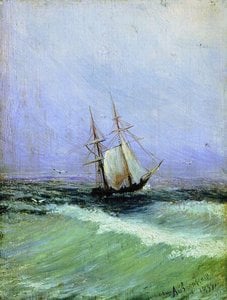
Ivan Aivazovsky, 1817 – 1900

Ivan Aivazovsky: The 100 Most Famous Paintings

The Ninth Wave (1850) is the most famous painting by Ivan Aivazovsky. View of Constantinople and the Bosporus and Jesus walks on water (1888) are the next two works the world knows best. From the 1,123 works of Ivan Aivazovsky in our catalogue, here are the 100 that collectors and museum visitors look at most, with the year, the museum and the story of each.

Ranked by our popularity score, which combines the searches, visits and orders for each work. Updated October 2026. Every masterpiece on this page can be ordered as a museum-quality, hand-painted oil reproduction or a fine art print, at the size you choose.

Portrait of Ivan Aivazovsky
Ivan Aivazovsky · 1817 – 1900
Born · died
1817 – 1900, Feodosiia
Movement
Romanticism
Works in our catalogue
1,123
Most famous
The Ninth Wave (1850)
Most works at
Tretyakov Gallery

Top 10: Ivan Aivazovsky's best-known paintings

The Ninth Wave (1850) by Ivan Aivazovsky
1

The Ninth Wave

1850 · Oil On Canvas

Ivan Aivazovsky's *The Ninth Wave* is a masterpiece of Romanticism that captures the raw and untamed power of nature. Created in 1850, this monumental seascape depicts a dramatic scene of survival and struggle against the elements. The painting showcases Aivazovsky's unparalleled ability to convey the sublime beauty and terrifying force of the ocean, making it one of his most celebrated works.

Hand-painted oil reproduction from $181 39 × 26 cm
View of Constantinople and the Bosporus by Ivan Aivazovsky
2

View of Constantinople and the Bosporus

Oil On Canvas

To gaze upon Ivan Aivazovsky's depiction of the View of Constantinople and the Bosporus is to be swept away by an oceanic breath, a moment suspended between day and night. This painting transcends mere landscape; it is an immersion into the very soul of maritime life and the enduring spirit of a great city. The composition unfolds with breathtaking breadth, drawing the viewer's eye across the vast expanse where the…

Hand-painted oil reproduction from $206 40 × 25 cm
Jesus walks on water (1888) by Ivan Aivazovsky
3

Jesus walks on water

1888 · Oil On Canvas

Aivazovsky's "Jesus Walks on Water": A Tempest of Faith Ivan Konstantinovich Aivazovsky’s “Jesus Walks on Water,” painted in 1888, is more than a depiction of a biblical scene; it’s an immersive experience of raw power and spiritual awe. Born in Feodosia, Russia, Aivazovsky dedicated his life to capturing the soul of the Black Sea – its capricious moods, its breathtaking grandeur, and its inherent danger. This painting exemplifies his mastery,…

Hand-painted oil reproduction from $281 28 × 36 cm
Creation of the World (1864) by Ivan Aivazovsky
4

Creation of the World

1864 · Acrylic On Canvas

Ivan Konstantinovich Aivazovsky’s “Creation of the World,” painted in 1864, is not merely a seascape; it’s a profound meditation on creation itself. This monumental canvas – measuring 196 x 233 cm – captures a moment of primordial chaos and nascent life, rendered with the masterful technique that cemented Aivazovsky's reputation as the “Wave Master” of Russian art. The scene unfolds beneath a dramatically lit sky, bruised with swirling clouds and…

Hand-painted oil reproduction from $181 35 × 29 cm Same size as the original $1517 233 × 196 cm Order at original size →
The Bay of Naples at moonlit night. Vesuvius (1840) by Ivan Aivazovsky
5

The Bay of Naples at moonlit night. Vesuvius

1840 · Oil On Canvas

To gaze upon Ivan Konstantinovich Aivazovsky’s “The Bay of Naples at Moonlit Night. Vesuvius” is to be instantly enveloped in a profound sense of tranquility, a moment suspended between the day's vibrant activity and the deep embrace of nocturnal slumber. This masterpiece is far more than a mere topographical record of the Italian coastline; it is an emotional landscape where the drama of nature meets the quiet poetry of human…

Hand-painted oil reproduction from $181 28 × 36 cm
Seacape with Full Moon by Ivan Aivazovsky
6

Seacape with Full Moon

Acrylic On Canvas · Sakıp Sabancı Museum, Istanbul

Ivan Konstantinovich Aivazovsky's "Seascape with Full Moon" is more than just a depiction of a nighttime ocean; it’s a profound meditation on the sublime power of nature, rendered with an almost hallucinatory intensity. Painted around 1857-1858, during his peak period of artistic output, this work exemplifies Aivazovsky's signature style – a masterful blend of Romanticism and meticulous realism that captured the very essence of the sea. The painting immediately draws…

Hand-painted oil reproduction from $181 39 × 26 cm
Deluge (1864) by Ivan Aivazovsky
7

Deluge

1864 · Oil On Canvas

In the grand tradition of Romanticism, Ivan Konstantinovich Aivazovsky’s Deluge stands as a breathtaking testament to the untamable spirit of the ocean. This monumental oil on canvas, measuring an imposing 247 x 369 cm, does not merely depict a storm; it invites the viewer to stand upon the precipice of nature's most violent crescendo. The scene is one of profound drama, where the churning, dark waters of a tempestuous sea…

Hand-painted oil reproduction from $181 36 × 28 cm
The Bay of Naples at moonlit night. Vesuvius (1870) by Ivan Aivazovsky
8

The Bay of Naples at moonlit night. Vesuvius

1870 · Oil On Canvas

To gaze upon this depiction of The Bay of Naples at moonlit night is to be enveloped in a profound sense of tranquility, a moment suspended between the day's activity and the deep embrace of slumber. Ivan Konstantinovich Aivazovsky, master chronicler of maritime moods, has gifted us more than just a seascape; he has captured an atmosphere—the very breath of the Mediterranean under a luminous, celestial gaze. The full moon…

Hand-painted oil reproduction from $181 38 × 27 cm
Between the waves (1898) by Ivan Aivazovsky
9

Between the waves

1898 · Oil On Canvas · Feodosia National Gallery I. K. Aivazovsky, Feodosiia

Aivazovsky wasn't simply recording a seascape; he was channeling a profound emotional response to it. The surging waves symbolize the overwhelming forces of nature, reminding us of our own vulnerability and insignificance in the face of such power. The vastness of the ocean depicted evokes feelings of awe, wonder, and perhaps even a touch of melancholy – common themes within Romantic art. The composition itself contributes to this emotional impact;…

Hand-painted oil reproduction from $181 39 × 26 cm Same size as the original $345 97 × 66 cm Order at original size →
Battle of Cesme at Night (1848) by Ivan Aivazovsky
10

Battle of Cesme at Night

1848 · Acrylic On Canvas

A Nightstorm Unleashed: Decoding Ivan Aivazovsky’s Battle of Cesme The painting “Battle of Cesme at Night” by Ivan Konstantinovich Aivazovsky isn't merely a depiction of naval warfare; it’s an immersive experience into the turbulent heart of Romanticism itself. Completed in 1848, this monumental canvas – measuring 193 x 183 cm – transcends simple representation, striving instead to convey the visceral drama and emotional intensity characteristic of its era. It's a…

Hand-painted oil reproduction from $181 31 × 33 cm Same size as the original $1210 183 × 193 cm Order at original size →

The rest of the Ivan Aivazovsky ranking, 11 to 100

Battle of Sinop (1853) by Ivan Aivazovsky
#14

Battle of Sinop

1853

A Tempestuous Triumph: Aivazovsky’s Battle of Sinop Subject Matter Artist Date Size Ivan Konstantinovich Aivazovsky's "Battle of Sinop" is a monumental depiction of the pivotal naval engagement that…

Order a reproduction from $181 →
Stormy Sea. (1868) by Ivan Aivazovsky
#15

Stormy Sea.

1868 · Tretyakov Gallery

Ivan Aivazovsky’s Stormy Sea is a breathtaking example of Romantic marine art. Created in 1868, the painting vividly portrays two boats navigating turbulent waters beneath a menacing stormy…

Order a reproduction from $331 →
Rocky Cliffs by Ivan Aivazovsky
#16

Rocky Cliffs

Sakıp Sabancı Museum

“Rocky Cliffs,” painted by Ivan Konstantinovich Aivazovsky in 1891, isn’t merely a landscape; it’s an immersive experience. The canvas explodes with the raw energy of the Black Sea,…

Order a reproduction from $181 →
Moon Night (1885) by Ivan Aivazovsky
#20

Moon Night

1885

Ivan Konstantinovich Aivazovsky's “Moon Night” is more than just a depiction of a seascape; it’s an immersion into the very soul of the sea itself. Painted in 1885,…

Bring it home from $181 →
A Lunar night on the Bosphorus (1894) by Ivan Aivazovsky
#22

A Lunar night on the Bosphorus

1894 · Tretyakov Gallery

Aivazovsky’s technique is characterized by loose, expressive brushstrokes that contribute significantly to the painting’s dynamic quality. He employed a layering method – *glazing* – building up color gradually…

Bring it home from $181 →
Bay of Naples (1845) by Ivan Aivazovsky
#25

Bay of Naples

1845

To gaze upon this depiction of the Bay of Naples at sunset is to surrender to a moment suspended in amber light. Ivan Konstantinovich Aivazovsky, master chronicler of…

Bring it home from $181 →
Sea view (1895) by Ivan Aivazovsky
#26

Sea view

1895

is an oil painting executed by Ivan Aivazovsky in 1895. The work belongs to the artist's late period, produced during a time when his technical command of maritime…

Bring it home from $181 →
Storm (1880) by Ivan Aivazovsky
#35

Storm

1880 · Sakıp Sabancı Museum

The atmosphere hangs heavy with the scent of salt and impending chaos. A vast, dark expanse of clouds dominates the upper two-thirds of the canvas, pressing down upon…

Order a reproduction from $181 →
The Rainbow. (1873) by Ivan Aivazovsky
#44

The Rainbow.

1873 · Tretyakov Gallery

To gaze upon Ivan Konstantinovich Aivazovsky’s 1873 masterpiece, “The Rainbow,” is to witness a profound dialogue between the heavens and the sea. Aivazovsky, a titan of Romantic marine…

Order a reproduction from $181 →
The Battle of Navarino (1846) by Ivan Aivazovsky

In the grand tradition of Romanticism, Ivan Konstantinovich Aivazovsky’s The Battle of Navarino stands as a monumental testament to the sublime power of both nature and human conflict.…

Bring it home from $181 →
Sea coast (1840) by Ivan Aivazovsky
#47

Sea coast

1840 · Tretyakov Gallery

In the quietude of 1840, Ivan Konstantinovich Aivazovsky captured a moment that transcends mere landscape, offering instead a window into the very soul of the maritime world. His…

Commission a hand-painted copy from $181 →
Tempest. Sunset (1856) by Ivan Aivazovsky
#48

Tempest. Sunset

1856

Ivan Aivazovsky’s “Tempest. Sunset,” painted in 1856, is a breathtaking representation of the ocean's raw power and sublime beauty. This oil on canvas masterpiece, measuring 67 x 89…

Bring it home from $181 →
Sea view (1841) by Ivan Aivazovsky
#50

Sea view

1841

To stand before Ivan Aivazovsky’s "Sea view," is not merely to observe a painting; it is to be enveloped by the very breath of the ocean itself. This…

Bring it home from $181 →
Ocean (1896) by Ivan Aivazovsky
#51

Ocean

1896

In the hauntingly beautiful masterpiece Ocean, painted in 1896, Ivan Konstantinovich Aivazovsky invites the viewer into a realm where the boundary between the heavens and the abyss dissolves.…

Order a reproduction from $181 →
The sunset (1866) by Ivan Aivazovsky
#53

The sunset

1866

This captivating seascape, painted in 1866 by the titan of Russian Romanticism, Ivan Konstantinovich Aivazovsky, transcends a simple depiction of a sailboat; it’s an immersive experience of the…

Order a reproduction from $181 →
Tempest (1850) by Ivan Aivazovsky
#55

Tempest

1850

Ivan Konstantinovich Aivazovsky’s “Tempest” is not merely a depiction of a storm at sea; it is an immersive experience, a visceral confrontation with the untamed power of nature.…

Order a reproduction from $181 →
Wave. Two Ships by Ivan Aivazovsky
#58

Wave. Two Ships

National Gallery of Armenia

In the painting Wave. Two Ships, Ivan Aivazovsky captures a moment of maritime tension. The scene unfolds with a focus on the interaction between the sea and the…

Order a reproduction from $206 →
Marina (1892) by Ivan Aivazovsky
#67

Marina

1892

A Moment of Maritime Drama: Ivan Aivazovsky's "Marina" This captivating oil painting, “Marina,” by the renowned Russian Romantic artist Ivan Aivazovsky, transports viewers to a scene of dynamic…

Commission a hand-painted copy from $181 →
Seashore. (1840) by Ivan Aivazovsky
#70

Seashore.

1840 · Tretyakov Gallery

Ivan Konstantinovich Aivazovsky's "Seashore," painted in 1840, isn’t merely a depiction of a seascape; it’s an immersive experience, a visceral journey into the heart of the Black Sea.…

Bring it home from $181 →
Odessa (1840) by Ivan Aivazovsky
#77

Odessa

1840 · Pushkin State Museum

Ivan Aivazovsky's "Odessa," painted in 1840, isn’t merely a depiction of a coastal city; it’s an immersive experience. The canvas breathes with the salty air of the Black…

Commission a hand-painted copy from $181 →
Darial Gorge (1862) by Ivan Aivazovsky
#86

Darial Gorge

1862

The painting Darial Gorge presents a dramatic and atmospheric landscape defined by towering, dark, and imposing cliffs that dominate the composition. A deep gorge is carved through these…

Bring it home from $181 →
Venice (1874) by Ivan Aivazovsky
#91

Venice

1874

The painting Venice by Ivan Aivazovsky is a breathtaking representation of the city at sunset. Created in 1874, this oil on canvas masterpiece measures 130 x 170 cm…

Bring it home from $181 →
Wave (1889) by Ivan Aivazovsky
#98

Wave

1889

The work before us is Wave, an oil on canvas painting executed by Ivan Aivazovsky in 1889. It belongs to the genre of marine art, functioning as a…

Bring it home from $181 →

Ivan Aivazovsky's paintings by period

The subjects Ivan Aivazovsky painted most

The four subjects that return most often among these masterpieces, with the finest example of each.

Where to see Ivan Aivazovsky's paintings

The 8 museums that hold the most of the paintings on this page.

Museum City Works by Ivan Aivazovsky Paintings from this list
Tretyakov Gallery, MoscowTretyakov Gallery Moscow 17 Stormy Sea., A Lunar night on the Bosphorus, The Rainbow.
National Gallery of Armenia, YerevanNational Gallery of Armenia Yerevan 25 Moonlit Night (1958), Sea on a moonlit night, Wave. Two Ships
Feodosia National Gallery I. K. Aivazovsky, FeodosiiaFeodosia National Gallery I. K. Aivazovsky Feodosiia 31 Between the waves, Portrait of the Artist's Wife Anna Burnazyan, The Island of Rhodes
The State Russian Museum, St. PetersburgThe State Russian Museum St. Petersburg 20 Peter the First to light out a watch fire, View of Constantinople by Moonlight, A Lunar night in the Crimea
Sakıp Sabancı Museum, IstanbulSakıp Sabancı Museum Istanbul 5 Seacape with Full Moon, Rocky Cliffs, Storm
Yekaterinburg Museum of Fine Arts, YekaterinburgYekaterinburg Museum of Fine Arts Yekaterinburg 3 Moonlit Night
Hermitage Museum, Saint PetersburgHermitage Museum Saint Petersburg 2 Ship in the Stormy Sea
Nikanor Onatsky Regional Art Museum in Sumy, SumyNikanor Onatsky Regional Art Museum in Sumy Sumy 1 Moonlit Night on the Crimea. Gurzuf

Ivan Aivazovsky through the decades: one masterpiece for each

  1. 1830s
    Moonlit Night on the Crimea. Gurzuf (1839) by Ivan Aivazovsky
    #32 of 100

    Moonlit Night on the Crimea. Gurzuf

    Age 13 – 22 · Nikanor Onatsky Regional Art Museum in Sumy

    The painting Moonlit Night on the Crimea. Gurzuf by Ivan Aivazovsky is a breathtaking example of Romanticism in art. Created in 1839, this beautiful oil on canvas piece…

  2. 1840s
    The Bay of Naples at moonlit night. Vesuvius (1840) by Ivan Aivazovsky
    Rank 5 / 100

    The Bay of Naples at moonlit night. Vesuvius

    Age 23 – 32

    To gaze upon Ivan Konstantinovich Aivazovsky’s “The Bay of Naples at Moonlit Night. Vesuvius” is to be instantly enveloped in a profound sense of tranquility, a moment suspended…

  3. 1850s
    The Ninth Wave (1850) by Ivan Aivazovsky
    #1 of 100

    The Ninth Wave

    Age 33 – 42

    Ivan Aivazovsky's *The Ninth Wave* is a masterpiece of Romanticism that captures the raw and untamed power of nature. Created in 1850, this monumental seascape depicts a dramatic…

  4. 1860s
    Creation of the World (1864) by Ivan Aivazovsky
    #4 of 100

    Creation of the World

    Age 43 – 52

    Ivan Konstantinovich Aivazovsky’s “Creation of the World,” painted in 1864, is not merely a seascape; it’s a profound meditation on creation itself. This monumental canvas – measuring 196…

  5. 1870s
    The Bay of Naples at moonlit night. Vesuvius (1870) by Ivan Aivazovsky
    #8 of 100

    The Bay of Naples at moonlit night. Vesuvius

    Age 53 – 62

    To gaze upon this depiction of The Bay of Naples at moonlit night is to be enveloped in a profound sense of tranquility, a moment suspended between the…

  6. 1880s
    Jesus walks on water (1888) by Ivan Aivazovsky
    Rank 3 / 100

    Jesus walks on water

    Age 63 – 72

    Aivazovsky's "Jesus Walks on Water": A Tempest of Faith Ivan Konstantinovich Aivazovsky’s “Jesus Walks on Water,” painted in 1888, is more than a depiction of a biblical scene;…

  7. 1890s
    Between the waves (1898) by Ivan Aivazovsky
    No. 9 of 100

    Between the waves

    Age 73 – 82 · Feodosia National Gallery I. K. Aivazovsky

    Aivazovsky wasn't simply recording a seascape; he was channeling a profound emotional response to it. The surging waves symbolize the overwhelming forces of nature, reminding us of our…

Ivan Aivazovsky's paintings: frequently asked questions

What is the most famous Ivan Aivazovsky painting?Show the answer

The Ninth Wave (1850). Next come View of Constantinople and the Bosporus and Jesus walks on water (1888).

At what age did Ivan Aivazovsky paint The Ninth Wave?Show the answer

33 years old: The Ninth Wave dates from 1850 and Ivan Aivazovsky was born in 1817.

Which are the 10 most famous Ivan Aivazovsky paintings?Show the answer

The Ninth Wave, View of Constantinople and the Bosporus, Jesus walks on water, Creation of the World, The Bay of Naples at moonlit night. Vesuvius, Seacape with Full Moon, Deluge, The Bay of Naples at moonlit night. Vesuvius, Between the waves and Battle of Cesme at Night. The ranking above gives the year and the museum of each.

How many paintings by Ivan Aivazovsky are there?Show the answer

Our catalogue lists 1,123 works by Ivan Aivazovsky, dated from 1837 to 1898.

Where can I see the most famous Ivan Aivazovsky paintings?Show the answer

Most of them are in Tretyakov Gallery (Moscow), National Gallery of Armenia (Yerevan) and Feodosia National Gallery I. K. Aivazovsky (Feodosiia). The table above lists the museums one by one.

In which period did Ivan Aivazovsky paint the best-known works?Show the answer

In 1840s: 23 of the 100 works on this page date from then, among them The Bay of Naples at moonlit night. Vesuvius.

What is the earliest famous Ivan Aivazovsky painting, and the latest?Show the answer

The earliest on this page is Windmill on the Sea Coast. (1837), the latest Between the waves (1898).

What subjects did Ivan Aivazovsky paint?Show the answer

Seascape (27), Boats (22) and Ocean (14), among the 100 works on this page.

What did Ivan Aivazovsky paint on, and with what?Show the answer

Oil On Canvas: 82 of the 100 works on this page.

Which movement does Ivan Aivazovsky's art belong to?Show the answer

Romanticism, as the paintings on this page show.

What Ivan Aivazovsky paintings does the Tretyakov Gallery hold?Show the answer

Stormy Sea., A Lunar night on the Bosphorus and The Rainbow. are among the 7 works on this page held by the Tretyakov Gallery, Moscow.

Where can I buy a Ivan Aivazovsky reproduction?Show the answer

Yes. Every painting on this page can be ordered as a museum-quality, hand-painted oil reproduction or a fine art print, in the size you choose, from the painting's own page.

Ivan Aivazovsky: biography

Early Life, Family and Training

To understand the technical precision of Ivan Konstantinovich Aivazovsky, one must look to his origins in the Crimean port of Feodosia. Born on 29 July [O.S. 17 July] 1817, he was raised in an Armenian family. His baptismal name, Hovhannes, son of Gevorg Aivazian, reflects a specific cultural lineage that preceded his emergence in the Russian imperial art scene. This early environment, defined by the constant presence of the Black Sea, provided the raw material for a career that would eventually dominate marine painting.

His formal development was not a matter of chance but the result of rigorous academic instruction. He moved from the coastal realities of Feodosia to the Imperial Academy of Arts in Saint Petersburg. It was here that his talent was refined through disciplined study. Under the guidance of the landscape painter Maxim Vorobyov, Aivazovsky acquired the foundational skills necessary to translate the movement of water and light onto canvas. This training provided the structural logic behind his later, more dramatic compositions.

Travels and Italian Influence

Aivazovsky’s time in Italy during the early 1840s changed his trajectory. It was here that he transitioned from his student identity to the name Aivazovsky, a shift that coincided with his growing recognition in Europe. This period provided more than just a change in scenery; it offered a direct encounter with the light and atmosphere that would define his technical approach. His ability to translate these observations into significant work earned him a gold medal from Pope Gregory XVI.

His movement through the Mediterranean and the Levant continued to expand his visual vocabulary. In 1845, he traveled to the Aegean Sea, the Ottoman capital Constantinople, and the Greek islands of Patmos and Rhodes. These excursions provided the specific maritime environments necessary to refine his depictions of coastal light and sea conditions. The exposure to these diverse locations ensured his work was grounded in direct observation rather than mere academic imitation.

Naval Commissions and Career

Aivazovsky’s professional ascent was cemented by his direct connection to the machinery of the Russian Empire. His appointment as the official painter of the Russian Navy provided more than just a title; it granted him the proximity required to render maritime life with technical authority. This role allowed him to witness naval maneuvers and the realities of seafaring firsthand. He moved within the highest circles of power, maintaining close ties with the military and political elite of the empire. This social standing was not merely a byproduct of his talent but a reflection of his integration into the state's institutional structure.

His status within the imperial hierarchy continued to rise throughout his long career. In 1896, he reached the rank of full privy councillor, a significant elevation in the civil service. This position underscored his transition from a mere observer of the sea to a figure of substantial social and political weight. His work during this period reflected the dignity and scale expected by his patrons, moving beyond simple landscape studies into the realm of official state representation.

Mastery of Technique and Style

Aivazovsky’s command over the medium stems from a refusal to rely on mere academic precision. As a Russian Romantic painter, he prioritized the visceral impact of light and movement over static accuracy. He achieved this through a specific technical discipline: applying paint in thin, translucent layers. This method allowed light to penetrate the surface, creating a luminous texture that mimics the way sunlight filters through seawater. In works like Among the Waves, he utilized a glazing technique to produce waves that appear transparent, capturing the specific clarity of water in motion.

His ability to render the atmosphere was not a product of studio imagination alone. He frequently worked en plein air, painting directly from nature to seize fleeting light effects before they vanished. This direct engagement with the elements allowed him to translate the actual behavior of light on the sea onto the canvas. He did not merely depict a scene; he reconstructed the physics of light and water. His compositions often rely on the tension between deep, dark shadows and sudden, sharp highlights, a technique that emphasizes the physical weight of the ocean.

Iconic Masterpieces and Key Works

Aivazovsky’s ability to render the physics of water remains his most significant technical achievement. In The Ninth Wave (1850), he moves beyond simple observation to depict the violent aftermath of a storm. The work focuses on survivors clinging to wreckage amidst a sea of foam and turbulent energy. He achieved a specific translucency in his waves through a glazing technique, allowing light to appear as if it were passing through the crests of the water. This method gives his depictions of the ocean a physical, almost sculptural depth that avoids the flat surfaces of his contemporaries.

His command of light is perhaps most evident in his nocturnal compositions. The Bay of Naples at moonlit night (1842) uses a cool palette of blues and greens to establish a sense of stillness, while Moonlight in Feodosia (1852) captures a more tranquil, atmospheric scene. These works rely on thick impasto to create a textured surface that catches the light, mimicking the way moonlight hits moving water. Even in his later years, his focus on the interaction between celestial light and the sea remained constant, as seen in Among the waves (1898), where he continued to use light to define the movement of the swells.

Other significant works include:

Legacy and Enduring Influence

Aivazovsky remains a central figure in the history of marine art, having established a standard for the genre that persists in modern collections. His technical approach to light and water left a clear imprint on subsequent painters, specifically influencing the work of Lev Lagorio, Mikhail Latri, Aleksey Ganzen, and Vartan Makhokhian. These artists operated within the shadow of his ability to render the ocean's physical presence. Beyond the sea, his contributions helped shape the trajectory of Russian landscape painting, moving the discipline toward a more dynamic engagement with natural forces.

The reach of his work is not confined to historical archives; his paintings continue to resonate with global audiences. This enduring appeal stems from a specific ability to translate the raw energy of the elements into a visual language that remains legible today. He did not merely paint scenes; he documented the interaction between light and liquid with a precision that defined an era of Romanticism. His influence is visible in the way later artists approached the atmospheric qualities of the coast and the sea.

Where to See the Works Today

Aivazovsky’s presence in modern collections remains substantial, ensuring his technical approach to light and water is still accessible to those studying marine art. In Moscow, the Tretyakov Gallery holds View of Leandrovsk tower in Constantinople, a work that demonstrates his ability to anchor a composition with architectural detail against a maritime backdrop. His reach extends to Istanbul, where the Sakıp Sabancı Museum maintains several of his canvases, including Seascape with Full Moon. These works allow for a direct examination of his glazing techniques and the way he handled nocturnal light.

The artist's most famous output, such as the 1850 work The Ninth Wave, continues to define the standard for dramatic seascape painting. While many of his approximately 6,000 paintings are dispersed across global institutions, specific collections provide the best insight into his evolution. For instance, The Harbor At Odessa On The Black Sea is held within our catalog, offering a view of his frequent subject matter. His legacy is not found in a single location but is distributed through major museums that preserve his specific rendering of the ocean's power.