Edvard Munch, 1863 – 1944

Edvard Munch Paintings: The 100 Most Famous Works, Ranked

Edvard Munch's most famous painting is The Scream (1893), in the Nasjonalgalleriet, Oslo. With Vampyren nasjonalgalleri oslo and Puberty (1914), it completes the three works everyone recognises. Our catalogue lists 2,121 works by Edvard Munch; the 100 below are the ones the world looks at most, each with its year, the museum that holds it and why it matters.

Ranked by our popularity score, which combines the searches, visits and orders for each work. Updated October 2026. Every masterpiece on this page can be ordered as a museum-quality, hand-painted oil reproduction or a fine art print, at the size you choose.

Portrait of Edvard Munch
Edvard Munch · 1863 – 1944
Born · died
1863 – 1944, Ådalsbruk
Movement
Expressionism
Works in our catalogue
2,121
Most famous
The Scream (1893)
Most works at
Munch Museum

The 10 most famous Edvard Munch paintings

The Scream (1893) by Edvard Munch
1

The Scream

1893 · Oil On Canvas · Nasjonalgalleriet, Oslo

To look closely at this 1893 work is to witness a profound departure from the objective world. The scene does not attempt to replicate reality with photographic precision; instead, it translates an internal psychological storm onto the canvas. A gaunt, androgynous figure dominates the foreground, hands pressed against its cheeks, mouth agape in what many perceive as a silent cry. Yet, if you observe the hands more closely, they are…

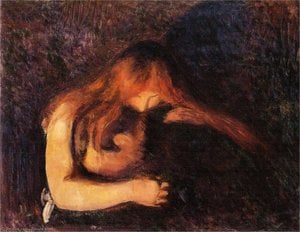
Vampyren nasjonalgalleri oslo by Edvard Munch
2

Vampyren nasjonalgalleri oslo

Oil On Canvas · Munch Museum, Oslo

A Haunting Embrace: Decoding Edvard Munch’s ‘Vampyren’ ‘Vampyren’ (The Vampire), created by Norwegian master Edvard Munch, is a deeply evocative and psychologically charged work that exemplifies the burgeoning Symbolist movement of the late 19th century. This intimate depiction of two figures locked in an embrace transcends simple representation, delving into themes of love, loss, and the darker aspects of human connection. Subject & Composition The artwork presents a close-up view…

Puberty (1914) by Edvard Munch
3

Puberty

1914 · Oil On Canvas · Munch Museum, Oslo

The Threshold of Change A young girl sits on the edge of a bed, her body positioned frontally against the horizontal plane of the mattress. Her limbs are crossed, and she uses her arms to shield her crotch, an instinctive gesture of modesty and vulnerability. The figure is rendered in soft, pale tones that contrast with a fragmented, mosaic-like background. To the left, a pillow rests near her; to the…

Anxiety 2 (1894) by Edvard Munch
4

Anxiety 2

1894 · Oil On Canvas · Munch Museum, Oslo

Introduction to the Artist and Painting Edvard Munch was a Norwegian painter, and his work Anxiety 2, created in 1894, is a quintessential example of Expressionism. This style of art emphasizes the subjective emotional experience of the artist, often using distorted or exaggerated forms to convey intense emotions. Anxiety 2 is part of Munch's oeuvre that explores themes of anxiety, fear, and the human condition. Image Information and Style The…

the kiss (1897) by Edvard Munch
5

the kiss

1897 · Acrylic On Canvas · Munch Museum, Oslo

Edvard Munch’s “The Kiss” (1897) isn't merely a depiction of romantic embrace; it’s a profound exploration of isolation, vulnerability, and the unsettling undercurrents of human connection. Painted during a period of intense personal turmoil for the artist – marked by illness, loss, and a pervasive sense of dread – the work transcends simple representation to become a visceral embodiment of Munch's psychological landscape. The scene unfolds within a deliberately ambiguous…

The Dance of Life (1899) by Edvard Munch
6

The Dance of Life

1899 · Oil On Canvas · Nasjonalgalleriet, Oslo

Edvard Munch's "The Dance of Life" (1899) is a captivating expressionist masterpiece that invites viewers into a world of vibrant colors, dynamic movement, and profound emotional depth. This iconic painting, part of Munch's celebrated The Frieze of Life series, explores the complexities of human relationships and the passage of time through a lively social gathering.

Night street Karl Johan 03 (1892) by Edvard Munch
7

Night street Karl Johan 03

1892 · Acrylic On Canvas · Bergen Kunstmuseum, Bergen

Introduction Explore the depths of human emotion and urban life in Edvard Munch's captivating work, 'Night Street Karl Johan 03'. This masterpiece is a testament to Munch's unique style and his ability to evoke powerful feelings through art. Artist: Edvard Munch Edvard Munch (1863-1944) was a Norwegian painter and printmaker, known for his Expressionist style. His work often depicted intense emotions and personal experiences, reflecting the inner turmoil of modern…

Melancholy (1894) by Edvard Munch
8

Melancholy

1894 · Oil On Canvas · Nasjonalgalleriet, Oslo

Painted in 1894, this evocative work by Norwegian artist Edvard Munch is a powerful embodiment of fin-de-siècle angst and the burgeoning Expressionist movement. Measuring 81 x 101 cm, it transcends mere landscape painting to become a profound exploration of human emotion – specifically, the weight of melancholy and isolation.

Madonna (1894) by Edvard Munch
9

Madonna

1894 · Acrylic On Canvas · Munch Museum, Oslo

Created in 1894 by Norwegian master Edvard Munch, this powerfully emotive work transcends mere representation to become a visceral exploration of human suffering and the complexities of motherhood. Far removed from idealized depictions, it presents a raw and unsettling vision that continues to resonate with viewers today.

Christmas in the Brothel (1905) by Edvard Munch
10

Christmas in the Brothel

1905 · Oil On Canvas · Munch Museum, Oslo

"Christmas in the Brothel" (1905) by Edvard Munch invites viewers into a vibrant and emotionally charged interior scene. This captivating artwork showcases Munch's signature expressive style, blending bold colors and dynamic brushstrokes to create a sense of intimacy and contemplation.

Edvard Munch, paintings 11 to 100

Madonna (1894) by Edvard Munch
#11

Madonna

1894 · Munch Museum

Edvard Munch's "Madonna" (1894) is a hauntingly beautiful testament to his pioneering role in the Expressionist movement. This evocative work captures the essence of human emotion through its…

Bring it home →
Ashes (1894) by Edvard Munch
#12

Ashes

1894 · National Museum of Art, Architecture and Design

"Ashes" (1894) is a hauntingly beautiful artwork by Norwegian master Edvard Munch, renowned for his deeply emotional and psychologically charged paintings. This piece exemplifies Munch's distinctive style, blending…

Commission a hand-painted copy →
The Day After (1895) by Edvard Munch
#13

The Day After

1895 · Nasjonalgalleriet

Edvard Munch's "The Day After" (1895) is a profound exploration of human emotion, capturing a moment of quiet introspection and vulnerability. This evocative artwork invites viewers into a…

Order a reproduction →
Near the bed of death (fever) (1915) by Edvard Munch
#14

Near the bed of death (fever)

1915 · Munch Museum

Created in 1915, this powerfully emotive painting by Edvard Munch is a cornerstone of Expressionist art, offering a raw and unflinching depiction of grief, mortality, and the psychological…

Order a reproduction →
Cree (casein on cardboard) 2 (1893) by Edvard Munch
#15

Cree (casein on cardboard) 2

1893 · National Museum of Art, Architecture and Design

Introduction to the Painting The Cree is a powerful and evocative piece created in 1893 by Norwegian artist Edvard Munch. This casein-on-cardboard painting showcases the artist's mastery of…

Commission a hand-painted copy →
Separation (1896) by Edvard Munch
#16

Separation

1896 · Bergen Kunstmuseum

In the hauntingly beautiful lithograph "Separation," created in 1896, Edvard Munch transcends the boundaries of mere visual representation to touch the very essence of human vulnerability. This masterpiece…

Commission a hand-painted copy →
The Child and Death (1899) by Edvard Munch
#17

The Child and Death

1899 · Kunsthalle Bremen

A Haunting Vision of Grief: Edvard Munch’s ‘The Child and Death’ Edvard Munch's 1899 painting, *The Child and Death*, is a profoundly moving exploration of loss, trauma, and…

Bring it home →
The Kiss (1895) by Edvard Munch
#19

The Kiss

1895

An Intimate Encounter Amidst the Shadows Edvard Munch’s The Kiss is far more than a mere depiction of romantic closeness; it is a profound, visceral exploration of the…

Commission a hand-painted copy →
The Murderer (1910) by Edvard Munch
#20

The Murderer

1910 · Munch Museum

A Shadowed Journey: Unveiling Edvard Munch’s ‘The Murderer’ Edvard Munch's *The Murderer*, painted in 1910, is a profoundly unsettling work that embodies the core tenets of Expressionism. Measuring…

Bring it home →
Girls on the Pier (1904) by Edvard Munch
#21

Girls on the Pier

1904 · Kimbell Art Museum

Edvard Munch's “Girls on the Pier,” painted in 1904, isn’t merely a depiction of a seaside scene; it’s a profound exploration of isolation, anxiety, and the unsettling beauty…

Bring it home →
Vampire (1893) by Edvard Munch
#23

Vampire

1893 · Gothenburg Museum of Art

Edvard Munch’s “The Vampire,” painted in 1893-94, stands as a powerful and unsettling example of Symbolist painting. More than just a depiction of figures, it is an exploration…

Order a reproduction →
Kiss (1897) by Edvard Munch
#24

Kiss

1897 · The Munch Museum

Edvard Munch's "Kiss" is a profound exploration of solitude and introspection, capturing the essence of human emotion through a solitary figure in a dimly lit interior. This evocative…

Bring it home →
Despair (1892) by Edvard Munch
#25

Despair

1892

Edvard Munch's "Despair" is a profoundly moving oil on canvas painting created in 1892, serving as a quintessential representation of the artist’s unique style blending Expressionism and Symbolism.…

Order a reproduction →
Eye in Eye (1894) by Edvard Munch
#26

Eye in Eye

1894

Edvard Munch’s *Eye in Eye*, painted in 1894, isn’t merely a depiction of two figures; it’s a visceral plunge into the depths of human emotion. This arresting canvas,…

Commission a hand-painted copy →
Meeting in Space (1899) by Edvard Munch
#28

Meeting in Space

1899 · Tel Aviv Museum of Art

Edvard Munch's *Meeting in Space*, created in 1899, stands as a cornerstone of Expressionism—a movement that prioritized subjective experience and emotional intensity over objective representation. More than just…

Order a reproduction →
The Sick Child (1925) by Edvard Munch
#29

The Sick Child

1925 · Munch Museum

Step closer and observe the quiet intensity within this room. The scene centers on a young person, identifiable by their reddish-orange hair, sitting upright in a bed. Beside…

Commission a hand-painted copy →
Young woman on the shore (1896) by Edvard Munch
#30

Young woman on the shore

1896 · Munch Museum

A Solitary Vision: Exploring Edvard Munch’s “Young Woman on the Shore” “Young Woman on the Shore,” painted in 1896, is a powerful and evocative work by Norwegian artist…

Order a reproduction →
The Sick Child (1885) by Edvard Munch
#31

The Sick Child

1885

A Window into Grief: Exploring Edvard Munch’s *The Sick Child* Edvard Munch's *The Sick Child* is far more than a depiction of illness; it’s a profoundly moving exploration…

Bring it home →
Moonlight (1895) by Edvard Munch
#32

Moonlight

1895 · Nasjonalgalleriet

Moonlight: A Serene Expression of Nature's Mystery Edvard Munch’s "Moonlight," painted in 1895, is a captivating work that exemplifies the artist's profound connection with nature and his mastery…

Order a reproduction →
The Scream (1893) by Edvard Munch
#33

The Scream

1893 · Munch Museum

The composition centers on a hairless, skeletal figure positioned along a receding diagonal boardwalk. This figure, with hands pressed against its head, faces a landscape in flux. Behind…

Order a reproduction →
Kiss IV (1902) by Edvard Munch
#34

Kiss IV

1902

A Whisper of Intimacy: Decoding Edvard Munch’s *Kiss IV* Edvard Munch's 1902 woodcut, *Kiss IV*, is a profoundly moving exploration of human connection, rendered with the raw emotionality…

Commission a hand-painted copy →
The Murderess (1907) by Edvard Munch
#35

The Murderess

1907 · Munch Museum

Step closer to the canvas and you will feel the weight of the room pressing against you. In this 1907 oil on canvas, a vertical figure stands near…

Order a reproduction →
Self-Portrait (1895) by Edvard Munch
#36

Self-Portrait

1895 · Kunsthaus Zürich

Edvard Munch's “Self-Portrait,” painted in 1895, isn’t merely a likeness; it’s a raw, unflinching plunge into the artist’s own tormented psyche. Created during a period of intense personal…

Bring it home →
Melancholy, Laura (1899) by Edvard Munch
#37

Melancholy, Laura

1899 · Munch Museum

Edvard Munch’s “Melancholy, Laura,” painted in 1899, is not merely a portrait; it's an intimate and profoundly moving exploration of the human psyche. This work, housed within the…

Commission a hand-painted copy →
Men bathing (1907) by Edvard Munch
#38

Men bathing

1907

Introduction to the Painting "CITE>Edvard Munch:CITE>" is renowned for his bold and expressive works, and "CITE>Men Bathing:CITE>" (1907) is no exception. This large oil on canvas painting depicts…

Commission a hand-painted copy →
The Sick Child (1896) by Edvard Munch
#39

The Sick Child

1896 · Gothenburg Museum of Art

Edvard Munch's 1896 painting, ‘The Sick Child,’ is not merely a depiction of illness; it is a visceral embodiment of grief, memory, and the inescapable specter of mortality.…

Order a reproduction →
Two Heart (1899) by Edvard Munch
#40

Two Heart

1899 · Tel Aviv Museum of Art

In the vast landscape of Expressionist masterworks, few pieces capture the raw, unshielded essence of the human psyche as poignantly as Edvard Munch’s “Two Heart.” Created in 1899,…

Order a reproduction →
Death at the helm (1893) by Edvard Munch
#41

Death at the helm

1893 · Munch Museum

Edvard Munch’s Death at the Helm stands as a haunting testament to existential anxieties and the inescapable grip of mortality—themes central to Munch’s artistic vision and profoundly influential…

Bring it home →
Storm (1893) by Edvard Munch
#42

Storm

1893

Edvard Munch's "The Storm," painted in 1893, isn’t merely a depiction of a raging tempest; it’s a visceral embodiment of inner turmoil—a profound exploration of anxiety and the…

Bring it home →
The Death and the Young Girl (1893) by Edvard Munch
#43

The Death and the Young Girl

1893 · Munch Museum

Edvard Munch’s “The Death and the Young Girl,” completed in 1893, stands as a cornerstone of Expressionist art—a haunting testament to Munch's profound engagement with themes of mortality,…

Bring it home →
Madonna (1902) by Edvard Munch
#44

Madonna

1902 · Ohara Museum of Art

To encounter Edvard Munch’s Madonna is to step directly into the turbulent psyche of the Expressionist movement. This masterpiece, a profound exploration of human vulnerability, transcends mere portraiture…

Order a reproduction →
Four Ages in Life (1902) by Edvard Munch
#46

Four Ages in Life

1902 · Bergen Kunstmuseum

Edvard Munch's “Four Ages in Life,” painted in 1902, isn’t merely a depiction of four individuals; it’s a profound meditation on the human condition, rendered with the artist’s…

Commission a hand-painted copy →
Moonlight (1893) by Edvard Munch
#47

Moonlight

1893 · National Museum of Art, Architecture and Design

Edvard Munch, a pivotal figure in modern art, created the captivating painting Moonlight in 1893. This oil on canvas artwork is a quintessential representation of the Symbolism movement,…

Order a reproduction →
Starry Night (1893) by Edvard Munch
#49

Starry Night

1893

Introduction to the Artist and Style Edvard Munch, a pivotal figure in modern art, was born on 12 December 1863 in Norway. He is globally renowned for his…

Bring it home →
Winter Night (1900) by Edvard Munch
#50

Winter Night

1900 · Kunsthaus Zürich

In the quiet, biting chill of 1900, Edvard Munch captured more than just a Norwegian landscape; he distilled the very essence of psychological solitude into Winter Night. This…

Order a reproduction →
The Kiss (1892) by Edvard Munch
#51

The Kiss

1892

Edvard Munch's 1892 painting, *The Kiss*, is not a depiction of blissful union, but rather a profound exploration of the complexities inherent in human connection – desire, longing,…

Order a reproduction →
Mother and Daughter (1897) by Edvard Munch
#52

Mother and Daughter

1897 · Nasjonalgalleriet

Mother and Daughter: A Portrait of Anxiety and Connection Edvard Munch’s “Mother and Daughter,” created in 1897, stands as a cornerstone of Expressionist art—a haunting depiction that transcends…

Bring it home →
The Girl by the Window (1893) by Edvard Munch
#54

The Girl by the Window

1893 · Art Institute of Chicago

Edvard Munch's “The Girl by the Window,” painted in 1893, isn’t merely a portrait; it’s a distilled essence of anxiety and introspection – a window directly into the…

Bring it home →
Nude I (1913) by Edvard Munch
#55

Nude I

1913 · Munch Museum

A Vision of Sensuality and Modernity: Exploring Munch’s *Nude I* Edvard Munch's *Nude I*, painted in 1913, is a powerful testament to the burgeoning Expressionist movement. This oil…

Order a reproduction →
Night (1890) by Edvard Munch
#57

Night

1890

The Painting "CITE>Night" by Edvard Munch, created in 1890, is a poignant and enigmatic oil on canvas painting that embodies the essence of Expressionism. Measuring 64 x 54…

Bring it home →
Anxiety (1894) by Edvard Munch
#58

Anxiety

1894

Edvard Munch’s “Anxiety,” painted in 1894, isn't merely a depiction of a scene; it’s an excavation of the human psyche. More than just a landscape, it’s a visceral…

Order a reproduction →
Madonna (1894) by Edvard Munch
#59

Madonna

1894 · Hamburger Kunsthalle

A nude woman is centered from the waist up, her head tilted back in an almost trance-like pose. The skin is rendered in pale, sickly tones of white,…

Commission a hand-painted copy →
untitled (7660) by Edvard Munch
#60

untitled (7660)

Introduction to Expressionism Expressionism is a modernist movement that emerged in the early 20th century, characterized by its emotional intensity and bold use of color. This movement was…

Order a reproduction →
Vampire II (1902) by Edvard Munch
#61

Vampire II

1902

In the quiet, unsettling depths of Edvard Munch’s 1902 masterpiece, Vampire II, we encounter more than a mere depiction of figures; we step into a visceral landscape of…

Order a reproduction →
Jealousy (1895) by Edvard Munch
#62

Jealousy

1895 · Bergen Kunstmuseum

Edvard Munch's "Jealousy" (1895) is a captivating work that embodies the essence of Expressionism. This hauntingly atmospheric painting invites viewers into a world of emotional depth and symbolic…

Commission a hand-painted copy →
Portrait of Herbert Esche (1905) by Edvard Munch
#63

Portrait of Herbert Esche

1905 · Kunsthaus Zürich

Edvard Munch's "Portrait of Herbert Esche," painted in 1905, isn’t merely a likeness; it’s a profound exploration of the human psyche rendered with the raw intensity characteristic of…

Order a reproduction →
Dance on the Beach (1904) by Edvard Munch
#64

Dance on the Beach

1904 · National Gallery Prague

Edvard Munch's Dance on the Beach is a captivating oil painting that embodies the essence of expressionism. Created in 1904, this artwork is a beautiful representation of people…

Order a reproduction →
The Sick Child (1907) by Edvard Munch
#65

The Sick Child

1907 · Thiel Gallery

The air in the room feels heavy, thick with the scent of sickness and the weight of unspoken words. A young girl lies propped up against a large,…

Order a reproduction →
Woman Combing Her Hair (1892) by Edvard Munch
#66

Woman Combing Her Hair

1892

Edvard Munch's "Woman Combing Her Hair," painted in 1892, is more than a simple depiction of domesticity; it’s a profound exploration of the human psyche—a window into the…

Bring it home →
The Assassin (1910) by Edvard Munch
#67

The Assassin

1910

A Portrait of Inner Turmoil: Decoding Edvard Munch’s ‘The Assassin’ Edvard Munch's 1910 painting, *The Assassin*, is a potent distillation of Expressionist anxieties. More than a depiction of…

Order a reproduction →
The killer (1906) by Edvard Munch
#68

The killer

1906

The Killer Edvard Munch, a Norwegian artist renowned for his contributions to Expressionism, created "The Killer" in 1906. This painting is a testament to Munch’s ability to evoke…

Order a reproduction →
Under the Chestnut Tree (1937) by Edvard Munch
#69

Under the Chestnut Tree

1937 · Munch Museum

A single figure rests within the heavy weight of green. Large, overlapping leaves press down from the upper canvas, creating a ceiling of deep forest tones and pale…

Order a reproduction →
Starry Night (1923) by Edvard Munch
#70

Starry Night

1923

Introduction to Edvard Munch and Expressionism Edvard Munch (1863-1944) was a Norwegian painter who is best known for his contribution to the art movement of Expressionism. This movement…

Commission a hand-painted copy →
Starry Night (1901) by Edvard Munch
#71

Starry Night

1901 · Museum Folkwang

The Composition and Visual Elements The painting presents a night landscape at the coastline of Åsgårdstrand, Norway. In the foreground, a white fence runs diagonally across the scene.…

Commission a hand-painted copy →
Tavern in St. Cloud (1890) by Edvard Munch
#72

Tavern in St. Cloud

1890

WahooArt.com presents a meticulously hand-painted reproduction of Edvard Munch's seminal work, “Tavern Scene” (1890), a painting that transcends its subject matter to become a potent symbol of the…

Order a reproduction →
Melancholy (1894) by Edvard Munch
#73

Melancholy

1894

A heavy, dark figure sits slumped on the edge of a rocky beach, their weight pressing into the very foreground of the scene. The person rests their chin…

Bring it home →
Three Girls in Åsgårdstrand (1905) by Edvard Munch
#75

Three Girls in Åsgårdstrand

1905 · Thiel Gallery

A Somber Gathering Three young female figures occupy a shallow foreground plane, arranged in a triangular formation that directs the eye toward a central, taller figure flanked by…

Order a reproduction →
Jealousy (1907) by Edvard Munch
#76

Jealousy

1907 · Munch Museum

The man’s skin carries the sickly hue of a bruised lime. He stares from the lower left corner, his eyes wide and startled, fixed upon the viewer with…

Bring it home →
Friederich Nietzsche (1906) by Edvard Munch
#77

Friederich Nietzsche

1906 · Munch Museum

Friedrich Nietzsche stands on a bridge, his form caught in a three-quarter view against a landscape of shifting mountains. The sky above is a streaked expanse of orange,…

Order a reproduction →
The girl and death (1894) by Edvard Munch
#78

The girl and death

1894

In the hauntingly beautiful lithograph "The Girl and Death," Edvard Munch invites us into a private, somber theater of the human soul. Created in 1894, this work is…

Order a reproduction →
Irmgard Steinbart (1913) by Edvard Munch
#81

Irmgard Steinbart

1913 · Mildred Lane Kemper Art Museum

A Moment of Quietude Irmgard Steinbart presents us with a scene of profound stillness. A single woman stands centered within a lush, natural setting, her presence anchored by…

Commission a hand-painted copy →
Death Chamber (1915) by Edvard Munch
#82

Death Chamber

1915 · Munch Museum

Step closer to the canvas and you might feel the air grow heavy. In Death Chamber, we encounter a space that feels less like a room and more…

Order a reproduction →
Snow shovelers (1911) by Edvard Munch
#83

Snow shovelers

1911

Introduction to Edvard Munch and Expressionism Edvard Munch, a Norwegian painter, is best known for his contribution to the Expressionist movement. Expressionism is an art movement that emerged…

Bring it home →
The Dead Mother and Child (1901) by Edvard Munch
#86

The Dead Mother and Child

1901 · Kunsthalle Bremen

In the quiet, somber depths of Edvard Munch’s 1901 masterpiece, The Dead Mother and Child, viewers are not merely observers of a scene, but witnesses to an intimate…

Order a reproduction →
By the Roulette (1892) by Edvard Munch
#87

By the Roulette

1892

The Painting and Its Context "CITE>By the Roulette" by Edvard Munch, created in 1892, is a significant work of art that encapsulates the essence of Expressionism. This painting…

Order a reproduction →
Summer (1889) by Edvard Munch
#88

Summer

1889

The sun hangs heavy over a landscape of rolling hills and lush meadows. From the shade of an interior space, a woman leans against a wooden balustrade, her…

Order a reproduction →
Vampire (1894) by Edvard Munch
#89

Vampire

1894

The composition centers on two figures locked in an intimate, unsettling embrace. A woman leans over a man, her long reddish-brown hair flowing toward him and partially obscuring…

Commission a hand-painted copy →
Helge Bäckström (1893) by Edvard Munch
#90

Helge Bäckström

1893 · Thiel Gallery

A Study in Shadow and Thought The man leans forward, his weight pressing into the quiet space between himself and the viewer. His hands are clasped, fingers interlaced…

Order a reproduction →
friedrich nietzsche by Edvard Munch
#91

friedrich nietzsche

Munch’s masterful use of color is immediately striking. Bold shades of crimson dominate the background, mirroring the inner turmoil simmering beneath Nietzsche's surface—a visual representation of existential dread.…

Commission a hand-painted copy →
Self-Portrait I (1896) by Edvard Munch
#92

Self-Portrait I

1896

Edvard Munch's "Self-Portrait I," painted in 1895-1896, isn’t merely a depiction of an artist; it’s a raw, visceral embodiment of the anxieties and psychological turmoil that defined his…

Bring it home →
fortvivlan (1892) by Edvard Munch
#93

fortvivlan

1892

Edvard Munch’s Fortvivlan, created in 1892, stands as a cornerstone of Expressionism—a movement that prioritized subjective emotional experience above objective representation. More than just a painting; it's a…

Order a reproduction →
Nude (1896) by Edvard Munch
#94

Nude

1896 · Rasmus Meyer Collection

Edvard Munch's "Nude," painted in 1896 during his formative years in Paris, isn’t merely a depiction of a woman seated on a bench; it’s a profound exploration of…

Order a reproduction →
Ungdom (Youth) by Edvard Munch
#95

Ungdom (Youth)

Museum Folkwang

A single male nude figure occupies the center of this vertical composition. He stands facing forward, his hands clasped together in front of his body. The skin of…

Order a reproduction →
Skriet oslo by Edvard Munch
#96

Skriet oslo

Edvard Munch, a name synonymous with the anxieties and emotional turbulence of the modern age, gifted us with *Skriet Oslo*, more commonly known as *The Scream*. Born in…

Commission a hand-painted copy →
Red vine (1898) by Edvard Munch
#97

Red vine

1898

“Red Vine” (1898) by Edvard Munch is a seminal work within the Expressionist movement, offering a profound exploration of human emotion and psychological distress. This painting isn't merely…

Bring it home →
The House is Burning! (1927) by Edvard Munch
#100

The House is Burning!

1927 · Munch Museum

Step closer and observe the movement within the frame. There is a profound sense of instability here, as if the canvas itself might succumb to the heat. The…

Bring it home →

Edvard Munch's paintings by period

The subjects Edvard Munch painted most

The four subjects that return most often among these masterpieces, with the finest example of each.

Where to see Edvard Munch's paintings

The 8 museums that hold the most of the paintings on this page.

Museum City Works by Edvard Munch Paintings from this list
Munch Museum, OsloMunch Museum Oslo 1,030 Vampyren nasjonalgalleri oslo, Puberty, Anxiety 2
Nasjonalgalleriet, OsloNasjonalgalleriet Oslo 10 The Scream, The Dance of Life, Melancholy
Bergen Kunstmuseum, BergenBergen Kunstmuseum Bergen 42 Night street Karl Johan 03, Separation, Four Ages in Life
National Museum of Art, Architecture and Design, OsloNational Museum of Art, Architecture and Design Oslo 51 Ashes, Cree (casein on cardboard) 2, Moonlight
Kunsthaus Zürich, ZurichKunsthaus Zürich Zurich 25 Self-Portrait, Winter Night, Portrait of Herbert Esche
Thiel Gallery, StockholmThiel Gallery Stockholm 13 The Sick Child, Three Girls in Åsgårdstrand, Helge Bäckström
Gothenburg Museum of Art, GothenburgGothenburg Museum of Art Gothenburg 5 Vampire, The Sick Child
Museum Folkwang, EssenMuseum Folkwang Essen 5 Starry Night, Ungdom (Youth)

Edvard Munch's most famous painting of each decade

  1. 1880s
    The Sick Child (1885) by Edvard Munch
    Rank 31 / 100

    The Sick Child

    Age 17 – 26

    A Window into Grief: Exploring Edvard Munch’s *The Sick Child* Edvard Munch's *The Sick Child* is far more than a depiction of illness; it’s a profoundly moving exploration…

  2. 1890s
    The Scream (1893) by Edvard Munch
    No. 1 of 100

    The Scream

    Age 27 – 36 · Nasjonalgalleriet

    To look closely at this 1893 work is to witness a profound departure from the objective world. The scene does not attempt to replicate reality with photographic precision;…

  3. 1900s
    Christmas in the Brothel (1905) by Edvard Munch
    Rank 10 / 100

    Christmas in the Brothel

    Age 37 – 46 · Munch Museum

    "Christmas in the Brothel" (1905) by Edvard Munch invites viewers into a vibrant and emotionally charged interior scene. This captivating artwork showcases Munch's signature expressive style, blending bold…

  4. 1910s
    Puberty (1914) by Edvard Munch
    Rank 3 / 100

    Puberty

    Age 47 – 56 · Munch Museum

    The Threshold of Change A young girl sits on the edge of a bed, her body positioned frontally against the horizontal plane of the mattress. Her limbs are…

  5. 1920s
    The Sick Child (1925) by Edvard Munch
    No. 29 of 100

    The Sick Child

    Age 57 – 66 · Munch Museum

    Step closer and observe the quiet intensity within this room. The scene centers on a young person, identifiable by their reddish-orange hair, sitting upright in a bed. Beside…

  6. 1930s
    Under the Chestnut Tree (1937) by Edvard Munch
    #69 of 100

    Under the Chestnut Tree

    Age 67 – 76 · Munch Museum

    A single figure rests within the heavy weight of green. Large, overlapping leaves press down from the upper canvas, creating a ceiling of deep forest tones and pale…

Questions about Edvard Munch's paintings

What is Edvard Munch's most famous painting?Show the answer

The Scream (1893), Nasjonalgalleriet, Oslo. Next come Vampyren nasjonalgalleri oslo and Puberty (1914).

How old was Edvard Munch when The Scream was painted?Show the answer

30 years old: The Scream dates from 1893 and Edvard Munch was born in 1863.

What are the top 10 paintings by Edvard Munch?Show the answer

The Scream, Vampyren nasjonalgalleri oslo, Puberty, Anxiety 2, the kiss, The Dance of Life, Night street Karl Johan 03, Melancholy, Madonna and Christmas in the Brothel. The ranking above gives the year and the museum of each.

How many paintings did Edvard Munch make?Show the answer

Our catalogue lists 2,121 works by Edvard Munch, dated from 1882 to 1937.

Where are Edvard Munch's most famous paintings?Show the answer

Most of them are in Munch Museum (Oslo), Nasjonalgalleriet (Oslo) and Bergen Kunstmuseum (Bergen). The table above lists the museums one by one.

When did Edvard Munch paint the most famous works?Show the answer

In 1890s: 52 of the 100 works on this page date from then, among them The Scream.

What are Edvard Munch's earliest and latest famous paintings?Show the answer

The earliest on this page is Garden with Red House (1882), the latest Under the Chestnut Tree (1937).

What did Edvard Munch paint most often?Show the answer

Anxiety (29), Woman (17) and Melancholy (17), among the 100 works on this page.

What medium did Edvard Munch use most?Show the answer

Oil On Canvas: 51 of the 100 works on this page.

Which art movement does Edvard Munch belong to?Show the answer

Expressionism, as the paintings on this page show.

Which Edvard Munch paintings can I see at the Munch Museum?Show the answer

Vampyren nasjonalgalleri oslo, Puberty and Anxiety 2 are among the 27 works on this page held by the Munch Museum, Oslo.

Can I buy a reproduction of a Edvard Munch painting?Show the answer

Yes. Every painting on this page can be ordered as a museum-quality, hand-painted oil reproduction or a fine art print, in the size you choose, from the painting's own page.

About Edvard Munch

The Life and Identity of Edvard Munch

Edvard Munch was a Norwegian painter whose life was deeply tied to the landscapes and the heavy atmosphere of his homeland. Born on 12 December 1863, he spent much of his existence navigating the complexities of the human psyche through his brush and printmaking tools. His work often felt like a direct extension of his own internal struggles, turning private emotions into something visible and shared. He remained an active presence in the art world until his death on 23 January 1944.

His ability to capture the tremors of human existence reached a peak in 1893 with the creation of The Scream. This specific work has become one of the most acclaimed images in Western art, recognized globally for its depiction of existential dread. While many artists sought to replicate the physical world, Munch was interested in the things that cannot be seen, such as anxiety and the weight of loneliness. He used color and form to give a shape to the invisible forces that pull at the human spirit.

Throughout his long career, he produced a vast body of work that spanned many different mediums. His output included:

Early Life, Family and Training

Edvard Munch was born in 1863 amidst the stark landscapes of Norway. His childhood was shaped by a household where the presence of sickness was a constant companion. In 1868, his mother died from tuberculosis, a loss that left a heavy mark on the young boy. This sense of fragility deepened in 1877 when his sister, Johanne Sophie, also succumbed to tuberculosis at the age of 15. These early bereavements meant that the shadows of mortality were woven into the fabric of his daily life.

His father, Christian Munch, worked as a physician and medical officer. Christian was a man of intense religious devotion, but he also struggled with a temperament that was nervous and obsessively religious. The atmosphere of the home was often heavy with this sense of dread. Growing up in such a setting, Edvard often found himself drawing to keep occupied during the long winters when illness kept him from school. These early experiences of grief and fear would eventually find their way onto his canvases.

For his formal education, he attended the Royal School of Art and Design in Kristiania. It was here that he began to develop the technical skills that would support his later explorations of the human psyche. His training provided the foundation for a career spent translating internal distress into visual form.

The Bohemian Circles of Kristiania

In the streets of Kristiania, the former name of Oslo, Munch found a community that challenged everything he had been taught. He moved within the bohemian circles of the city, a group of people who lived outside the strict rules of the era. Among them was the naturalistic painter Christian Krohg, who was a part of this progressive circle. These gatherings were not just social; they were spaces where new ways of seeing the world were debated and lived.

It was through the influence of the nihilist Hans Jæger that Munch’s own path began to shift. Jæger urged him to move away from the polite, academic traditions of the time. He encouraged the artist to look inward and paint his own emotional and psychological state. This was a radical idea. Instead of trying to capture the world as it appeared to others, Munch began to use his canvas to express the internal storms of his own mind.

Travels and Influences in Paris and Berlin

Moving through the centers of European art allowed Munch to see his own impulses reflected in the work of others. In Paris, he encountered the techniques of artists like Paul Gauguin and Vincent van Gogh. He learned much from them, absorbing how they used color and form to move beyond simple representation. His time in the city also brought him into contact with Henri de Toulouse-Lautrec. These encounters helped him refine a way of seeing that prioritized the internal over the external.

His time in Berlin shifted his focus toward the deeper, more unsettling layers of the human mind. It was there that he met the Swedish dramatist August Strindberg. These connections with figures such as Strindberg pushed his investigations into psychological themes. He began to use his art to explore the tremors of human existence, moving away from naturalistic depictions toward a style that could communicate the heavy weight of fear and anxiety.

Technique and Style of Soul Painting

Munch did not aim to replicate the physical world as it appeared to the eye. Instead, he sought to externalize his internal state, a method he called soul painting. He used distorted forms and rhythmic lines to communicate the tremors of human existence, turning psychological distress into a visible, tangible form. His brushwork often reflected the turbulence of his own mind, using color and shape to translate what he felt rather than what he saw.

This focus on the internal led him to experiment extensively with various mediums. He was a highly active printmaker, working through lithography, woodcut, and etching to expand his reach. His technical range was broad, involving intaglio processes such as aquatint, drypoint, and engraving on copper. These methods allowed him to layer textures and lines that mirrored the complexity of human emotion.

The Frieze of Life and Key Works

Munch sought to capture the recurring cycles of human existence through a series of works he called The Frieze of Life. This collection focused on the heavy, inescapable themes of love, fear, death, and anxiety. He did not aim for a simple depiction of life, but rather an exploration of the internal storms that define it. His paintings often functioned as a way to process the grief and the psychological tremors that stayed with him from his youth.

Many of his most recognized images emerged from these personal struggles. He conceived The Scream while in Kristiania, using swirling, fiery landscapes to represent a sense of existential dread. In other works, he turned his gaze toward the complexities of human connection and the fragility of life. Madonna explores the intersection of sexuality and mortality, while The Sick Child remains a poignant reminder of the loss of his sister, Sophie. These pieces reflect a man trying to make sense of the shadows that followed him.

Later Years and Death

The later years of Munch's life were marked by a significant shift in his personal habits and his creative environment. Following a mental breakdown in 1908, he made the decision to give up heavy drinking. This period of change led him away from the turbulent social scenes of his youth. Instead, he spent his remaining years working in peace and privacy, finding a quiet space to continue his practice.

His output remained steady until the end of his life. By the time he passed away in 1944, he had amassed a collection of 1006 paintings. While the world around him faced the immense upheaval of World War II, the majority of his works survived the conflict, ensuring that his visual language would remain available for future generations to study and experience.

The Lasting Legacy and Influence

Munch's ability to confront the darker aspects of the human condition helped pave the way for German Expressionism. He was a pioneer of Expressionism, moving away from the polite rules of academic art to find a way to show the internal storms of the mind. By translating psychological distress into visual form, he changed how artists approached the canvas. His work became a cornerstone of the modernism movement, shifting the focus from what the eye sees to what the soul endures.

His presence is felt deeply within the history of Norwegian art. He helped define a national identity through his exploration of universal human experiences. The way he used color and distorted lines to communicate the tremors of existence left a mark that many artists followed. His influence reached far beyond the borders of Norway, affecting how the modern world perceives anxiety and isolation.

Where to See the Works Today

To experience the breadth of his life's work, one must travel to Oslo, Norway. The Munch Museum is the primary guardian of his legacy, housing a vast collection that spans the full range of his artistic output. It is a place where the sheer scale of his production becomes clear, offering a deep look into the themes he explored throughout his years of painting and printmaking.

Other significant pieces are held in the city's other major institutions. The National Gallery in Oslo holds the 1893 tempera and crayon on cardboard version of The Scream. This specific piece offers a different texture and feeling compared to other versions. Additionally, the National Museum of Norway is home to a version of Madonna, allowing visitors to see how he approached the same subject through different lenses.

All 2121 works by Edvard Munch →