David Roberts, 1796 – 1864

The 100 Most Famous Paintings by David Roberts

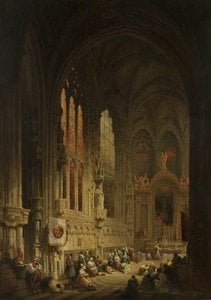
The painting that made David Roberts famous is Interior of Cologne Cathedral, with a Funeral (1838); it hangs in the Wolverhampton Art Gallery, Wolverhampton. The Chancel of the Church of the Nativity (or St. Helena), Bethlehem (1842) and Philae, Temple of Isis, the Court and the Second Pylon follow it in the hearts of collectors and museum visitors. Of the 291 works by David Roberts in our catalogue, these 100 are the most admired, each presented with its date, its museum and what sets it apart.

Ranked by our popularity score, which combines the searches, visits and orders for each work. Updated October 2026. Every masterpiece on this page can be ordered as a museum-quality, hand-painted oil reproduction or a fine art print, at the size you choose.

Portrait of David Roberts
David Roberts · 1796 – 1864
Born · died
1796 – 1864, Stockbridge
Movement
Romanticism
Works in our catalogue
291
Most famous
Interior of Cologne Cathedral, with a Funeral (1838)
Most works at
Scottish National Gallery

David Roberts: the ten masterpieces

Interior of Cologne Cathedral, with a Funeral (1838) by David Roberts
1

Interior of Cologne Cathedral, with a Funeral

1838 · Acrylic On Canvas · Wolverhampton Art Gallery, Wolverhampton

David Roberts’s Vision of Sacred Space David Roberts (1796-1864) stands as a pivotal figure in 19th-century art history—a Scottish painter whose meticulous lithographs and expansive oil paintings captured the grandeur of Oriental landscapes and architectural marvels alike. More than just documenting places, Roberts sought to convey their spiritual essence, establishing himself as one of the foremost Royal Academicians of his time and profoundly influencing European artistic sensibilities. His legacy continues…

Hand-painted oil reproduction from $181 28 × 36 cm
The Chancel of the Church of the Nativity (or St. Helena), Bethlehem (1842) by David Roberts
2

The Chancel of the Church of the Nativity (or St. Helena), Bethlehem

1842 · Watercolor · National Museums Liverpool, Liverpool

David Roberts' "The Chancel of the Church of the Nativity (or St. Helena)," painted in 1842, isn’t merely a depiction of a building; it’s an immersion into a profound atmosphere of reverence and historical significance. This watercolor, rendered with meticulous detail and imbued with a subtle luminosity, transports the viewer to the heart of Bethlehem – the birthplace of Jesus Christ. Roberts, a Scottish painter celebrated for his evocative depictions…

Hand-painted oil reproduction from $406 38 × 27 cm Same size as the original $422 47 × 32 cm Order at original size →
Philae, Temple of Isis, the Court and the Second Pylon by David Roberts
3

Philae, Temple of Isis, the Court and the Second Pylon

Oil On Canvas

In this landscape composition, we encounter Philae, Temple of Isis, the Court and the Second Pylon, a work by the Scottish painter David Roberts. The scene focuses on the architectural remains of the Temple of Isis at Philae. Roberts produced these paintings during his time in Egypt, specifically around 1838, capturing the structures as they appeared in the early nineteenth century.

Hand-painted oil reproduction from $281 39 × 26 cm
Interview with the Viceroy of Egype at His Palace in Alexandria (1849) by David Roberts
4

Interview with the Viceroy of Egype at His Palace in Alexandria

1849 · Oil

Interview with the Viceroy of Egype at His Palace in Alexandria by David Roberts captures a specific moment of diplomatic or social encounter. The scene documents an interview with the Viceroy of Egypt held at his palace in Alexandria. This meeting occurred on May 12th, 1839.

Hand-painted oil reproduction from $181 38 × 26 cm Same size as the original $205 51 × 35 cm Order at original size →
The Grand Portico Of The Temple At Esneh, Egypt by David Roberts
5

The Grand Portico Of The Temple At Esneh, Egypt

Lithograph

The Grand Portico Of The Temple At Esneh, Egypt is a work by David Roberts. This architectural study focuses on the massive stone structures of an ancient Egyptian temple. The artist captures the immense scale and the heavy grandeur of the site through a precise observation of its form. It is a record of stone and shadow.

Hand-painted oil reproduction from $356 38 × 26 cm
Caiaphas Looking Towards Mount Carmel by David Roberts
6

Caiaphas Looking Towards Mount Carmel

Watercolor

The artwork is titled Caiaphas Looking Towards Mount Carmel. It was executed by the Scottish painter David Roberts. Born in 1796, Roberts developed a technical foundation through an apprenticeship in house painting and decoration before transitioning into scene painting and landscape studies.

Hand-painted oil reproduction from $281 39 × 26 cm

More David Roberts masterpieces, 11 to 100

Rouen Cathedral (1826) by David Roberts
#34

Rouen Cathedral

1826 · Smithsonian American Art Museum

In his 1826 masterpiece, Rouen Cathedral, David Roberts invites the viewer into a breathtaking window of the nineteenth century, where the monumental weight of history meets the delicate…

Commission a hand-painted copy from $356 →
The Giudecca, Venice (1854) by David Roberts
#84

The Giudecca, Venice

1854 · Yale Center for British Art

David Roberts’s “The Giudecca, Venice” isn't merely a depiction of a cityscape; it’s a carefully constructed tableau of light, atmosphere, and the enduring spirit of a city steeped…

Bring it home from $181 →

David Roberts's paintings by period

The subjects David Roberts painted most

The four subjects that return most often among these masterpieces, with the finest example of each.

Where to see David Roberts's paintings

The 8 museums that hold the most of the paintings on this page.

Museum City Works by David Roberts Paintings from this list
Scottish National Gallery, EdinburghScottish National Gallery Edinburgh 10 Hindoo Architecture A Composition, St Patrick's Church, Cowgate, Edinburgh, Baalbec
Birmingham Museum and Art Gallery, BirminghamBirmingham Museum and Art Gallery Birmingham 5 Colossi, Thebes, Egypt, St Catherine's Convent, Mount Sinai, Holy Land, Interior Of Seville Cathedral, Spain
Government Art Collection, LondonGovernment Art Collection London 3 The Great Staircase, Stafford House, Interior of St Peter's, Rome, Interior of the Duomo, Milan
Museo del Prado, MadridMuseo del Prado Madrid 4 Untitled (AQTNF8), Español Interior de la mezquita de Córdoba English The Interior of the Mosque, Cordoba
Yale Center for British Art, New HavenYale Center for British Art New Haven 3 The Hypostyle Hall of the Great Temple at Abu Simbel, Egypt, The Giudecca, Venice
York Museums Trust, YorkYork Museums Trust York 2 Entrance to St Germain, Amiens, Interior of York Minster
Guildhall Art Gallery, LondonGuildhall Art Gallery London 2 Edinburgh from the Calton Hill, The Forum, Rome, Italy
Wallace Collection, LondonWallace Collection London 2 Lierre Interior of Saint Gommaire, Granada the Chapel of Ferdinand and Isabella

David Roberts, decade by decade: the defining painting of each

  1. 1820s
  2. 1830s
    Interior of Cologne Cathedral, with a Funeral (1838) by David Roberts
    No. 1 of 100

    Interior of Cologne Cathedral, with a Funeral

    Age 34 – 43 · Wolverhampton Art Gallery

    David Roberts’s Vision of Sacred Space David Roberts (1796-1864) stands as a pivotal figure in 19th-century art history—a Scottish painter whose meticulous lithographs and expansive oil paintings captured…

  3. 1840s
  4. 1850s
  5. 1860s

David Roberts's masterpieces: questions and answers

Which painting is David Roberts best known for?Show the answer

Interior of Cologne Cathedral, with a Funeral (1838), Wolverhampton Art Gallery, Wolverhampton. Next come The Chancel of the Church of the Nativity (or St. Helena), Bethlehem (1842) and Philae, Temple of Isis, the Court and the Second Pylon.

How old was David Roberts when painting Interior of Cologne Cathedral, with a Funeral?Show the answer

42 years old: Interior of Cologne Cathedral, with a Funeral dates from 1838 and David Roberts was born in 1796.

What are David Roberts's ten greatest paintings?Show the answer

Interior of Cologne Cathedral, with a Funeral, The Chancel of the Church of the Nativity (or St. Helena), Bethlehem, Philae, Temple of Isis, the Court and the Second Pylon, Interview with the Viceroy of Egype at His Palace in Alexandria, The Grand Portico Of The Temple At Esneh, Egypt, Caiaphas Looking Towards Mount Carmel, Citadel Of Sidon, Untitled (AQTNEW), Edinburgh Town and Castle and Entrance to St Germain, Amiens. The ranking above gives the year and the museum of each.

How many works did David Roberts paint?Show the answer

Our catalogue lists 291 works by David Roberts, dated from 1822 to 1863.

In which museums can I see David Roberts's masterpieces?Show the answer

Most of them are in Scottish National Gallery (Edinburgh), Birmingham Museum and Art Gallery (Birmingham) and Government Art Collection (London). The table above lists the museums one by one.

When did David Roberts paint the masterpieces?Show the answer

In 1830s: 27 of the 100 works on this page date from then, among them Interior of Cologne Cathedral, with a Funeral.

What are the first and last famous paintings of David Roberts?Show the answer

The earliest on this page is Interior of a Cathedral (1822), the latest Edinburgh from the Calton Hill (1863).

What were David Roberts's favourite subjects?Show the answer

Religious art (7), Architecture (7) and Victorian era (5), among the 100 works on this page.

Which technique did David Roberts favour?Show the answer

Oil On Canvas: 5 of the 100 works on this page.

What art movement is David Roberts part of?Show the answer

Romanticism and Orientalism, as the paintings on this page show.

Which masterpieces by David Roberts hang at the Scottish National Gallery?Show the answer

Hindoo Architecture A Composition, St Patrick's Church, Cowgate, Edinburgh and Baalbec are among the 8 works on this page held by the Scottish National Gallery, Edinburgh.

Can I own a reproduction of a David Roberts masterpiece?Show the answer

Yes. Every painting on this page can be ordered as a museum-quality, hand-painted oil reproduction or a fine art print, in the size you choose, from the painting's own page.

The life of David Roberts

David Roberts: A Life in Art

David Roberts (1796-1864) was a Scottish painter celebrated for his detailed Orientalist scenes and meticulous lithographs. His work provides invaluable visual documentation of the Middle East during the 19th century, bridging artistic representation with historical record.

Early Life and Career

Born on October 24, 1796, in Stockbridge near Edinburgh, Roberts’s early life was marked by practical training. At the age of ten, he began an apprenticeship with house painter and decorator Gavin Beugo. This foundational experience instilled a strong technical skill set, which he supplemented through evening art studies.

His initial professional work included redecorating Scone Palace in 1815. He then transitioned to scene painting for James Bannister’s circus, honing his skills in creating immersive environments. These early experiences laid the groundwork for his later success as a prominent Orientalist painter.

Artistic Journey and Influences

Roberts' artistic development was shaped by a growing fascination with different cultures and landscapes. While initially focused on theatrical scenery, he gradually shifted towards more independent artistic pursuits. His travels to Spain in 1832 were formative, sparking an interest in architectural detail and exotic locales.

However, it was his extensive tours of Egypt and the Near East (1838-1840) that truly defined his career. These journeys provided him with a wealth of sketches and observations which he later translated into his most famous works. His style wasn’t heavily influenced by any single artist, but rather developed from careful observation and technical mastery.

Notable Works and Achievements

Roberts is best known for The Holy Land, Syria, Idumea, Arabia, Egypt, and Nubia – a series of meticulously detailed lithograph prints. These images captured the grandeur of ancient sites and the vibrancy of contemporary life in the region.

  • Lithographs: His lithographs were widely circulated and became highly influential in shaping European perceptions of the Middle East.
  • Paintings: He also produced numerous oil paintings, often large-scale works depicting expansive landscapes and architectural marvels.

In 1841, Roberts was elected as a Royal Academician – a significant recognition of his contributions to the art world.

Artistic Style and Characteristics

Roberts’s artistic style is characterized by:

  • Orientalism: A strong focus on depicting scenes from the Middle East, reflecting the European fascination with “the Orient.”
  • Attention to Detail: His work is renowned for its precision and accuracy in rendering architectural details, costumes, and landscapes.
  • Landscaping & Townscapes: He skillfully combined romantic sensibilities with detailed observation, creating evocative depictions of both natural environments and urban settings.

Legacy and Historical Significance

David Roberts’s work played a crucial role in popularizing the Middle East among European audiences. His images provided a visual window into a region that was largely unknown to many, influencing travel, scholarship, and artistic representation.

His lithographs served as important historical documents, preserving images of sites that have since changed or been lost. He left an indelible mark on the art world, inspiring subsequent generations of artists and continuing to captivate viewers today.