The Master of Victorian Nuance: Thomas Alexander Ferguson Graham
In the heart of the Victorian era, a period defined by its rigid social structures and burgeoning industrial grandeur, Thomas Alexander Ferguson Graham emerged as a painter capable of capturing both the external dignity and the internal soul of his subjects. Born in 1840, Graham’s life and work were deeply intertwined with the cultural fabric of Scotland. His journey began in Edinburgh, an environment rich with academic rigor and literary depth, which provided the foundation for a career marked by an unwavering commitment to classical technique. As a student at the Royal Scottish Academy starting in 1863, he came under the profound influence of William Quiller Orchardson. This mentorship was pivotal; from Orchardson, Graham inherited a mastery of compositional balance and a devotion to realism that would become the hallmark of his enduring legacy.
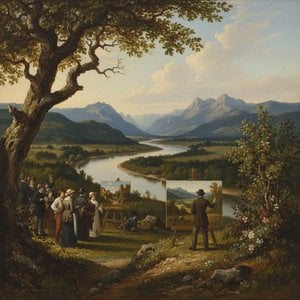
Graham’s artistic evolution is a fascinating study in stylistic transition. His early explorations were deeply rooted in the Romantic idealism that swept through the 19th century, particularly through his evocative landscapes of the Scottish Highlands. In these works, one can observe a sensitivity to the rugged beauty of the natural world, often imbued with a sense of poetic longing. However, as his technical prowess matured, Graham pivoted toward the intimate and psychological complexities of portraiture. He moved away from the vastness of the landscape to focus on the human countenance, developing an ability to render anatomical precision alongside a profound psychological nuance. This shift allowed him to become one of Scotland’s most sought-after portraitists, capable of translating the status and character of his sitters onto canvas with remarkable accuracy.
A Legacy of Precision and Emotion
The breadth of Graham's oeuvre is reflected in the diversity of his subject matter, ranging from the sweeping vistas of coastal life to the formal dignity of the Scottish intelligentsia. His ability to navigate different modes of painting—from the realist traditions of the Hudson River School style seen in works like "The Lass that Baits the Lines" to the more atmospheric, almost impressionistic touches in his maritime scenes—demonstrates a versatile genius. In pieces such as "Going to Sea", Graham utilizes a palette of muted blues and browns to evoke the poignant emotions of separation and longing, proving that his technical skill was always at the service of emotional storytelling.
His professional achievements were cemented through prestigious commissions that placed him at the center of Victorian society. His portraits of notable figures include:
- Sir George Anderson Lawson, captured with the dignity befitting his station.
- Lord Balfour of Blythswood, a testament to Graham's ability to handle high-society portraiture.
- Sir James Low, the Lord Provost of Dundee, where Graham showcased his talent for rendering rich detail and military splendor.
Beyond the finished masterpieces, much of Graham’s greatness resided in his disciplined process. He was a practitioner of the academic tradition, relying heavily on meticulous preparatory sketches and studies. These preliminary works were not merely exercises but essential guides that allowed him to build layers of meaning and texture. Through this rigorous approach, Thomas Alexander Ferguson Graham did more than just record faces and places; he preserved the spirit of an era, leaving behind a body of work that continues to resonate with its quiet strength and timeless elegance.
Questions & Answers
Is there a complete list of Thomas Alexander Ferguson Graham's artworks?
Every work by Thomas Alexander Ferguson Graham on this website can be browsed from the artist's All Artworks page.
Where are Thomas Alexander Ferguson Graham's artworks grouped by palette?
Thomas Alexander Ferguson Graham's works can be browsed by color palette on the artist's By Palettes page.
Where can I find statistics about Thomas Alexander Ferguson Graham's works?
A Stats page exists for Thomas Alexander Ferguson Graham, presenting statistics about the artist's artworks on this website.