Tamara Kvesitadze: Sculpting Movement and Emotion from Georgian Roots
Born in Tbilisi, Georgia, in 1968, Tamara Kvesitadze’s artistic journey is deeply intertwined with her homeland's rich cultural heritage and a fascination with the interplay between human emotion and dynamic form. From an early foundation in architecture – graduating from the Technical University of Georgia – she transitioned seamlessly into sculpture, quickly establishing herself as a distinctive voice within contemporary Georgian art and gaining international recognition for her kinetic works that breathe life into stone and metal.
Kvesitadze’s artistic development is marked by a profound engagement with both ancient traditions and modern sensibilities. Her early work demonstrated an appreciation for classical sculpture, particularly the dramatic figures of Giacometti and della Francesca, yet she quickly moved beyond mere imitation, incorporating elements of Arte Povera – a movement emphasizing simplicity and the use of ordinary materials – into her practice. This fusion results in sculptures that are simultaneously familiar and strikingly original, imbued with a sense of both timelessness and contemporary urgency.
The ‘Man and Woman’ / ‘Ali and Nino’ Transformation
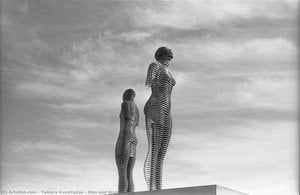
Perhaps Kvesitadze's most celebrated work is “Man and Woman,” initially conceived in 2007 and installed on the seafront promenade of Batumi, Georgia. This monumental kinetic sculpture, a captivating dance between two figures, quickly gained popularity but was later renamed "Ali and Nino" – a poignant tribute to the tragic love story depicted in Alexander Kazhdariev’s 1937 novel. The renaming reflects Kvesitadze's intention to imbue her work with layers of narrative and emotional resonance, transforming it from a purely abstract form into a powerful allegory of human connection and loss.
The sculpture itself is a marvel of engineering and artistic vision. Designed to move and interact with each other, “Ali and Nino” creates an ever-changing tableau, inviting viewers to contemplate the complexities of relationships and the enduring power of love. The decision to relocate it from its original location further amplified its symbolic significance, placing it within a public space where it could engage with a wider audience.
A Global Presence: Exhibitions and Recognition
Kvesitadze’s artistic vision has resonated across continents, leading to numerous exhibitions in prestigious venues both nationally and internationally. She has presented her work at the 52nd Venice Biennale in 2007, a testament to her growing recognition within the global art community. Her sculptures have been showcased in galleries and museums throughout Europe, North America, and Asia, including prominent collections in France, the United States, Germany, and Vietnam.
In 2018, Kvesitadze’s work received significant attention through a virtual exhibition on Google Arts & Culture, offering a global audience access to her compelling creations. This digital platform highlighted her unique approach to sculpture – blending traditional techniques with innovative concepts – solidifying her position as a leading figure in contemporary art.
Beyond the Sculpture: Architectural Roots and Continuing Evolution
Kvesitadze’s background in architecture profoundly influences her sculptural practice, informing her understanding of space, form, and movement. Her sculptures are not simply static objects; they are designed to engage with their environment and invite interaction. This commitment to dynamism is further evident in her exploration of kinetic elements, creating works that seem to breathe and evolve over time.
Currently residing and working in Tbilisi, Georgia, Tamara Kvesitadze continues to push the boundaries of sculpture, exploring themes of human connection, mythology, and the enduring power of storytelling. Her work stands as a testament to her artistic vision, blending Georgian heritage with a distinctly contemporary sensibility, and solidifying her place as one of the most compelling sculptors working today.
Questions & Answers
Can I browse Tamara Kvesitadze's works by movement?
The All Movements page groups Tamara Kvesitadze's artworks by art movement.
Can I explore Tamara Kvesitadze's works by color spectrum?
Tamara Kvesitadze's works can be explored by color on the artist's Spectral Index page.
Where can I see the color profile of Tamara Kvesitadze's work?
Tamara Kvesitadze's use of color across the works listed on this website can be studied on the artist's Palette Genome page.