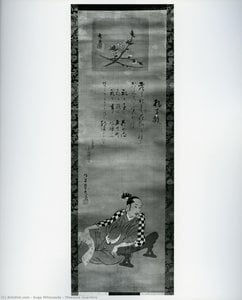
The Ethereal World of Suga Mitsusada
Suga Mitsusada, a name often whispered alongside his equally evocative pseudonym Iseki, remains one of the most captivating figures of the Japanese Edo Period. Born in Tokyo in 1738, Mitsusada emerged during an era of profound cultural transformation, where the rigid structures of feudal society began to dance with the burgeoning hedonism of the urban merchant class. While the biographical records of his early life remain as delicate and elusive as a silk thread, it is widely understood that he was steeped in the prestigious traditions of Kano painting. This classical foundation, characterized by disciplined brushwork and idealized natural landscapes, provided him with a technical rigor that he would later subvert to capture something far more intimate and transient: the pulse of human desire.
His artistic journey is defined by a masterful transition from the formal to the fluid. While his training instilled in him a respect for precision, Mitsusada found his true voice in the Ukiyo-e tradition and the delicate medium of silk painting. He moved away from the static grandeur of his predecessors to embrace a style that favored looser, more expressive brushstrokes. This evolution allowed him to capture fleeting moments of emotion and the subtle nuances of human psychology, bridging the gap between the classical elegance of the Kano school and the dynamic, often provocative energy of the floating world.
Sensuality and Symbolism in the Pleasure Quarters
The true legacy of Mitsusada lies in his unparalleled ability to document the Pleasure Quarters. His series of silk paintings serves as a profound window into the social fabric of the Edo era, offering much more than mere erotic allure. Through his eyes, we witness scenes of aristocratic indulgence and intimate encounters that are imbued with deep symbolic significance. These works often reflect the complex tensions of his time—the friction between burgeoning social morality and the unyielding human pursuit of sensual experience.
In these masterpieces, every detail is a testament to his technical command. A viewer might find themselves lost in the meticulous rendering of:
- Opulent Fabrics: The heavy, shimmering textures of silk kimonos that suggest wealth and status.
- Subtle Expressions: The fleeting glances and micro-expressions on the faces of his subjects, which reveal a profound understanding of human longing.
- Atmospheric Depth: The way light and shadow play across intimate settings, creating an immersive sense of presence within the scene.
A Lasting Influence on Japanese Art
As the Edo Period progressed toward its golden age, Mitsusada’s stylistic innovations helped pave the way for future masters. His ability to blend the refined aesthetics of classical painting with the bold, narrative-driven compositions of Ukiyo-e created a unique stylistic bridge. This approach aligns him closely with the burgeoning influence of artists like Kunisada, whose work would later push the boundaries of perspective and composition even further. The collaboration of ideas between these different schools of thought exemplifies the creative crucible that defined Japanese art in the late 18th century.
Though he passed away in 1806, the impact of Suga Mitsusada continues to resonate. He did not merely paint scenes; he captured the very essence of an era—a period of intense beauty, social complexity, and the eternal human search for pleasure. His work remains a vital touchstone for anyone seeking to understand the sophisticated, often contradictory, heart of Japanese history.