Su Renshan: A Pioneer of Qing Dynasty Innovation
Su Renshan (1814 – 1850?), a figure shrouded in intriguing mystery, stands apart as one of the most unconventional and captivating artists to emerge from China’s Qing dynasty. Despite his tragically brief life span, he left an indelible mark on the artistic landscape, continuing to fascinate scholars and collectors alike with his distinctive style—a bold departure from established conventions that nonetheless remained deeply rooted in Chinese tradition. Born in Shunde, Guangdong Province, Su Renshan's artistic journey unfolded during a period of significant cultural transformation, shaping him into a visionary whose oeuvre defies easy categorization.- Early Life and Influences: Little is known definitively about Su Renshan’s formative years. However, anecdotal evidence suggests he was educated in calligraphy and painting, absorbing the traditions of Shanshui (mountain landscape) art—a movement emphasizing spontaneity and capturing the essence of nature—particularly influenced by Wanganyi and Yunqi. These masters championed a looser brushstroke technique prioritizing emotional expression over meticulous realism.
- Distinctive Style: Su Renshan’s artistic hallmark was his revolutionary approach to painting. Unlike many of his contemporaries who adhered rigidly to stylistic norms, he embraced vibrant colors—a daring choice considering the prevailing monochrome aesthetic—and employed dynamic compositions that conveyed a palpable sense of movement and energy. His perspective was equally innovative, often incorporating unusual viewpoints that challenged conventional representations of mountainous terrains.
Notable Works and Artistic Achievements
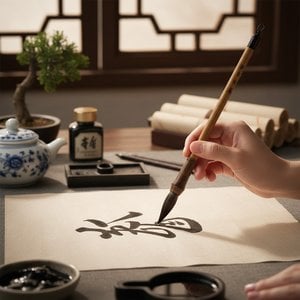
Su Renshan’s artistic output consisted primarily of ink wash paintings and calligraphy, reflecting his profound understanding of Chinese culture and philosophy. Among his most celebrated pieces is “Record of the Iron Ox,” a stunning calligraphy scroll executed in running cursive script—a style known for its flowing rhythm and expressive character—that captures the spirit of Guizhou Province’s mountainous landscapes. The meticulous left-hand execution underscores the artist's dedication to mastering technique while simultaneously conveying a sense of immediacy and emotion. Furthermore, “Tiger” from his album "Landscapes and More" exemplifies Su Renshan’s masterful command of brushwork and tonal gradation—a hallmark of Shanshui art—demonstrating his ability to distill complex visual information into evocative imagery. Finally, “Travellers in the Mountains,” a serene monochrome landscape painting, showcases Su Renshan's sensitivity to capturing the sublime beauty of nature and its spiritual resonance.- Legacy and Significance: Despite his untimely demise at the age of thirty-six, Su Renshan’s influence extended far beyond his lifetime. His pioneering style served as a catalyst for artistic experimentation during the Qing dynasty, inspiring subsequent generations of artists to push boundaries and explore new expressive possibilities. Today, Su Renshan's works are revered as masterpieces of Chinese art—testaments to his unwavering commitment to innovation and his profound connection to the cultural heritage of China.
Further Exploration
For a deeper understanding of Su Renshan’s artistic vision and its enduring impact, we encourage you to visit Su Renshan's Artist Profile. You can also delve into his celebrated artwork “Record of the Iron Ox” at here and admire "Tiger" from his album Landscapes and More at this link.Questions & Answers
What are the birthplace and birth year of Su Renshan?
Su Renshan was born in Shunde in 1814.
Where are Su Renshan's artworks mapped by subject?
The Subject Atlas page maps Su Renshan's artworks by subject.
In which historical period did Su Renshan work?
Su Renshan worked in the 19th-Century period. The period situates the artist's activity in history.