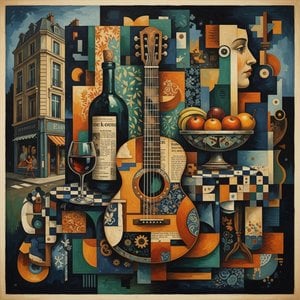
The Alchemist of Abstraction: The Art of Philip Taaffe
In the vibrant landscape of contemporary American painting, few artists navigate the delicate boundary between historical reverence and radical innovation as gracefully as Philip Taaffe. Born in Elizabeth, New Jersey, in 1955, Taaffe has cultivated a visual language that acts as a bridge across centuries, weaving together the fragmented geometry of Synthetic Cubism with the profound spiritual echoes of ancient iconography. His work is not merely an exercise in abstraction; it is a deliberate, rhythmic dialogue with the ghosts of art history, where the textures of the past are reimagined through a modern, experimental lens.
Taaffe’s artistic identity was forged in the crucible of New York City’s rigorous academic environment. After earning his Bachelor of Fine Arts from the prestigious Cooper Union in 1977, he began to develop a method that would become his hallmark: a process-based approach where the act of creation is as significant as the final image. His fascination with the layering of color and the fragmentation of form was deeply rooted in the legacies of Matisse and the principles of Cubism. Yet, Taaffe’s vision extends far beyond European modernism. His travels through Morocco and India infused his palette and motifs with a global consciousness, allowing him to integrate elements ranging from Roman mosaics to Byzantine altarpieces into a singular, cohesive aesthetic.
A Tapestry of Influence and Technique
What distinguishes Taaffe’s oeuvre is his ability to transform borrowed motifs into something entirely transformative. He does not simply replicate; he reinterprets. This is perhaps most evident in his mid-1980s explorations, where he engaged directly with the giants of mid-century abstraction. In his evocative work We Are Not Afraid (1985), Taaffe took the iconic "zip" motif of Barnett Newman and evolved it into a swirling spiral, creating a kinetic energy that breathes new life into the original concept. Similarly, in pieces like Defiance (1986), he reinterpreted the optical complexities of Bridget Riley, proving himself a master of structural tension and visual rhythm.
The technical mastery behind his canvases is nothing short of alchemical. Taaffe utilizes complex techniques such as paper marbling and pigment dispersion to generate surfaces that possess an almost tactile depth. These methods allow him to create intricate, labyrinthine compositions—seen in works like Enchiridion II—where interlocking circles and swirling patterns pulse with an internal light. His ability to balance the chaotic energy of organic forms, such as the mushrooms found in Necromancer, with rigid geometric precision creates a sense of "controlled spontaneity" that captivates the viewer’s eye.
Legacy and Global Recognition
The significance of Philip Taaffe’s contribution to contemporary art is reflected in the prestigious institutions that house his masterpieces. His work has been celebrated on the world stage, earning him inclusion in landmark exhibitions such as the Carnegie International, two Sydney Biennales, and three Whitney Biennales. The presence of his paintings in the permanent collections of the Museum of Modern Art (MoMA), the San Francisco Museum of Modern Art (SFMOMA), and the Whitney Museum of American Art serves as a testament to his enduring impact on the trajectory of abstract painting.
Beyond the museum walls, Taaffe’s influence has touched the highest echelons of cultural collecting, with his works once gracing the residences of icons like Gianni Versace and Elton John. As he continues to live and work in New York City, Taaffe remains a vital force in the art world—a painter who looks backward into the archives of human creativity only to propel those images forward into a new, luminous future. His career stands as a profound reminder that true innovation is often found in the thoughtful synthesis of tradition and vision.