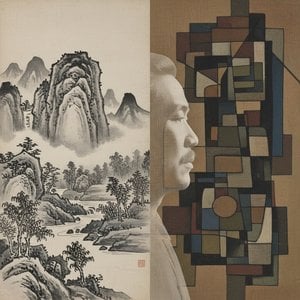
Matsuo Bashō: Life and Legacy
Early Life and Background
- Born Matsuo Kinsaku in 1644 near Ueno, Iga Province, Japan.
- Came from a family with samurai roots, though his father was likely a low-ranking retainer.
- Received an early education and showed an aptitude for poetry.
- Served as a page to Tōdō Yoshitada, fostering his interest in *haikai no renga* (linked verse).
Artistic Development and Influences
- Initially focused on collaborative poetry forms like *renga*.
- The death of his patron, Tōdō Yoshitada, in 1666 marked a turning point, leading him to dedicate himself fully to poetry.
- Influenced by Zen Buddhism, which emphasized simplicity, mindfulness, and connection with nature.
- Early works showed conventional styles but gradually evolved towards a more minimalist and evocative approach.
- Chinese poetry also played a role in shaping his aesthetic sensibilities.
The Rise of Haiku and Bashō’s Style
- Bashō is credited with elevating the *hokku* (the opening verse of a *renga*) to an independent poetic form, later known as haiku.
- His haiku are characterized by their concise language, vivid imagery, and focus on nature.
- He sought to capture fleeting moments and evoke deep emotions with minimal words.
- Emphasized *sabi* – the beauty of transience, imperfection, and age – in his work.
Travels and Major Works
- Bashō embarked on several journeys throughout Japan, seeking inspiration for his poetry.
- His most famous travelogue is Oku no Hosomichi (The Narrow Road to the Deep North), published in 1694.
- Other notable works include *Nozarashi kikō* (Records of a Weather-Exposed Skeleton) and numerous collections of haiku and *renga*.
- His travel writings blended poetry with prose, creating a unique literary style known as haibun.
Achievements and Historical Significance
- Widely regarded as the greatest master of haiku in Japanese history.
- Revolutionized the art of *haikai no renga* by emphasizing naturalness and emotional depth.
- His work influenced generations of poets and continues to be studied and admired today.
- Bashō’s poetry is often reproduced on monuments and traditional sites throughout Japan, demonstrating his enduring cultural impact.
- He helped establish haiku as a major art form, recognized for its ability to capture the essence of life in a few carefully chosen words.
Legacy
- Bashō’s emphasis on direct experience and observation continues to resonate with artists and writers worldwide.
- His minimalist style has influenced modern poetry and other art forms.
- He remains a symbol of Japanese artistic excellence and spiritual depth.
Questions & Answers
Where are Matsuo Bashō's artworks grouped by keywords?
To find works by Matsuo Bashō on a specific theme, use the artist's By Keywords page, which groups the artworks by keyword.
What colors did Matsuo Bashō use most often?
The color profile of Matsuo Bashō's work is shown on the artist's Palette Genome page.
What are the birthplace and birth year of Matsuo Bashō?
Matsuo Bashō was born in Ueno in 1644.