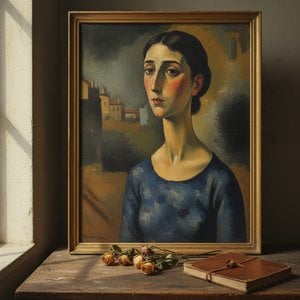
The Delicate Hand of a Polish Master
In the twilight of the eighteenth century, amidst the shifting political landscapes of Central Europe, the art of the miniature and the portrait found a profound voice in the works of Józef Kosiński. Born in 1753 in the historic city of Kraków, Kosiński emerged from a noble lineage, bearing the prestigious Rogala coat of arms. His early life was steeped in the cultural richness of Poland, a foundation that would later allow him to navigate the highest circles of the royal court with grace and artistic distinction. To master the subtle nuances of light and human expression, he sought the guidance of the esteemed Italian painter Marcello Bacciarelli, whose influence instilled in Kosiński a refined sense of classical elegance and a meticulous approach to detail.
Kosiński’s journey was one of both movement and refinement. His travels through Italy were not merely academic excursions but essential pilgrimages that expanded his visual vocabulary, allowing him to bring a Mediterranean lightness back to the more somber palettes of Northern Europe. This synthesis of Italian grace and Polish sensibility defined his unique aesthetic. Upon his return, his talent was recognized by the highest authority in the land; he was appointed as a court painter by King Stanisław II August, a position that placed him at the very heart of Poland's cultural renaissance. His ability to capture the essence of his subjects—ranging from the minor nobility to legendary figures like Tadeusz Kościuszko—earned him the prestigious Medal Bene Merentibus and cemented his status as a premier chronicler of his era.
A Legacy in Miniature and Oil
The artistry of Kosiński was characterized by an extraordinary versatility, as he moved seamlessly between the expansive medium of oils and the intimate, painstaking world of watercolors and miniatures. His technique often focused on the profound psychological depth of the face, a feat achieved through a delicate touch that could convey both strength and vulnerability. In his studio, Kosi ński fostered a tradition of mentorship, welcoming students such as Antoni Blank and Józefat Ignacy Łukasiewicz. He was known for a collaborative approach to the canvas; often, he would focus his intense energy on rendering the soul of the portrait—the eyes and facial features—and entrust the broader composition to his skilled apprentices, ensuring that the central human connection remained the masterpiece's heartbeat.
While much of his professional life was spent documenting the faces of the Polish elite, his work transcends simple documentation. His portraits serve as windows into a vanished world, capturing the dignity and the fleeting elegance of a society on the brink of monumental change. Though relatively few of his paintings have survived the ravages of time, those that remain in museums in Warsaw and Kraków stand as testament to his enduring skill. His oeuvre remains a vital link to the late Enlightenment, representing a period where art served as both a mirror to nobility and a vessel for national identity.
Questions & Answers
In which historical period did Józef Kosiński work?
Józef Kosiński worked in the Early-Modern period. The period situates the artist's activity in history.
How popular are Józef Kosiński's artworks?
The Stats page of Józef Kosiński presents statistics computed from the artist's artworks listed on this website.
What are the birthplace and birth year of Józef Kosiński?
Józef Kosiński was born in Kraków in 1753.