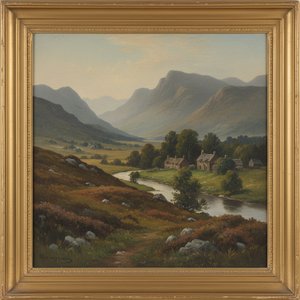
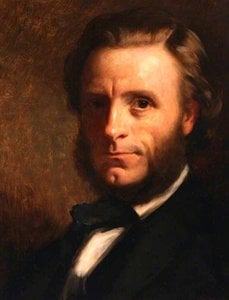
Early Life and Artistic Foundations
John Maclaren Barclay, born in Edinburgh in 1811, emerged from a Scotland steeped in romanticism and burgeoning national identity. While detailed biographical information remains somewhat elusive, we know his artistic journey began within the established traditions of Scottish painting. The early 19th century was a period of significant change for art; the rigid formality of Neoclassicism was giving way to the emotional intensity of Romanticism, and Barclay’s work reflects this transition. He initially trained in portraiture, a highly sought-after skill that provided both financial stability and access to prominent societal figures. This early focus honed his technical abilities – his precision in capturing likenesses, rendering textures, and conveying character would become hallmarks of his style. However, even within the constraints of portrait work, Barclay demonstrated an inclination towards narrative detail and atmospheric effects, hinting at a broader artistic ambition. The influence of artists like Sir Henry Raeburn, renowned for his dignified portraits and masterful use of light, is palpable in Barclay’s early pieces. He wasn't merely replicating faces; he was attempting to capture the essence of his sitters within the context of their time.A Focus on Scottish History and Genre Scenes
As Barclay matured as an artist, he increasingly turned away from purely portraiture towards scenes depicting historical events and everyday life in Scotland. This shift wasn’t simply a change in subject matter; it represented a deliberate engagement with national identity and the preservation of cultural memory. His paintings often feature meticulously researched costumes, architecture, and landscapes, demonstrating a commitment to authenticity. Barclay's work became particularly known for its depictions of 17th and 18th-century Scottish life, a period marked by significant political and social upheaval. He wasn’t necessarily offering grand historical narratives; instead, he focused on intimate moments – scenes of domesticity, religious gatherings, or public events – that collectively painted a vivid picture of the past. This approach resonated with a growing Victorian audience eager to connect with their heritage. His paintings weren't just visually appealing; they were windows into a bygone era, offering glimpses of customs and traditions that were rapidly disappearing.Technical Mastery and Artistic Style
Barclay’s artistic style is characterized by its remarkable technical proficiency and attention to detail. He possessed an exceptional ability to render textures – the sheen of silk, the roughness of stone, the warmth of human skin – with astonishing realism. His use of light and shadow is equally impressive, creating a sense of depth and atmosphere that draws the viewer into the scene. He employed a meticulous layering technique, building up color and form gradually to achieve a luminous quality in his paintings. While rooted in traditional techniques, Barclay wasn’t afraid to experiment with composition and perspective. He often used dramatic lighting effects to highlight key figures or elements within his scenes, guiding the viewer's eye and emphasizing their importance. His palette tended towards rich, earthy tones – browns, ochres, and reds – which further enhanced the sense of historical authenticity.Legacy and Historical Significance
Although not as widely celebrated as some of his contemporaries, John Maclaren Barclay played a significant role in preserving and popularizing images of Scottish history and culture during the Victorian era. His paintings offer valuable insights into the social customs, beliefs, and daily lives of people in 19th-century Scotland.- His commitment to historical accuracy makes his work an important resource for historians.
- Barclay’s scenes of everyday life provide a glimpse into the domestic sphere and the experiences of ordinary people.
- He contributed to the growing Victorian fascination with national identity and cultural heritage.
Questions & Answers
Where are John Maclaren Barclay's artworks grouped by keywords?
John Maclaren Barclay's works can be explored by keyword on the artist's By Keywords page. Each keyword groups the related artworks.
Is there a timeline of John Maclaren Barclay's works?
A timeline of John Maclaren Barclay's works exists: the artist's Artwork Timeline page orders the artworks by creation date.
What moods do John Maclaren Barclay's artworks express?
John Maclaren Barclay's works can be browsed by mood on the artist's Mood Room page, which arranges the artworks by their recorded moods.
Where are John Maclaren Barclay's artworks grouped by palette?
To find works by John Maclaren Barclay in a specific palette, use the artist's By Palettes page.
How many artworks by John Maclaren Barclay are available to browse?
You can browse 54 artworks by John Maclaren Barclay on the All Artworks page.
Where are John Maclaren Barclay's artworks grouped by technique?
John Maclaren Barclay's works can be browsed by medium on the artist's All Medium page.
Where can I find statistics about John Maclaren Barclay's works?
Statistics about John Maclaren Barclay's works are available on the artist's Stats page.
In which movements did John Maclaren Barclay work?
The All Movements page groups John Maclaren Barclay's artworks by art movement.