The Soul Behind the Canvas: The Life and Legacy of John Houston
In the grand tapestry of twentieth-century British art, few names evoke such a profound sense of psychological depth and classical elegance as John Houston. Born on April 1, 1930, in the coastal town of Buckhaven, Scotland, Houston’s journey from a young boy in Fife to a celebrated figure in the world of portraiture is a testament to a life dedicated to the pursuit of truth through paint. While his early years were shaped by the rugged landscapes of his Scottish upbringing, his artistic spirit was forged in the prestigious studios of London and Edinburgh. Before he became a master of the brush, Houston’s physical prowess led him to a brief career as a semi-professional footballer with Dundee United, an athletic chapter that ended abruptly due to a knee injury in 1951. This unexpected turn of fate redirected his energy from the pitch to the easel, setting the stage for a transformative career in fine art.
Houston’s formal education at the Edinburgh College of Art provided the technical foundation upon which he would build his illustrious reputation. He was not merely a student of technique but a scholar of the human condition. His early influences were deeply rooted in the classical traditions, and he possessed a rare ability to marry the meticulous precision of the Old Masters with a modern, expressive sensibility. As a teacher at the Edinburgh College of Art between 1955 and 1989, he also helped shape the next generation of artists, fostering an environment where technical mastery and emotional honesty could coexist. His involvement in the contemporary art scene was equally significant; in the late 1950s, he co-founded and exhibited at the 57 Gallery, one of Edinburgh's pioneering artist-run spaces, demonstrating his commitment to the evolution of the artistic community.
A Mastery of Light, Color, and Character
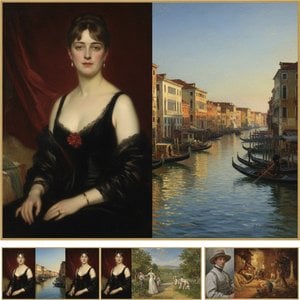
The work of John Houston is characterized by an extraordinary ability to transcend mere representation. While he was widely celebrated for his exquisite portraits of aristocratic women, his true achievement lay in his capacity to capture the inner life of his subjects. To look upon a Houston portrait is to encounter a person, not just a likeness. He utilized innovative glazing techniques to achieve a luminous color palette and an atmospheric depth that seemed to breathe within the frame. This mastery allowed him to navigate the delicate balance between the regal dignity of his subjects and their palpable, human vulnerabilities.
Beyond the intimate confines of portraiture, Houston’s repertoire expanded into breathtaking landscapes and evocative still lifes. His approach to nature was often marked by an expressionist flair, where bold and expressive brushstrokes breathed energy and movement into the canvas. Consider his notable works:
- Sunset over a Lake: A stunning display of atmospheric intensity, where deep red and purple hues dance across a dark background, creating a sense of profound tranquility and natural drama.
- Towards the Bass Rock: A piece that showcases his ability to capture the rugged, majestic essence of the Scottish coastline.
- Still Life Subjects: His delicate explorations of flowers and vases, which revealed a sensitive eye for texture, light, and the fleeting beauty of the organic world.
Historical Significance and Enduring Influence
The historical significance of John Houston resides in his role as a bridge between eras. In an age where much of the art world was moving toward abstraction, Houston remained a steadfast guardian of the figurative tradition, proving that the human face and the natural landscape still possessed an inexhaustible well of narrative power. His portraits, such as the widely acclaimed depiction of Queen Alexandra of Denmark, serve as enduring windows into the social and emotional complexities of his time. Through these works, he captured the essence of an era, documenting the grace and the underlying tensions of the British upper class with unparalleled sensitivity.
By the time of his passing in Edinburgh on September 27, 2008, Houston had left behind a prolific legacy consisting of hundreds of works that continue to resonate in private collections and public institutions across Europe and America. He remains a singular figure—an artist who could command the grandeur of a royal portrait while simultaneously whispering the quiet truths of a sunset or a single wilting petal. His life’s work stands as a monumental achievement in the preservation of beauty, character, and the eternal human spirit.
Questions & Answers
How can I follow John Houston's work year by year?
John Houston's artworks can be seen in chronological order on the artist's Artwork Timeline page.
How did John Houston's art evolve over time?
A chronological account of John Houston's work is available on the artist's Chronicle page, where the artworks pass in order of creation, chapter by chapter.
Can I browse John Houston's works by color palette?
John Houston's works can be browsed by color palette on the artist's By Palettes page.