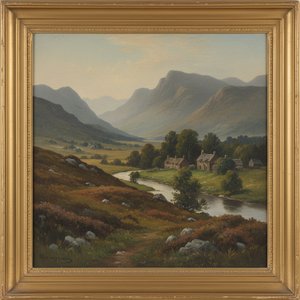
A Legacy Forged in Edinburgh
Born into the noble traditions of Edinburgh in 1816, James Drummond was a man whose very existence was intertwined with the historical fabric of Scotland. His journey began at the prestigious Trustees Academy, where he studied under the watchful eye of Sir William Allan. This classical apprenticeship instilled in him a profound respect for meticulous detail and the mastery of traditional technique, yet Drummond’s spirit was far from static.He possessed a Romantic soul that sought to breathe life into the past, transforming historical records into vibrant, emotional tapestries. His lineage provided more than just social standing; it offered a deep-seated reverence for heritage that would become the heartbeat of his entire artistic oeuvre. Through his eyes, the shadows of the past were not merely memories but living, breathing entities waiting to be rediscovered through the stroke of a brush.
The Intersection of Light and History
Beyond the canvas, Drummond was a pioneer of visual documentation, finding an unexpected ally in the burgeoning medium of photography. Around 1843, his collaboration with the legendary Hill & Adamson allowed him to explore the ephemeral beauty of the Scottish landscape and the architectural grandeur of Edinburgh through a new lens. This fascination with capturing the fleeting moment complemented his scholarly pursuits as a dedicated member of the Society of Antiquaries of Scotland.Whether through the silver nitrate of early photography or the rich oils of his paintings, Drummond was obsessed with the preservation of culture. His work often functioned as a bridge between the documented reality of his era and the imagined grandeur of centuries prior, creating a seamless narrative of Scottish identity that blended scientific observation with profound artistic intuition.
Masterpieces of Romantic Drama
The true essence of Drummond’s genius lies in his ability to reconstruct history with unparalleled dramatic fervor. He did not merely paint events; he staged them. In works such as The Return of Mary Queen of Scots to Edinburgh, the viewer is thrust into the celebratory tension of 1561, where the textures of silk and velvet are rendered with breathtaking precision. His canvases pulsate with an energy that captures the emotional intensity of political upheaval and conflict, from the harrowing The Porteous Mob to the monumental Battle of the Nile.As the curator of the National Gallery of Scotland from 1868 to 1877, his influence extended far beyond his own brushstrokes, shaping the very institution that preserves the nation's visual soul. His legacy remains a testament to the power of art to act as a living, breathing chronicle of a people’s triumphs and tragedies, ensuring that the monumental moments of Scottish history are never truly lost to time.
Questions & Answers
Where can I see James Drummond's artworks in chronological order?
A timeline of James Drummond's works exists: the artist's Artwork Timeline page orders the artworks by creation date.
Where can I see the color profile of James Drummond's work?
James Drummond's use of color across the works listed on this website can be studied on the artist's Palette Genome page.
Can I browse James Drummond's works by movement?
The movements James Drummond worked in can be seen on the artist's All Movements page, which groups the artworks by movement.
Where is James Drummond from?
James Drummond was born in United Kingdom.
Is there a 3D virtual tour of James Drummond's works?
The 3D Museum of James Drummond is a page that displays the artist's artworks in a virtual three-dimensional gallery.
Can I browse James Drummond's works by medium?
James Drummond's works can be browsed by medium on the artist's All Medium page.
What moods do James Drummond's artworks express?
The artist's Mood Room page shows James Drummond's artworks arranged by their atmosphere.
What are the birthplace and birth year of James Drummond?
James Drummond was born in Edinburgh in 1816.