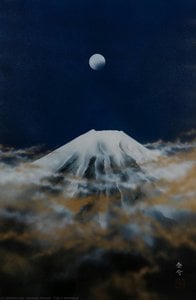
Hamada Taisuke: A Legacy of Lunar Fuji Landscapes
Hamada Taisuke (born 1932), a Japanese Nihonga painter, stands as a singular voice in contemporary landscape art—a master craftsman dedicated to capturing the ethereal beauty of Mount Fuji under moonlight. His distinctive style blends meticulous observation with profound spiritual contemplation, resulting in images that resonate with both visual splendor and emotional depth. Born in Ehime Prefecture, Hamada pursued his artistic education at Kyoto Municipal University of Arts, establishing a foundation for his lifelong commitment to traditional Japanese painting techniques.
- Early Influences: Hamada’s formative years were marked by exposure to Western art movements like Surrealism and Expressionism, particularly through the work of Vincent Price—a celebrated actor and collector who championed Japanese art within the United States. Price's involvement with Sears Roebuck & Company further solidified Hamada’s connection to the international art world.
- Formal Training: He honed his skills at Kyoto Municipal University of Arts, mastering the techniques of *sumi-e* (ink wash painting) and *goshi-su* (layering pigment), disciplines that prioritize subtlety and conveying emotion through tonal variations rather than bold color palettes.
Hamada’s artistic vision centers on portraying Mount Fuji—a symbol of Japan's spiritual heritage—during the tranquil hours of moonlight. Unlike many artists who depict Fuji in daylight, Hamada seeks to capture its luminescence and serenity under a silvery sky. This fascination stems from a deep appreciation for Zen Buddhism, which emphasizes mindfulness and perceiving reality beyond sensory perception. He meticulously renders the mountain’s contours with delicate brushstrokes, utilizing subtle gradations of ink to evoke the ethereal glow of moonlight filtering through clouds.
- Technique: Hamada's technique is characterized by painstaking layering of pigment—often achieved through *goshi-su*—creating textured surfaces that mimic the natural contours of Fuji’s volcanic slopes.
- Symbolism: The moon itself represents purity, tranquility, and enlightenment – concepts central to Zen philosophy and powerfully conveyed in Hamada's paintings.
Throughout his career, Hamada has produced numerous acclaimed works depicting Mount Fuji bathed in moonlight, earning him recognition as one of Japan’s foremost landscape artists. Notable pieces include “Night in the Harbor” (Minato no yoru), completed in 1938 and showcased at The Art Institute of Chicago, and “Tree Scene 99,” which exemplifies his masterful command of tonal harmony. His paintings are held in prestigious collections worldwide, testament to their enduring beauty and artistic merit.
- Notable Achievements: Hamada’s work has been featured in international exhibitions and recognized by prominent figures like Vincent Price, cementing his place as a pivotal figure in Japanese art history.
Hamada Taisuke's legacy extends beyond individual artworks; he embodies the spirit of Nihonga—a tradition dedicated to preserving Japan’s artistic heritage while simultaneously exploring universal themes of contemplation and beauty. His unwavering devotion to meticulous technique and profound spiritual insight ensures that his luminous depictions of Mount Fuji continue to inspire awe and reverence for generations to come.