A Life Between Two Shores
Gérard Jacobs lived a life shaped by the shifting borders of Belgium and the Netherlands. Born in Antwerp in 1865, he received his formal training at the Academy of Antwerp, an education that provided the foundation for a career defined by observation. While his roots remained in Belgium, the upheaval of the First World War prompted a significant change in his geography. In 1914, he moved to Vlissingen, Netherlands, a transition that would eventually bring him into close contact with the specific atmosphere of the Zeeland landscape.
His time in Vlissingen was not merely spent in quiet isolation. He became an active participant in the local creative community, notably founding the art circle Het Zuiden in 1920. This group brought together fellow artists such as G. Bergsma and L. Heymans, creating a shared space for artistic dialogue in the region. As both a painter and a teacher, Jacobs dedicated much of his energy to instructing a large group of students, passing on the technical rigors of his Antwerp training.
The Light of Zeeland
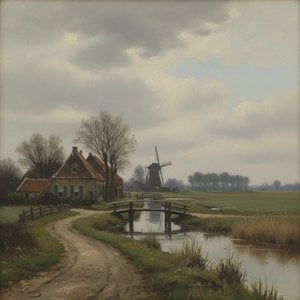
Jacobs possessed a particular interest in the way light interacts with the natural world. He was a strong colorist, utilizing a bright palette to capture the specific clarity of the Zeeland light. His work was never intended to be an abstraction; rather, he sought to create reflections of nature as they truly appeared. This commitment to accuracy led him to focus on a variety of subjects that mirrored his surroundings:
- Seascapes and river scenes, such as the Westerschelde near Vlissingen.
- Landscapes featuring cattle in spring meadows or winter rivers.
- Cityscapes and interiors that captured the quietude of daily life.
- Self-portraits and studies of the human form.
His technique often involved oil on canvas, sometimes applied to panel through a process known as marouflé. Whether painting the stranded fishing boats on the Scheldt in 1904 or the landscapes of the Hainaut province in 1929, he maintained a focus on the physical reality of his subjects. His paintings often utilized soft tones and a careful application of light to convey the atmosphere of the water and sky.
A Quiet Presence in Art History
By the time of his death in 1958, Jacobs had left behind a body of work that remains anchored in the landscapes of his adopted and native homes. His paintings are held in collections such as the MuZeeum Vlissingen and the Zeeuws Museum Midelburg, ensuring that his specific vision of the Low Countries is preserved. He did not seek to reinvent the medium but rather to document the subtle shifts in light and weather that define the coastal regions of Belgium and the Netherlands.
Questions & Answers
How can I follow Gerard Jacobs's work year by year?
Gerard Jacobs's artworks can be seen in chronological order on the artist's Artwork Timeline page.
Where are Gerard Jacobs's artworks grouped by art movement?
The All Movements page groups Gerard Jacobs's artworks by art movement.
Where can I find statistics about Gerard Jacobs's works?
Statistics about Gerard Jacobs's works are available on the artist's Stats page.
Where are Gerard Jacobs's artworks grouped by technique?
Gerard Jacobs's works can be browsed by medium on the artist's All Medium page.