The Silent Visionary: The Life and Legacy of Eugène Laermans
In the quiet, shadowed corners of Belgian art history, few figures command as much profound respect and haunting intrigue as Eugène Jules Joseph Baron Laermans. Born in 1864 in Molenbeek-Saint-Jean, Brussels, his life was defined by a struggle against the encroaching darkness and silence of physical infirmity. At the tender age of eleven, a devastating bout of meningitis robbed him of his hearing and left him nearly mute. Yet, rather than allowing this tragedy to sever his connection to the world, Laermulus transformed his sensory deprivation into an unparalleled visual acuity. Deprived of sound, he turned his entire being toward the power of sight, developing an observational intensity that would eventually allow him to capture the very soul of the marginalized and the downtrodden.
His journey through the artistic landscape was one of remarkable stylistic metamorphosis. Enrolling at the Académie Royale des Beaux-Arts in 1887, he studied under the guidance of Jean-François Portaels, an experience that provided him with a rigorous academic foundation. During his early years, Laermans found himself drawn to the provocative and the decadent. Influenced by the evocative writings of Charles Baudelaire, he actively participated in the Decadent movement of 1890, even lending his brush to illustrate the controversial Les Fleurs du Mal. This period of his life was marked by an exploration of uncomfortable truths and a willingness to confront the darker, more complex facets of human nature, often utilizing an expressive and sometimes unsettling aesthetic.
From Decadence to Social Realism
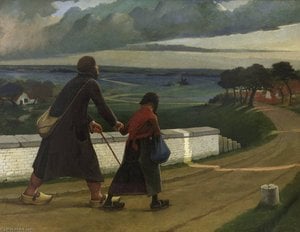
As his career matured, Laermans underwent a profound shift that would ultimately define his historical significance. By 1893, he began to move away from the stylized decadence of his youth, gravitating instead toward a rugged, earthy realism reminiscent of the great Pieter Bruegel. This transition saw him abandon ornamental flourishes in favor of a more somber, monumental approach to his subjects. He became a chronicler of the human condition, focusing his gaze on the heavy-laden laborers and impoverished peasants of the Belgian countryside. His work during this era was not merely observational; it was an empathetic, often visceral, portrayal of the dignity found within hardship.
His mastery of composition and tone reached new heights in works such as his celebrated triptych, Landverhuisers (Emigrants), inspired by the novel La Nouvelle Carthage by Georges Eekhoud. In these pieces, Laermans utilized a muted palette and atmospheric depth to convey the weight of displacement and the struggle for survival. While some contemporary critics dismissed his depictions as "disturbing caricatures," it is precisely this raw, unvarnished honesty that has secured his place in the canon of social realism. He possessed a unique ability to imbue even the most desolate scenes with a sense of monumental gravity, turning the mundane struggles of the working class into epic narratives of endurance.
The Fading Light and Eternal Impression
The trajectory of Laermans' life took a final, tragic turn in 1924 when his eyesight began to fail. For an artist whose entire identity was forged through the lens of visual perception, this loss was catastrophic. He famously declared, "I am no longer Laermans," as he ceased to paint, retreating into a reclusive existence. Despite being elevated to the rank of Baron in 1927 by King Albert, his later years were marked by the profound isolation of total blindness. He passed away in 1940, leaving behind a body of work that serves as a testament to the resilience of the human spirit.
Today, the legacy of Eugène Laermans endures through paintings that continue to haunt and inspire. His ability to find beauty in the bleak and strength in the silent remains his greatest achievement. To look upon a Laermans canvas is to witness:
- A heightened sensory experience: Where the absence of sound creates a profound visual stillness.
- Social empathy: A deep, respectful connection to the lives of those often ignored by history.
- Technical evolution: A journey from the intricate decadence of the late 19th century to the powerful, stripped-back realism of the early 20th century.
His work remains a vital pillar of Belgian art, reminding us that even when the world grows dark and silent, the eyes of the soul can still perceive the profound truths of existence.
Questions & Answers
How many artworks by Eugène Laermans are available to browse?
You can browse 11 artworks by Eugène Laermans on the All Artworks page.
Is there a 3D virtual tour of Eugène Laermans's works?
A virtual visit is possible: the 3D Museum page of Eugène Laermans presents the artist's works in a three-dimensional gallery.
Where can I find statistics about Eugène Laermans's works?
The Stats page of Eugène Laermans presents statistics computed from the artist's artworks listed on this website.
How can I follow Eugène Laermans's work year by year?
The artist's Artwork Timeline page presents Eugène Laermans's works ordered by date, year by year.
In which historical period did Eugène Laermans work?
Eugène Laermans worked in the 19th-Century period. The period situates the artist's activity in history.
Is there a complete list of Eugène Laermans's artworks?
Every work by Eugène Laermans on this website can be browsed from the artist's All Artworks page.
In which movements did Eugène Laermans work?
The movements Eugène Laermans worked in can be seen on the artist's All Movements page, which groups the artworks by movement.