The Dual Vision of Edward Hargitt: Where Art Meets Ornithology
Born in the historic heart of Edinburgh, Edward Hargitt emerged from a distinguished academic lineage, carrying within him a rare duality of purpose. As the son of the composer Charles Hargitt, he was steeped in a culture of creative excellence, yet his legacy would be defined by a unique intersection of aesthetic beauty and scientific precision. While many of his contemporaries sought only to capture the ephemeral light of the landscape, Hargitt’s gaze was sharpened by a fervent passion for ornithology, a pursuit that profoundly shaped his artistic output and cemented his place as a singular figure in Victorian Britain.
His formal artistic journey began under the tutelage of masters such as Robert Scott Lauder at the Royal Scottish Academy and the landscape painter Horatio MacCulloch. These early years provided him with a rigorous grounding in traditional techniques, particularly the delicate mastery of watercolor. His early works often reflected the Romantic ideals of his era, yet there was always an underlying meticulousness to his brushwork—a trait that would later serve his scientific endeavors just as effectively as his canvases. By 1871, his growing reputation led him to become a member of the Royal Institute of Painters in Watercolours, and his landscapes frequently graced the prestigious halls of the Royal Academy in Burlington House.
A Landscape Infused with Natural Truth
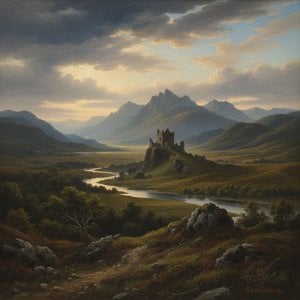
As Hargitt’s life progressed, his artistic focus underwent a subtle but significant evolution. After 1880, he began to specialize increasingly in watercolours, often turning his attention toward the rugged and evocative scenery of the Scottish Highlands. These were not merely picturesque representations of nature; they were landscapes viewed through the eyes of an observer deeply attuned to the rhythms of life within them. His time spent birdwatching in the Highlands allowed him to infuse his compositions with a profound understanding of ecology and habitat.
The brilliance of Hargitt’s work lies in this seamless blend of observation and artistry. In pieces such as Marauders, one can witness his ability to capture the thrill of outdoor adventure and the majesty of mountainous terrain, using warm tones and dynamic compositions to convey movement and energy. His landscapes possess a certain depth that transcends mere scenery, as if the very trees and hills are alive with the unseen presence of the avian species he so dearly loved. This scientific sensitivity allowed him to render natural details with a remarkable accuracy that resonated with both the art enthusiast and the naturalist alike.
The Legacy of the Woodpecker Scholar
Beyond the canvas, Hargitt’s most enduring contribution to human knowledge lies in his scholarly devotion to the Picidae family. His transition from painter to world-renowned expert on woodpeckers was a natural progression of his observational skills. This dedication culminated in the publication of his seminal monograph, “Book of Reference to the Picidae” (1895). This work, which remains a cornerstone of ornithological study, is celebrated for its meticulous research and exquisite illustrations—a testament to his belief that scientific truth and artistic expression are two sides of the same coin.
Today, the significance of Edward Hargitt’s life is felt in both the museum and the museum archive. While his landscapes continue to command impressive prices at auction houses like Christie's, his scientific contributions are preserved in institutions such as the State Darwin Museum in Moscow. He remains a profound example of how the disciplined eye of a scientist can enrich the soul of an artist, leaving behind a legacy where every brushstroke is informed by truth and every scientific discovery is touched by beauty.
Questions & Answers
Where can I see the color profile of Edward Hargitt's work?
The color profile of Edward Hargitt's work is shown on the artist's Palette Genome page.
Is there an overview of all the subjects Edward Hargitt painted?
Edward Hargitt's works can be explored by subject on the artist's Subject Atlas page.
How is Edward Hargitt's career divided into periods?
Edward Hargitt's career unfolds period by period on the artist's Chronicle page: a horizontal timeline of the artworks, grouped into career-period chapters.