The Life and Art of Dieric Bouts
Dieric Bouts was an Early Netherlandish painter who worked in Leuven from 1457 until his death in 1475. Born in Haarlem, Netherlands, he was a painter and draftsperson. His career included serving as the city painter of Leuven, a position he attained in 1468. Bouts was married twice and had four children, including two sons who became painters and continued the Bouts workshop into the mid-16th century.
His documented works include several significant pieces, such as:
Artistic Style and Notable Works
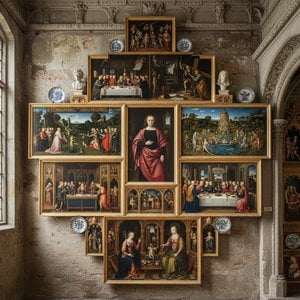
Bouts is recognized for his use of a single vanishing point, a technique demonstrated in his depiction of The Last Supper. This work shows Christ performing the consecration of the Eucharistic host, with four servants dressed in Flemish attire. His other known works include the Justice Panels, which depict the life of the Holy Roman Emperor Otto III, and various devotional panels, such as the Virgin and Child.
His oeuvre contains several other works, including:
Questions & Answers
Can I explore Dieric Bouts's works by subject?
Dieric Bouts's works can be explored by subject on the artist's Subject Atlas page.
Can I browse Dieric Bouts's works by medium?
The All Medium page groups Dieric Bouts's artworks by technique.
Where can I see Dieric Bouts's artworks in chronological order?
Dieric Bouts's artworks can be seen in chronological order on the artist's Artwork Timeline page.