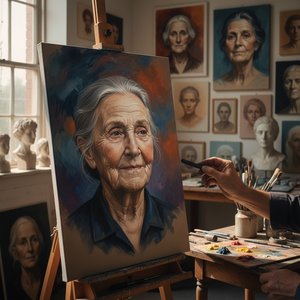
The Soul Behind the Surface: The Artistry of Daphne Todd
In the realm of contemporary British portraiture, few names command as much respect and intrigue as Daphne Todd. Born on March 27, 1947, Todd has spent her career not merely painting faces, but excavating the very essence of human character. Her work is a profound meditation on identity, captured through a mastery of oil painting that balances unflinching realism with a delicate, psychological depth. To look upon a Todd portrait is to encounter a subject stripped of pretense, presented with a clarity that feels both timeless and startlingly immediate.
Todd’s artistic journey began with a rigorous classical foundation, shaped by her formative years in York and her intensive studies at the Slade School of Fine Art between 1964 and 1971. Under the disciplined guidance of Sir William Coldstream, she mastered the technical nuances of light, shadow, and form. This period of academic excellence was marked by early triumphs, including the British Institute Award for Figurative Painting and the Tonks Drawing Prize, signaling the arrival of a formidable talent. Her ability to translate the physical world into emotive oil compositions would become the hallmark of her enduring legacy.
Breaking Barriers and Defining an Era
Beyond her technical prowess, Daphne Todd’s historical significance lies in her role as a trailblazer for women in the fine arts. She famously shattered gendered glass ceilings within the Royal Society of Portrait Painters, serving as its inaugural female president from 1994 to 2000. This achievement was not merely a personal milestone but a transformative moment for the institution, signaling a shift toward a more inclusive era of British portraiture. Her influence extended into the very fabric of London’s cultural landscape, earning her the title of Freeman of the City of London and an OBE for her contributions to the arts.
Her career is punctuated by moments of profound recognition that highlight her versatility and courage. While many portraitists seek only the flattering, Todd has demonstrated a fearless commitment to truth, even in the most challenging subject matter. Notable milestones include:
- The BP Portrait Award: Winning second prize in 1983 and receiving a special commendation in 1984, establishing her national prominence.
- The Hunting Art Prize: Securing this prestigious award for her oil painting "Four Spanish Chairs," showcasing her ability to find narrative power in still life.
- The Ondaatje Prize: Receiving the Gold Medal and the Ondaatje Prize for Portraiture, a testament to her skill in capturing the human spirit.
- The 2010 BP Portrait Award: A moment of profound artistic bravery where she won with a hauntingly beautiful painting of her late mother.
A Legacy of Character and Connection
The magic of Todd’s oeuvre lies in its breadth. Her subjects range from the academic and the distinguished to the everyday worker, such as the poignant study of Trevor Tasker, Cesspit Emptier. Whether she is painting a figure in a richly furnished library, like Sir Philip Christopher Ondaatje, or exploring the quiet contemplation of Professor Barry Supple, her brushwork remains consistent in its devotion to truth. She possesses a rare ability to weave subtle symbolism into her compositions, allowing the setting and the light to speak as loudly as the sitter’s expression.
Today, Daphne Todd remains a pivotal figure whose work continues to resonate within the halls of the National Portrait Gallery and private collections worldwide. Her legacy is one of uncompromising vision—a career dedicated to the belief that every face holds a story worth telling, and every shadow contains a truth waiting to be revealed. Through her eyes, British life is not just observed; it is immortalized with grace, dignity, and an unforgettable sense of humanity.
Questions & Answers
Where can I see Daphne Todd's artworks in a 3D gallery?
The 3D Museum of Daphne Todd is a page that displays the artist's artworks in a virtual three-dimensional gallery.
Is there a complete list of Daphne Todd's artworks?
Every work by Daphne Todd on this website can be browsed from the artist's All Artworks page.
Can I sort Daphne Todd's artworks by color?
The Spectral Index page organizes Daphne Todd's artworks by color.