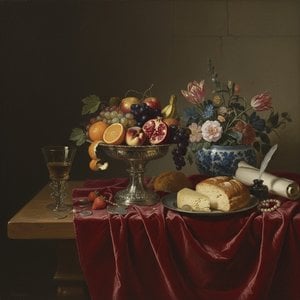
The Botanical Visionary of the Medici
In the golden age of the Florentine Baroque, few artists captured the delicate intersection of scientific curiosity and aesthetic splendor as masterfully as Bartolomeo Bimbi. Born in 1648 in the serene landscape of Settignano, near Florence, Bimbi was destined for a life shaped by the brush and the chisel. As the son of the sculptor Nicolò Bimbi, his early years were steeped in an environment where the physical world was meticulously observed and rendered. This foundational upbringing instilled in him a profound respect for texture, form, and the organic intricacies of nature, qualities that would later define his legendary status as a botanical virtuoso.
Bimbi’s artistic journey began in earnest under the tutelage of Lorenzo Lippii, one of Florence’s most esteemed painters. It was within Lippii’s workshop that Bimbi mastered the dramatic language of chiaroscuro, learning to manipulate light and shadow to breathe life into his subjects. Following the passing of his mentor, he continued to refine his eye for realism under Onorio Marinari, an artist renowned for his commitment to precise observation. These formative years provided him with more than just technical skill; they gifted him a way of seeing that bridged the gap between pure art and the burgeoning scientific inquiries of the 17th century.
A Symbiosis of Art and Science
The trajectory of Bimbi’s career was irrevocably altered by his pilgrimage to Rome around 1667. In the heart of the papal court, he encountered the influential Cardinal Leopoldo de’ Medici, a man whose passion for both art and natural science would become the catalyst for Bimbi's greatest achievements. This patronage transformed the artist from a skilled painter into a vital documentarian of the natural world. Tasked with illustrating the extraordinary botanical collections held by the Medici family, Bimbi turned his focus toward the opulent fruits, citrus, and exotic flora that populated the grand villas of the era.
His work became a celebrated record of the Villa dell’Ambrogiana and the della Topaia, creating canvases that served as both exquisite decorations and scientific specimens. In masterpieces such as "Large Citron in a Landscape" (1690), one can witness his ability to isolate a single subject—a solitary, textured citron—and place it within a sweeping, atmospheric vista. This technique allowed him to celebrate the tactile reality of the fruit while maintaining the grand, emotive scale characteristic of Baroque painting. His canvases were not merely still lifes; they were celebrations of fertility, discovery, and the prestige of the Medici botanical empire.
Legacy of Precision and Grandeur
Beyond his botanical triumphs, Bimbi demonstrated a remarkable versatility that allowed him to navigate various genres of the Baroque period. While he is most revered for his flora, his ability to render inanimate objects with equal fervor is evident in works such as "Turkish Arms" (1680). In this piece, he displays a breathtaking precision in capturing the cold, reflective surfaces of Ottoman weaponry and armor, proving that his mastery of light extended far beyond the organic. This breadth of talent ensured that his work resonated within the high-society circles of Florence, appealing to both the connoisseur of fine art and the scholar of natural history.
The historical significance of Bartolomeo Bimbi lies in his unique position as an artist who documented the transition from Renaissance idealism to the empirical rigor of the Enlightenment. He did not merely paint what he saw; he elevated the specimen to the level of the sublime. Today, his legacy survives through the preserved collections in the Pitti Palace and the Museo Botanico dell'Università di Firenze, where his paintings continue to serve as vibrant, breathing windows into a lost era of Florentine splendor. His life remains a testament to the power of art to serve as both a mirror to nature and a monument to human curiosity.
Questions & Answers
Where is Bartolomeo Bimbi from?
Bartolomeo Bimbi was born in Italy.
What are the birth city and country of Bartolomeo Bimbi?
Bartolomeo Bimbi was born in Florence, in Italy.
How do I find works by Bartolomeo Bimbi on a specific theme?
The By Keywords page of Bartolomeo Bimbi groups the artist's artworks by their keywords.