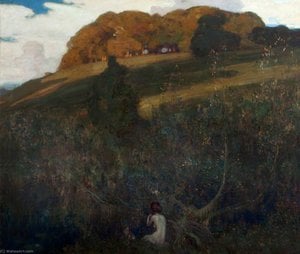
A Visionary of the Atmospheric Landscape
Sir Alfred Edward East emerged from the vibrant artistic milieu of Victorian Britain, a period defined by a profound fascination with both meticulous realism and burgeoning romantic ideals. Born in Kettering, Northamptonshire, his creative journey began with foundational training at the Glasgow School of Art. While his early inclinations were rooted in the venerable traditions of British landscape painting—a genre already graced by masters such as Constable and Turner—East’s artistic trajectory underwent a decisive and transformative shift. He moved beyond mere documentation, seeking instead to capture the very essence of the natural world through a lens of deep emotional resonance.
This evolution was profoundly shaped by his encounter with the French Barbizon school. Rather than simply adopting a new technique, East embraced a philosophical shift that prioritized direct observation and the unvarnified depiction of rural life. He eschewed grand historical narratives in favor of the poetry found in everyday scenes, focusing on how it felt to be truly immersed in nature. This pursuit of en plein air painting allowed him to master the subtle interplay of light, shadow, and atmosphere, creating works that possess an almost tactile quality.
The Influence of Far-Off Horizons
A pivotal moment in East's career arrived in 1888 when he was commissioned by Marcus Huish, the managing director of the Fine Art Society, to travel to Japan for six months. This expedition proved transformative, as the unique light, vibrant colors, and distinct cultural aesthetic of the Japanese landscape captivated his imagination. He did not merely document exotic locales; he absorbed a new way of seeing—a heightened sensitivity to composition and the delicate balance between nature and human presence. The subsequent exhibition of 104 paintings from this tour in 1890 was a spectacular success, firmly establishing him as a leading landscape painter of his era.
His work remains a beautiful synthesis of diverse influences, blending the following elements:
- The Barbizon Influence: A commitment to earthy tones, muted palettes, and the evocative power of atmospheric perspective.
- British Tradition: A deep-seated respect for the rugged beauty and tranquil spirit of the English countryside.
- Japanese Aesthetics: An infusion of new perspectives on light and a refined sensitivity to the natural world's subtle details.
Legacy and Artistic Significance
Throughout his life, East’s dedication to capturing the soul of the landscape left an indelible mark on the art of his time. His ability to convey the quiet grandeur of scenes like Midland Meadows or the seasonal shifts seen in October Glow, near Yardley Woods demonstrates a mastery of mood and light. Beyond his personal canvases, his connection to his roots remains preserved through the Alfred East Art Gallery in Kettering, which serves as a sanctuary for the very spirit of landscape painting he helped pioneer. His legacy continues to resonate through works that invite viewers to reconnect with the enduring beauty of the natural world.
Questions & Answers
What are the birthplace and birth year of Alfred East?
Alfred East was born in Kettering in 1844.
Can I sort Alfred East's artworks by color?
The Spectral Index page organizes Alfred East's artworks by color.
Is there an overview of all the subjects Alfred East painted?
Alfred East's works can be explored by subject on the artist's Subject Atlas page.