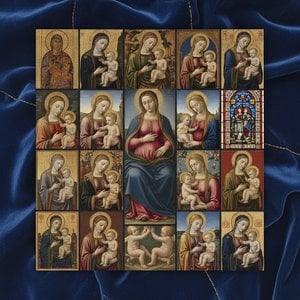
Introduction Step into a space where the boundaries between the earthly and the divine begin to blur. To explore religious art is not merely to study history; it is to embark on a journey through the deepest corridors of the human soul. For centuries...
To stand before a work of religious art is to encounter a window into the human attempt to grasp the infinite. For centuries, the canvas has functioned as more than a mere surface for pigment; it has been a vessel for the profound mysteries of faith, capturing moments where the boundaries between the earthly and the divine begin to blur. These works were rarely intended as simple decorations. Instead, they served as visual liturgies, tools for meditation, and mirrors reflecting the collective spiritual aspirations of entire civilizations.
The history of such imagery is found in the deliberate use of light and shadow to give form to the formless. From the gold-leafed majesty of medieval altarpieces to the psychological tension of later eras, artists have sought to translate complex theological truths into a visual language that anyone—regardless of literacy or status—could feel. When we observe the soft glow of a halo or the heavy drapery of a saint’s robe, we are witnessing a long-standing dialogue between the artist's hand and the unseen world.
The Emergence of Human Tenderness: Early Renaissance Innovations
The Enigmatic Visionary of Florence In the hallowed, sun-drenched corridors of Florentine art history, certain names resonate with clarity, while others linger like a beautiful, half-remembered dream. The Master of the Straus Madonna belongs to this ...
As the centuries progressed, the way in which the holy was depicted underwent a profound shift. In the transition from the heavy, solemn traditions of the Giottesque era toward the burgeoning humanist spirit, a new kind of intimacy began to emerge. This period saw a move away from rigid, symbolic icons toward a more palpable sense of human connection.
One can see this evolution clearly in the works associated with the Master of the Straus Madonna. This anonymous Florentine hand navigated a period of immense dynamism, synthesizing the monumental solidity of earlier traditions with a delicate, lyrical language. In his panels, the spiritual intimacy between the Virgin Mary and her infant son is rendered with a celestial lightness. The figures possess a weight that feels real, yet they are imbued with an ethereal grace that suggests their divine nature. This balance of form and emotion laid the groundwork for the more naturalistic approaches that would follow in the decades to come.
Naturalism and Symbolism: The Weight of Divinity in High Renaissance Works
Exquisite Depiction of Maternal Divinity This masterful Renaissance painting captures the tender intimacy between the Madonna and Child, a timeless subject that embodies divine love and maternal devotion. The composition draws viewers into a sacred m...
The High Renaissance brought a refined focus on naturalism, where the meticulous study of anatomy and light allowed the divine to inhabit a recognizable, physical reality. Artists began to use the tools of science—perspective, proportion, and the subtle gradation of tone—to ground sacred figures in the natural world.
In the hands of masters like Albrecht Dürer, the Christ Child is no longer an abstract symbol but a vulnerable, breathing infant. In his 1512 work, Madonna of the Pear, the artist employs a precise realism to capture the tender interaction between mother and child. Every detail carries weight; the soft skin of the infant and the gentle tilt of Mary’s head evoke a profound maternal tenderness. Even the inclusion of a simple pear serves as a layer of spiritual meaning, referencing fertility and the fruit of knowledge. Similarly, the works of Fra Filippo Lippi, such as his Uffizi Madonna, demonstrate how an artist could use bold colors and a landscape inspired by Flemish painting to bring the viewer closer to the figures. By placing the Madonna in front of an open window, looking out over a distant bay and mountains, the artist reduces the gap between the sacred scene and the observer, making the divine feel accessible and present.
Light, Shadow, and Intensity: The Baroque Reinterpretation of the Holy Infant
A Tender Moment: Zurbarán’s *Madonna with Child* This exquisite oil painting by Francisco de Zurbarán depicts the timeless image of the Virgin Mary cradling the infant Jesus – a devotional scene imbued with both profound spirituality and intimate hum...
The arrival of the Baroque era introduced a different kind of spiritual energy—one defined by drama, movement, and the intense use of chiaroscuro. This period moved away from the serene stillness of the Renaissance toward a more visceral, emotional experience. The technique of tenebrism, characterized by stark contrasts between deep shadows and brilliant highlights, became a primary tool for directing the viewer's focus to the heart of the sacred narrative.
In the paintings of Francisco de Zurbarán, this intensity is palpable. His Madonna with Child utilizes a shallow depth of field and dramatic lighting to emphasize the closeness between mother and child. The heavy, textured drapery and the luminous glow on the figures' skin create a sense of profound reverence. This style was not merely an aesthetic choice but a reflection of the Counter-Reformation spirit, where art served to reaffirm Catholic doctrine through emotional impact. In a similar vein, the works of Giovanni Battista Spinelli, influenced by the great Caravaggio, used these sharp contrasts to heighten the psychological depth of his religious subjects, ensuring that the light did not just illuminate the scene but seemed to emerge from the very essence of the figures themselves.
A Venetian Sanctuary of Light and Shadow In the quiet, labyrinthine corridors of Venice’s Cannaregio district, there exists a sacred space where the boundaries between the earthly and the divine seem to dissolve. The Madonna dell'Orto is far more tha...
The experience of encountering these artworks is often inseparable from the spaces they inhabit. Throughout Europe, sacred architecture has been designed to act as a stage for the divine, using scale, light, and material to foster a state of contemplative awe.
In Venice, the Madonna dell'Orto stands as a living chronicle of devotion. Within its walls, the presence of Jacopo Tintoretto’s monumental altarpieces creates a sense of Baroque drama that is amplified by the church's very structure. The interplay of light through the Venetian Gothic windows and the rhythmic grandeur of the marble columns provides a physical framework for the intense energy of the paintings. Elsewhere, in the Santuario Madonna dei Miracoli in Saronno, the architecture itself celebrates a moment of transcendence. The soaring Renaissance dome directs the eye upward, while the frescoes of Bernardino Luini use light and shadow to evoke a sense of serenity. These spaces remind us that art does not exist in a vacuum; it is part of a larger, architectural dialogue intended to bridge the gap between the earthly and the eternal.
Beyond the Canvas: The Enduring Resonance of Sacred Themes
While the historical contexts of these works—the theological debates of the Counter-Reformation or the humanist ideals of the Renaissance—may feel distant, the themes they explore remain strikingly relevant. The search for meaning amidst suffering, the celebration of innocence, and the experience of profound love are universal human endeavors that transcend any single era.
When we look at a reproduction of a classical work today, whether it is a large-scale mural in a modern hotel or a carefully chosen print in a private home, we are participating in this ancient tradition of reflection. The textures of oil on canvas and the deliberate placement of a brushstroke continue to stir something deep within us. At WahooArt.com, we believe that bringing these historical echoes into contemporary spaces allows for a continued connection to the beauty and gravity of our shared human history. Whether through a custom hand-painted oil reproduction or a carefully curated print, these works invite us to pause, to look closer, and to rediscover the enduring power of the divine.
Embark on a sophisticated journey through art history with our curated guide to the most iconic Madonna and Child masterpieces. Discover the profound beauty, theological depth, and enduring legacy of these sacred Renaissance treasures.
Journey through history with 10 iconic religious masterpieces. From Renaissance legends to Baroque drama, explore the stories behind these divine works. Find museum-quality art reproductions and curated decor inspiration. Discover all masterpieces on WahooArt.com.
Immerse yourself in the ethereal beauty of sacred art. Explore how light and color capture divine devotion through history. Discover exquisite, hand-painted oil reproductions from WahooArt.com, where every brushstroke honors the masters' luminous legacy.



 Divine Visions: Top 10 Masterpieces Exploring Religious Themes
 Master Of The Straus Madonna
 Madonna of the Pear
 Madonna with Child
 Madonna dell'Orto