The Enigmatic Visionary of Florence
In the hallowed, sun-drenched corridors of Florentine art history, certain names resonate with clarity, while others linger like a beautiful, half-remembered dream. The Master of the Straus Madonna belongs to this latter, more mysterious category. An artist whose true identity remains veiled behind the shroud of anonymity, he stands as a pivotal figure in Late Gothic painting, acting as a vital conduit between the heavy, solemn traditions of the Giottesque era and the burgeoning, luminous humanist spirit that would soon define the early fifteenth century. Though his personal biography is fragmented, scholars suggest a life rooted in the vibrant artistic pulse of Florence, with documentary traces pointing toward a birth around 1385.
His identity is often whispered to be one and the same as Cenni di Francesco di Ser Cenni, a connection that adds a layer of human depth to his otherwise elusive persona. To study his work is to witness a master navigating a period of profound artistic dynamism—a time when the monumental solidity of Giotto’s legacy met the delicate, ethereal revival of classical ideals championed by thinkers like Brunelleschi and Donatello. He did not merely follow these trends; he synthesized them into a singular, lyrical language that captured both the weight of the earthly and the grace of the divine.
A Symphony of Light and Devotion
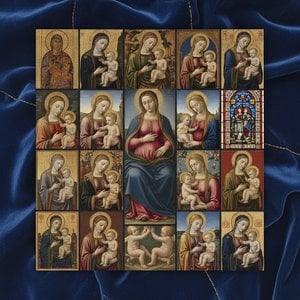
The oeuvre of this Florentine master is characterized by an extraordinary devotion to sacred themes, particularly the Madonna and Child. His surviving panels, numbering approximately thirty, reveal a painter deeply preoccupied with the spiritual intimacy of the Virgin Mary and her infant son. He achieved lasting renown through works such as the celebrated panel donated by the Straun family to the Museum of Fine Arts, Houston, from which he derives his moniker. In these compositions, one finds a breathtaking mastery of luminous coloration and delicate drapery, elements that imbue his figures with a sense of celestial lightness.
His technical prowess is perhaps most evident in the way he balances form and emotion:
- The Man of Sorrows with Instruments of the Passion: Housed in Warsaw’s National Museum, this work showcases his ability to portray human suffering through subtle modeling of flesh and an expressive, haunting gaze.
- The Annunciation: Located at the Accademia Gallery in Florence, this piece serves as a cornerstone of his legacy, utilizing vibrant, saturated hues to create an atmosphere of serene, spiritual contemplation.
- Virgin and Child with Two Angels: A testament to his skill in capturing spiritual evanescence, where slender, pale figures seem to float within a sacred, architectural space.
Legacy of the Late Gothic Transition
The historical significance of the Master of the Straus Madonna lies in his role as a bridge. He occupied the delicate space between the works of Agnolo Gaddi and the more advanced style of Lorenzo Monaco. His paintings are not merely religious icons but are windows into a transitional epoch where the heavy, grounded forms of the past were beginning to dissolve into the graceful, flowing lines of the early Renaissance. By blending Giottesque solidity with a new, lyrical tenderness, he helped prepare the Florentine palate for the profound humanism that was to follow.
Even without a confirmed name, his presence is felt in every delicate fold of pigment and every soulful glance captured on wood. He remains an essential voice in the narrative of Italian art—a master who, through the sheer beauty of his anonymous hand, continues to invite the modern viewer into a sanctuary of eternal grace and profound devotion.