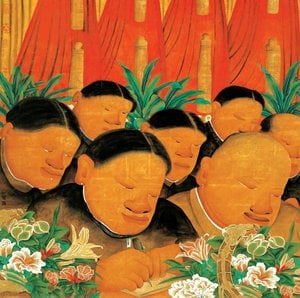
Ink On PaperContemporary Realism
 Contemporary
 160.0 x 200.0 cm
 Today Art Museum
Purchase a high-resolution, enhanced digital image, far superior to the online preview.
Each file is meticulously prepared by our in-house specialists using advanced tools and expert manual retouching. We ensure every image has exceptional clarity, precise color accuracy, and fine detail.
The final file is delivered via email within 72 hours, optimized for immediate use in professional, editorial, and print environments. This is the same quality trusted by top-tier design studios, publishers, and galleries.
Download a high-resolution file for personal display, printing, and creative projects. ( Switch to Print Buy Hand Made Painting)
When you choose WahooArt.com, you're not just getting an image - you're receiving a professionally enhanced digital artwork, crafted with precision and backed by a satisfaction guarantee. Here's everything that comes with your order, automatically:

Your high-resolution digital image file will be emailed to you within 72 hours of ordering - ready for immediate use.

Your artwork is professionally optimized using advanced AI tools and manual editing, ensuring maximum detail, clarity, and color accuracy.

Accidentally deleted or lost your file? No worries - we'll resend it to you anytime, free of charge.

Enjoy your artwork instantly with zero customs, duties, or delivery fees - digital downloads are always tax-free.

We ensure your digital image reflects the original colors as closely as possible using professional tools and color management.

If you're not satisfied with your digital image, we'll revise it or refund 100% within 100 days - no questions asked.

Not satisfied? Get a full refund within 100 days of receiving your digital file - no questions asked.

Buy 3 images, save 10% - Buy 5, save 15% - Buy 10+, save 20%. Great for creative projects, galleries, and agencies.
In the quiet corridors of contemporary Chinese art, few works command attention with such rhythmic simplicity as Zhu Wei’s Curtain, No.8. At first glance, the viewer is met with a striking expanse of deep red, interrupted only by the disciplined cadence of white stripes. This is not merely a study of fabric or pattern; it is an immersive experience that pulls the observer into a space of profound stillness. The painting, measuring a monumental 160 x 200 cm, utilizes its large scale to envelop the room, making it an ideal centerpiece for those seeking to introduce a sense of dramatic elegance and contemplative depth into a sophisticated interior.
The artistry lies in the masterful tension between tradition and modernity. Executed on paper, Zhu Wei employs techniques that bridge the gap between classical Chinese ink traditions and a contemporary, almost minimalist aesthetic. The way the red pigment interacts with the surface creates a visual texture that suggests the heavy, tactile weight of velvet or thick silk, yet retains a certain ethereal lightness characteristic of fine paper works. Each stripe serves as a structural element, guiding the eye across the composition and creating a hypnotic, undulating movement that mimics the gentle sway of a curtain caught in a phantom breeze.
To understand Curtain, No.8, one must look through the lens of Zhu Wei’s unique position in the post-Tiananmen era of Chinese art. As an artist trained at the People’s Liberation Army Art Academy, his early exposure to propaganda art—characterized by bold colors and clear messaging—informs his ability to manipulate powerful symbols. In this work, the red curtain acts as a potent metaphor. Red is a color deeply embedded in the Chinese cultural consciousness, representing both vitality and the political landscape of the nation. By presenting the curtain as an abstract, patterned object, Zhu Wei invites us to consider what lies behind the veil—the boundary between the public spectacle and the private reality.
For the discerning collector or interior designer, this piece offers a rare opportunity to possess a work that is both visually arresting and intellectually stimulating. The painting does not demand attention through chaos, but rather through a curated, rhythmic order. It provides a sophisticated anchor for a gallery wall or a standalone statement in a minimalist lounge. Whether viewed as a study of geometric pattern or a subtle critique of social layers, Curtain, No.8 remains an evocative masterpiece that brings the nuanced history of modern China into the contemporary living space.
Born in Beijing, China, in 1966, Zhu Wei is a prominent contemporary Chinese artist recognized for his subtly critical engagement with politics and society within the rapidly evolving landscape of modern China. He stands as one of the most visible practitioners of post-Tiananmen era art, demonstrating a remarkable fidelity to traditional Chinese painting while simultaneously offering a nuanced commentary on its historical context.
Zhu Wei occupies a crucial position within contemporary Chinese art. As an artist emerging in the aftermath of Tiananmen Square, his work reflects a complex negotiation between tradition and modernity, state control and individual expression. His subtle critique of political and social structures, delivered through the lens of classical Chinese painting, offers a unique perspective on China's rapid transformation. He demonstrates that traditional artistic forms can be powerfully adapted to address contemporary concerns, solidifying his legacy as a vital voice in global art discourse.

1966 - , China

 Preview
 Send
Send Share
Share
 Details

 Download
 Similars
 X-Ray
X-Ray Diaporama
 Stats
Stats Read More